
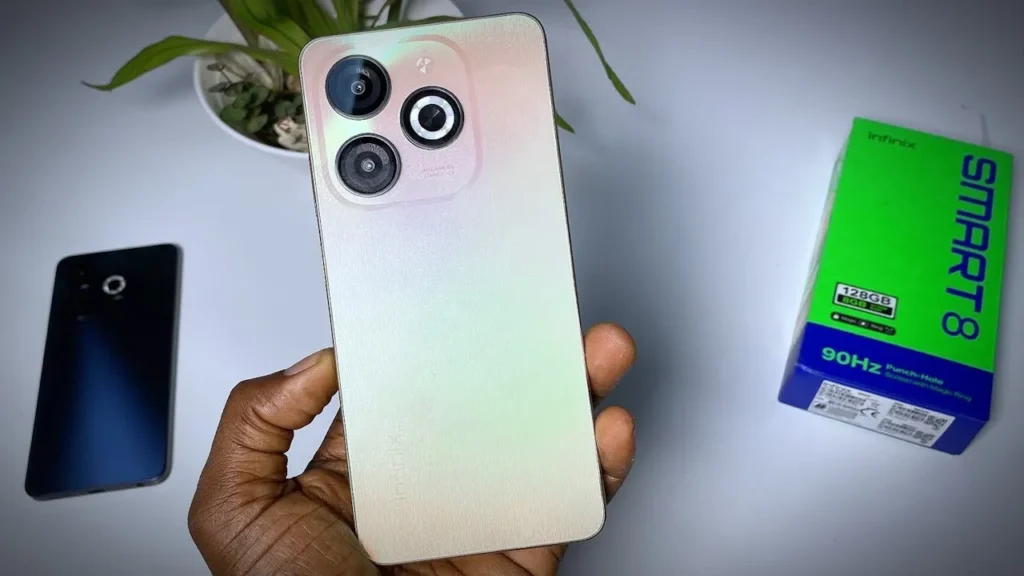
Introduction of Infinix Smart 8 HD
The Infinix Smart 8 HD is an entry-level smartphone designed for users who want essential features at a very affordable price. It focuses on practical everyday performance, offering a large 6.5-inch HD+ display, a reliable 5000 mAh battery, and simple Android software with the XOS interface. The device is built for common tasks such as calling, messaging, social media, and light video streaming. While it is not intended for heavy gaming or advanced photography, the Smart 8 HD provides dependable functionality for first-time smartphone buyers, students, and budget-conscious users looking for a straightforward and easy-to-use mobile device.
At-a-glance spec table
| Category | Key info |
| Model | Infinix Smart 8 HD |
| Screen | ~6.5″ HD+ IPS LCD (typical) |
| Resolution | 1600 × 720 (HD+) |
| CPU (typical) | Entry-level 4G SoC (Unisoc / MediaTek budget chip typical) |
| RAM / Storage | 2 / 3 / 4 GB RAM; 32 / 64 / 128 GB storage (varies by market) |
| Main camera | 8 MP – 13 MP single main lens |
| Front camera | 5 MP – 8 MP |
| Battery | ~5000 mAh |
| Charging | 10–18 W (typical) |
| OS | Android (Go edition or full) + XOS skin |
| Connectivity | 4G LTE, Wi-Fi, Bluetooth, GPS, 3.5mm jack |
| Price (typical) | Budget tier (varies by market) |
Design & build
Look and feel
The Smart 8 HD typically uses a plastic chassis with either a glossy or matte finish. It’s engineered to be light and comfortable for one-handed use despite a large ~6.5″ panel. Bezels are average for their price bracket. Expect a simple camera module, standard side buttons, and a bottom USB charging port.
Durability & ergonomics
This is not a premium build: no official IP water/dust rating in most SKUs. Smooth plastics can attract fingerprints but are easy to clean. Power and volume buttons usually sit on the right edge in a comfortable, natural reach zone. Editorial tip: recommend a low-cost TPU case and a screen protector to improve grip and protect the camera glass.
Display
- Size: ~6.5 inches — generous for reading and streaming.
- Type: IPS LCD — wide viewing angles, accurate saturation for the class, but not OLED deep blacks.
- Resolution: HD+ (1600×720) — perfectly adequate for everyday use; not for pixel-peepers.
Practical display tests:
- Measure perceived brightness outdoors (visual comparison with a midrange phone).
- Play a 720p and 1080p video and note any scaling artifacts.
- Check viewing angles using a flat color image and tilt the phone.
Performance & real-world speed
CPU & daily apps
Expect an entry-level 4G System-on-Chip tuned for efficiency rather than speed. Daily tasks like browsing, social apps, and streaming are handled fine. Heavy multitasking, compute-intensive games, or prolonged camera processing will expose the SoC’s limits.
RAM & storage tips
Choose the highest RAM SKU your budget allows (3–4 GB) for smoother multitasking. If internal storage is limited, use the microSD slot for photos and media; keep at least 10–15% free space for the OS to work efficiently.
Simple benchmark guidance
If you publish synthetic scores, keep them accessible:
- AnTuTu: entry-tier total.
- Geekbench: low single-core and multi-core.
- Explanation: translate numbers into plain language: “these numbers mean the phone will handle messaging and streaming fine, but expect lag when editing large images or running heavy games.”
Camera
What the camera can do
Most variants ship with a single main camera (8–13 MP) and a basic selfie sensor (5–8 MP). In daylight, the camera is serviceable for social media. In low light, expect noise and loss of detail.
Camera tips & sample ideas
- Shoot in daylight or well-lit interiors for best outcomes.
- Use HDR for high-contrast scenes; it helps preserve highlights and shadows.
- Avoid low-light closeups; switch to flash or Supplemental lighting.
- If you can provide a downloadable sample ZIP, include full-size JPEGs so readers can judge quality.
Camera gallery structure for the page
Include 6–8 samples: daylight street, indoor portrait, selfie, low light snapshot, macro (if supported), and a short 1080p video clip. Label each image with shooting conditions and basic EXIF (aperture, ISO, shutter).
Battery & charging
Real-life battery expectations
With ~5000 mAh, expect 1.5–2 days of light usage (calls, messaging, low-intensity browsing). Screen-on time typically ranges from 6–10 hours, depending on brightness and network conditions.
A simple battery test you can reproduce
- Set the screen to a standard brightness (approx. 200 nits / mid).
- Play a looping 1080p video over Wi-Fi until the phone drains to 0%.
- Log timestamps and battery percentages every 15–30 minutes. Provide a small CSV with timestamps and percentages to keep testing transparent.
Charging
Expect slow charging in the 10–18 W range. Charging 0→100% commonly takes 2–3 hours on basic chargers. Mention what comes in the box for the SKU you review.
Software & updates
The Smart 8 HD ships with an Android build (sometimes Android Go) with the XOS customization layer. XOS offers convenience features like app cloning and smart panel,s but also includes preinstalled apps (bloatware) that you can disable. Update cadence varies by region; always link to official support channels for OTA details.
Tip: Illustrate how to disable preinstalled apps and free up storage in three simple steps (Settings → Apps → Disable).
Connectivity & sensors
Typical hardware includes: 4G LTE (bands vary), Wi-Fi b/g/n, Bluetooth (often v5.0 or older), GPS, 3.5 mm headphone jack (very useful), and basic biometrics like a rear or side fingerprint sensor or software-based face unlock.
Benchmarks, gaming & real tests
Gaming
Select light or optimized titles (or low settings of popular games). For each title, record:
- Average FPS (use an overlay when possible)
- The battery drops during 30 or 60 minutes of play.
- Any thermal throttling (does the device get uncomfortably warm?)
Provide a short table summarizing each game’s results.
Real-app tests
- Cold app launch times (Facebook, Instagram)
- RAM retention after switching between apps
- Video playback quality at 720p and 1080p
Record times with a stopwatch and include the raw data to remain transparent.
Price & availability
Create a price matrix with country rows and columns for retailer, SKU, price, and date checked. Use live checks at publish time.
| Country | Retailer | SKU | Price | Date checked |
| Example Country | Example Store | Smart 8 HD 3/32 | $89 | YYYY-MM-DD |
Competitors & alternatives
Offer three alternatives in the same budget tier and compare core specs.
| Phone | Display | SoC | RAM | Camera | Battery | Why pick it |
| Infinix Smart 8 HD | HD+ | Entry SoC | 2–4 GB | 8–13 MP | 5000 mAh | Big battery, very affordable |
| Competitor A | HD+ | Similar | 3 GB | 8 MP | 5000 mAh | Slightly cheaper |
| Competitor B | HD+ | Better gaming SoC | 4 GB | 13 MP | 5000 mAh | Better performance for games |
Pros & Cons
Top pros
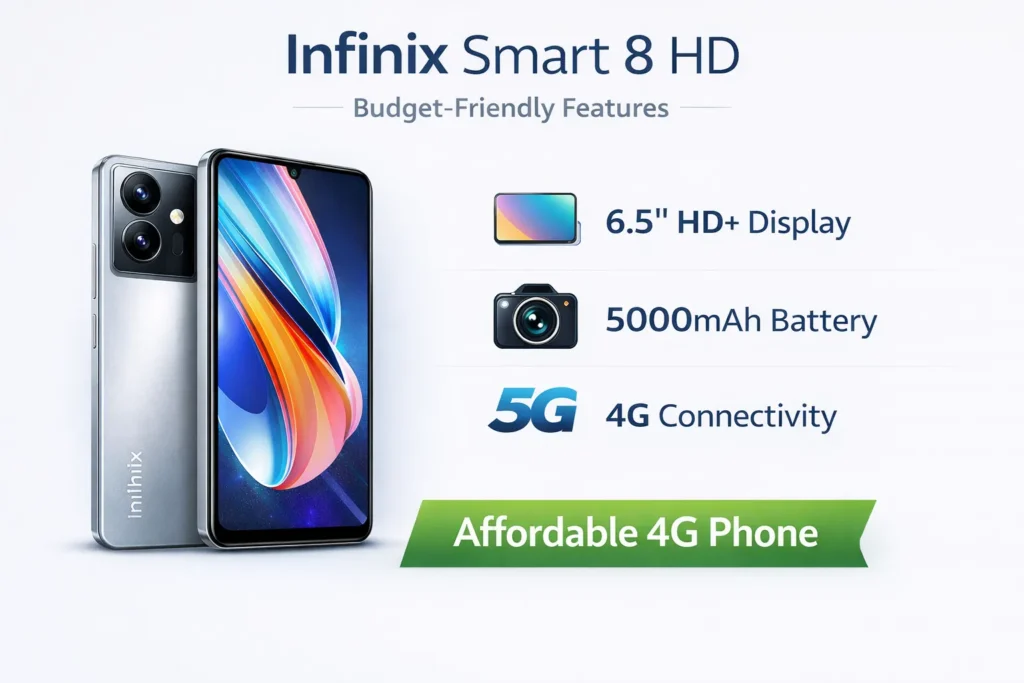
- Big battery — long autonomy.
- Large HD screen — good for reading and media.
- Very affordable price point.
- 3.5 mm headphone jack included.
- Expandable storage via microSD.
- Lightweight and easy to hold.
- Simple XOS features for non-tech users.
Top cons
- Low resolution versus midrange devices.
- Entry-level performance — not for gaming.
- The camera struggles in low light.
- Slow charging speed.
- No IP water resistance.
Who should buy this?
- Student on a tight budget — Yes
- Senior who wants a simple phone — Yes
- Mobile gamer wanting high framerate — No
- Photographer who needs pro photos — No
FAQs
The Infinix Smart 8 HD typically features a 6.5-inch HD+ IPS LCD with a resolution of 1600 × 720 pixels. The large screen is suitable for browsing, social media, and watching YouTube videos.
No. The Infinix Smart 8 HD is a 4G LTE smartphone designed for affordability. It supports standard connectivity such as Wi-Fi, Bluetooth, GPS, and a 3.5 mm headphone jack.
With a 5000 mAh battery, the phone can last one to two days with light to moderate use, including messaging, browsing, and video streaming.
Yes. The phone supports microSD card expansion, allowing users to store additional photos, videos, and apps beyond the internal storage.
The phone can run light or casual games, but it is not designed for heavy gaming. Entry-level hardware means demanding titles may run with lower graphics and occasional lag.
Conclusion
The Infinix Smart 8 HD is designed for buyers who want a dependable smartphone at a very affordable price. Its large 6.5-inch display, long-lasting 5000 mAh battery, and simple software experience make it ideal for everyday tasks such as calls, messaging, browsing, and watching videos. While the entry-level processor and basic camera limit performance in gaming and low-light photography, the device still delivers strong value for first-time smartphone users, students, and seniors. If your priorities are affordability, battery life, and a big screen rather than high performance, the Infinix Smart 8 HD remains a practical and budget-friendly choice.
