
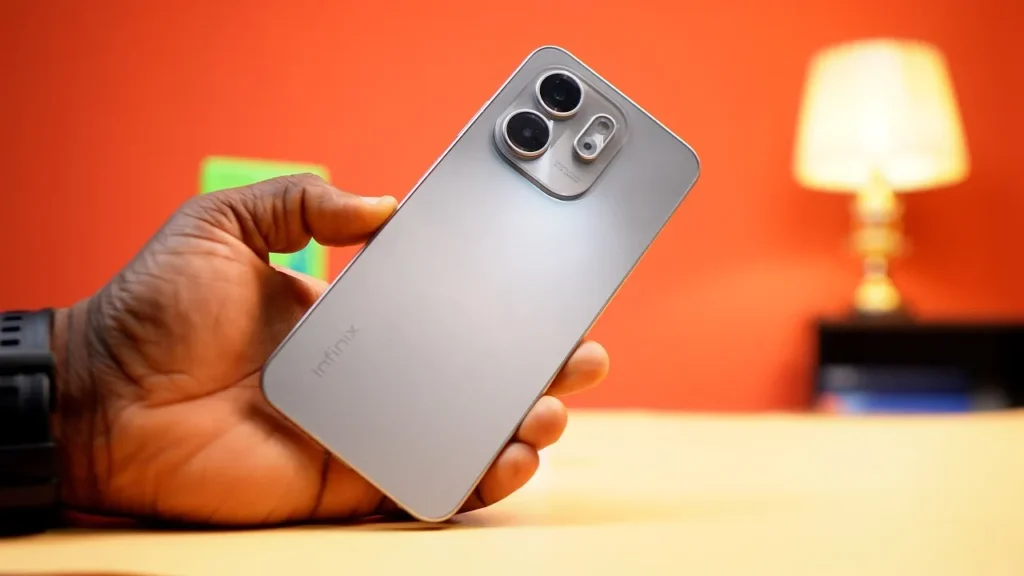
Introduction of Infinix Smart 9 Pro
Infinix Smart 9 Pro is an ultra-budget, entry-level smartphone designed around long endurance and everyday simplicity. Expect a large display, a 5000 mAh battery, basic MediaTek-class silicon in many SKUs, and software tuned for low-RAM experiences — a sensible pick for first-time users and tight budgets.
Fast facts
These are the high-impact statements that anchor your page. Treat them as claims to source from official pages, box labels, or timestamped retailer listings.
- Model: Infinix Smart 9 — entry/budget smartphone in the Smart 9 Pro family.
- Launch/release: Some regional listings show a launch/announcement date of 10 Nov 2024. Confirm with an official product page or press release.
- OS: Android 14 (Go edition) on select low-RAM SKUs; other regions may ship full Android 14 builds under XOS.
- Battery: ~5000 mAh typical.
- Retail snapshot (example): common Pakistan listings span PKR 25,499–26,999 for mainstream SKUs (prices move fast — always timestamp).
- Key selling points: large screen footprint, long battery life, value positioning for first-time buyers.
Specs table
Use this copy-ready table at the top of your product page. Add an HTML table and a downloadable CSV.
| Category | Typical spec/notes |
| Model name | Infinix Smart 9 Pro |
| OS | Android 14 (Go edition on some low-RAM SKUs); XOS overlay varies by region |
| Display | ≈6.6–6.7″ LCD; HD+ or FHD+ options; some HD variants claim 90Hz |
| SoC | Entry-level MediaTek Helio class (exact model varies by SKU) |
| RAM / Storage | 3GB / 64GB and 4GB / 128GB common; microSD supported |
| Rear camera(s) | 13MP main + auxiliary AI lens/macro/depth sensors (low-res) |
| Selfie | ~8MP on common SKUs |
| Battery | 5000 mAh; Type-C charging (charger wattage varies by market) |
| Connectivity | 4G LTE, Wi-Fi, Bluetooth, GPS; 5G typically not included |
| Colors | Metallic Black, Sandstone Gold, Mint Green, Neo Titanium (region-dependent) |
| Dimensions/weight | ≈165.7 x 77.1 x 8.35 mm; ≈188 g (varies by SKU) |
Note: Smart 9 Pro and Smart 9 HD are sibling variants — check the box MPN and SKU label for exact configuration before publishing specs.
Display & design
Display & user experience
The Smart 9 Pro series uses large, inexpensive LCD panels sized about 6.6–6.7 inches. For many buyers, the most meaningful display attributes are: usable brightness in sunlight, perceptual smoothness (60Hz vs 90Hz), color tone (warm vs cool), and bezel footprint.
- 90Hz claim: When a submodel advertises 90Hz, measure both refresh and touch sampling to confirm perceived smoothness — some budget implementations limit touch sampling, and the benefit is marginal.
- Brightness: Budget LCDs usually reach moderate peak nits. For outdoor legibility, measure peak brightness at white (use a lux meter) and report it in nits.
- Materials: plastic frame and back are expected. The front may use a low-cost laminated glass substitute or chemically strengthened glass — don’t claim Gorilla Glass unless the box/brand page says so. No IP water resistance unless explicitly listed.
What matters to real users
- Legibility outdoors beats slightly higher resolution on budget phones.
- Touch responsiveness and frame-to-frame smoothness matter more for perceived fluidity than raw pixel count.
- Bezel width affects perceived value — show 1:1 crops to communicate bezel thickness.
Design tips
- Include front and back hero images for every colorway with descriptive ALT tags.
- Provide a 1:1 crop of the screen showing bezels and a device-in-hand shot to show scale.
Cameras
Budget single- to dual-camera arrays on the Smart 9 Pro series are tuned for daylight snapshots. Don’t promise flagship-level detail — instead, deliver repeatable comparisons.
Camera expectations
- Main sensor: Public specs typically list a 13MP main camera. Sensor vendor (Sony/OmniVision) is usually not published; exact sensor IDs require a teardown or an unboxed sample check.
- Auxiliary lenses: Often low-res depth or macro sensors that add software-driven features more than optical versatility.
- Selfies: ~8MP typical; low-light selfies rely on screen flash.
Video
- Max recording: Expect 1080p@30 fps on most basic SKUs. Stabilization, if present, is likely electronic and limited.
Camera sample gallery checklist
- Daylight wide — full-res image + 2× crop (scene + details).
- Portrait / subject separation — with depth mode enabled/disabled to compare edge Detection.
- Night auto vs night mode — if a night mode exists, show both.
- Selfie (day) & selfie (low-light + screen flash).
- 100% crops for sharpness and noise analysis.
- EXIF.md — list aperture, shutter, ISO, focal length, and software mode.
Provide the full-resolution ZIP of samples for reviewers and link to it from the product page.
Battery & charging
Why a repeatable method matters
Battery life depends on SoC efficiency, OS power management, display power draw, and background apps. Use controlled tests and publish raw CSV logs so readers can verify.
Essential tests
- Screen-on endurance: Loop a 1080p video at a fixed brightness of 200 nits (measured with a lux meter) and log battery % every 5 minutes until shutdown. CSV columns: timestamp, battery%, elapsed_minutes, ambient_temp.
- Charging curve: From 0% to 100%, log battery % at defined checkpoints: 0, 5, 10, 20, 30, 40, 50, 60, 70, 80, 90, 100. Record charger wattage, wall-watt draw (if available), device surface temp, and ambient temp. Plot time vs % and compute time to 50% and time to 100%. Provide PNG + raw CSV.
- Mixed-use drain: 30 minutes social media (scrolling + videos) + 30 min web browsing + 30 min gaming (fixed settings) at fixed brightness; log battery delta.
- Standby drain: Leave the device in idle (airplane mode on vs. off) overnight and log the percent change.
Performance & gaming
SoC and memory notes
Public listings call out a MediaTek Helio-class SoC for many Smart 9 Pro SKUs. Do not assume the exact model — confirm via Settings → About phone or the box label.
Entity note: When you mention MediaTek on the page, make sure your internal SKU table shows the exact chip string you verified.
Benchmarks to run
- Geekbench (single-core and multi-core).
- AnTuTu (optional—respect local review policies).
- Game trace: run a realistic 10-minute session of a popular mobile title (PUBG Mobile/Call of Duty Mobile) with a frame-time logger (record FPS and frame-time variance).
- Thermal & throttling test: 30-minute CPU/GPU soak with periodic temp readings; include whether performance degrades over time.
How to present results
- Small, scannable table: benchmark name → score → device state (battery %, ambient).
- Screenshots of benchmark runs (with device battery % and clocked settings shown).
- A three-line takeaway summarizing typical performance (e.g., “Good for light apps, web browsing, and casual 2D games; not recommended for sustained high-end 3D gaming”).
Software, skin, and updates
Base OS and vendor skin
- Android 14 (Go edition) appears on low-RAM SKUs to save memory and reduce background work.
- XOS — Infinix’s customization layer — includes preinstalled apps, a list of which are removable. Provide a short “how to disable bloat” mini-guide.
Update policy & OTA tracking.
- Link to the official support or OTA changelog page and record the build number and date checked (create an “OTA notes” field on your page). If the vendor publishes a firmware history, link, and timestamp for each update.
Variants, SKUs & reconciliation
Retailers often list multiple SKUs under the same “Smart 9 Pro” umbrella. This leads to confusion and incorrect spec pages.
Why SKU reconciliation matters
Chipset, RAM, camera subcomponents, and even screen panels can vary across regional SKUs. A buyer in one country may get a different SoC than another.
Sample SKU table
| Box SKU label | RAM / Storage | Noted differences | Seller/region |
| SMART9 Pro-3/64 | 3GB / 64GB | Android Go, lower-tier SoC | Example retailer |
| SMART9 Pro-4/128 | 4GB / 128GB | Higher RAM, smoother multitasking | Example retailer |
How to identify your SKU: instruct users to check the box label (model number, MPN, IMEI listing) and Settings → About phone. Add screenshots of the box label as a verification asset.
Price & availability
Principle: For every published price, capture at least three reputable retailers per country with timestamps and direct links (CSV: retailer, price, date_checked, url).
Example snapshot process
- Visit the official brand store and two major regional retailers; take a screenshot and copy the exact price and currency.
- Use a price aggregator and capture the lowest listed retailer entry.
- Timestamp everything and add a “price last checked” note on the page.
Example:
- Retailer listing: PKR 26,999 for 4GB/128GB (checked March 6, 2026).
- Aggregator listing: PKR 25,499 (multiple sellers showing discounted listings).
On your live page, expose the price-check CSV and offer an affiliate “Compare prices” CTA with the last-checked timestamp.
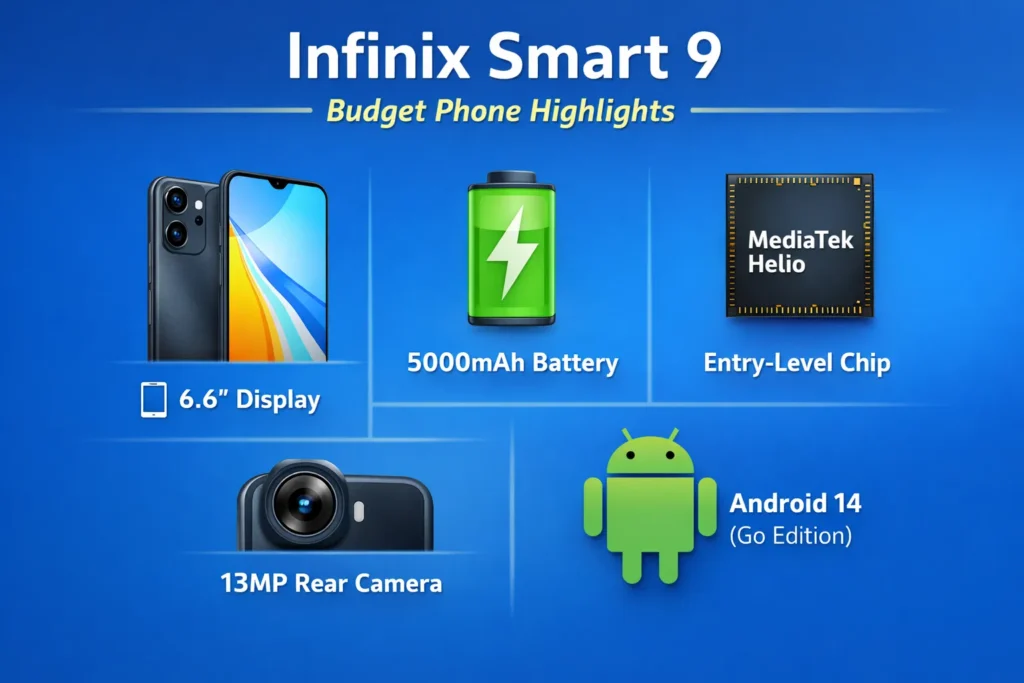
Competitors
The Smart 9 Pro sits in a crowded budget segment. Your comparison framework should focus on the three buyer-facing axes: display brightness & quality, battery life, and Camera Output.
Typical direct rivals
- Redmi / Poco entry models (if available regionally).
- Realme Narzo / Tecno Spark series.
- Other local-brand budget phones offer similar 5000 mAh batteries.
Comparison table
| Device | Battery | RAM / Storage | Main camera | Typical price |
| Infinix Smart 9 Pro | 5000 mAh | 3/64, 4/128 | 13MP | PKR 25–27k (example) |
| Rival A | 5000 mAh | 4/64 | 50MP | PKR 28k |
Buying rule: pick the phone with better display brightness and demonstrable camera samples; specs alone can be misleading in this price band.
Buyer personas
Buy if:
- You want a very affordable phone with long battery life.
- You need a large screen for reading and social apps.
- You need a cheap device for a child, a student, or as a backup.
Don’t buy if:
- You need flagship-level cameras or heavy 3D gaming.
- You require 5G or premium build materials.
FAQs
The Infinix Smart 8 HD typically features a 6.5-inch HD+ IPS LCD with a resolution of 1600 × 720 pixels. The large screen is suitable for browsing, social media, and watching YouTube videos.
A: Usage determines runtime. In controlled screen-on loop tests at 200 nits, many 5000 mAh phones in this class last a full day or longer under mixed usage.
A: Differences typically include display panel resolution and refresh rate (HD vs HD with 90Hz), minor camera tweaks, and sometimes software SKU differences. Always confirm the model number on the box or the retailer listing.
A: Common SKUs include 3GB/64GB and 4GB/128GB. Expandable storage via microSD is usually supported.
A: Check official brand stores and major regional retailers; price aggregators list sellers and snapshot prices.
Final verdict
Infinix Smart 9 Pro is a practical, no-frills budget phone that prioritizes battery endurance and a large display over premium cameras or high-end performance. It’s a smart choice for first-time buyers, students, or anyone seeking a dependable daily device on a tight budget. If you need premium cameras, sustained gaming, or 5G connectivity, look at higher-tier alternatives.
