
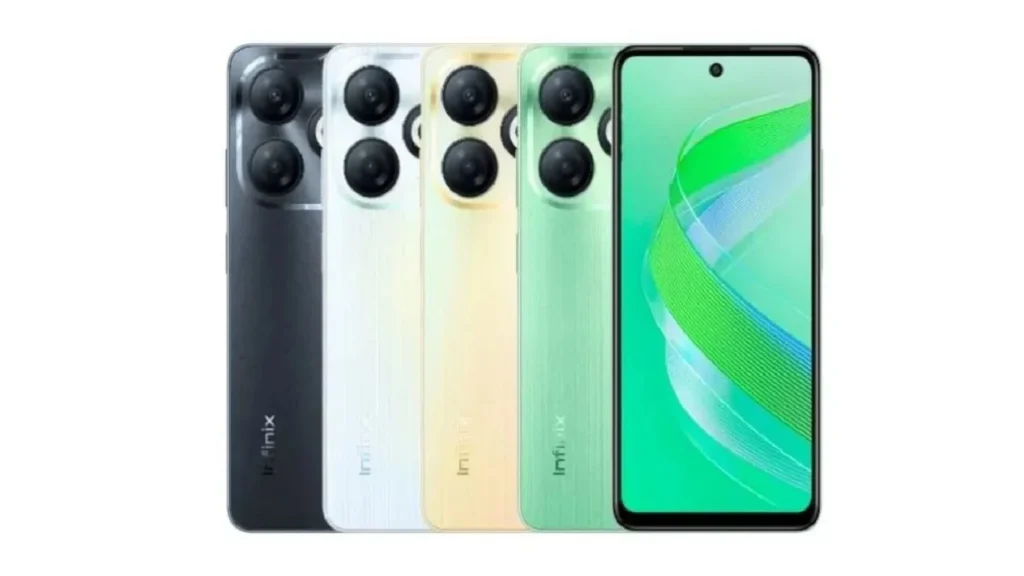
Introduction of Infinix Smart X
Buy the Infinix Smart X if you want a phone that feels fast: the 120Hz panel and Android 15 (Go) combine to deliver fluid navigation and snappy app switching on 4GB devices. The 5000 mAh battery keeps the lights on for extended sessions and travel days. Don’t buy it if photography detail, FHD displays, or heavy 3D gaming are priorities — for those, consider slightly costlier alternatives. If you’re price-sensitive but value perceived speed and battery life above raw camera specs, the Smart X is a pragmatic, budget-oriented pick.
Specs at a glance
- Display: 6.67″ IPS LCD, 720 × 1600 (HD+), 120Hz
- SoC: Unisoc T7250 (entry-level octa-core)
- RAM / Storage: commonly 4GB / 64GB (expandable via microSD) — some markets offer 6GB/128GB
- Rear camera: 8 MP main sensor (AI processing)
- Selfie: 8 MP
- Battery: 5000 mAh (charging wattage varies by region)
- OS: Android 15 (Go) with XOS custom skin
- Launch: July 2025 (typical)
- Typical Pakistan launch price: PKR ≈ 21,000–27,000 (retailer and promo dependent)
What the specs mean for you
- 120Hz IPS — adds perceptual smoothness: scrolling and UI transitions feel faster even when raw CPU cycles are limited.
- 5000 mAh — strong endurance for light-to-moderate users; multi-day potential if you throttle refresh rate and limit background tasks.
- Unisoc T7250 — fine for daily social apps and video; not for sustained high-graphics gaming.
- 8 MP cameras — okay in good light, fragile detail in low light; rely on software tuning for punchy results.
Design & build
Feel & materials
The Smart X leans on cost-efficient polymers: a plastic frame and back with a glossy finish. That keeps weight down and ensures it’s comfortable during long one-handed sessions. The finish attracts fingerprints; the included TPU case (when present) addresses grip and protects the glossy back.
Buttons & I/O
- Volume rocker and textured power button on the right.
- Bottom edge: USB-C port and single speaker grill.
- 3.5mm headphone jack retained — a plus in this segment.
- Dedicated microSD slot (non-hybrid) — a real-world advantage for users who prefer storage expansion without sacrificing a second SIM.
Durability
No IP water/dust rating. The construction is acceptable for day-to-day use, but treat the phone like an everyday device rather than a ruggedized one: add a screen protector and a case if you plan to keep it long-term.
Display
The big selling point: 120Hz
In a segment crowded with 60Hz panels, the Smart X’s 120Hz claim is the single biggest perceptual differentiator. Think of refresh rate like frame rate in a text-based animation: a higher refresh rate reduces motion aliasing and produces smoother scrolling and animation sequences. For everyday browsing and social feeds, this is the feature that makes the device feel faster than its benchmark scores imply.
Sharpness and clarity
Resolution is HD+ (720 × 1600). On a 6.67″ diagonal, this yields a modest pixel density — text remains readable at normal viewing distances, but fine detail is softer compared to FHD panels. Video playback looks acceptable, but if you’re pixel-hunting (e.g., reading small text or editing documents), the softness is noticeable.
Real-life behavior
- Scrolling & UI: buttery at 120Hz — micro-interactions and feed-swiping are perceptibly smoother.
- Video: Most streaming will render fine, but there’s no HDR uplift on this panel.
- Sunlight: overall brightness is average for an IPS LCD in this range; under direct sun, you’ll frequently need to max brightness to retain legibility.
Battery trade-off
Running at 120Hz consumes more energy than 60Hz. If battery life is paramount, switch to 60Hz (if the OS provides a toggle) or use any available adaptive refresh setting. For reviewers, show a 60Hz vs 120Hz battery drain comparison (SOT or % drop over 1 hour streaming) — readers find those Numbers Convincing.
Performance & benchmarks
What to expect from the Unisoc T7250
The Unisoc T7250 targets cost-sensitive devices: the design trade is predictable — efficient single-threaded responsiveness for light tasks, but limited sustained throughput for heavy loads. With 4GB RAM, the device is tuned for social, communication, and media consumption rather than computationally heavy apps.
Daily workflows are handled well
- Social apps (Facebook, Instagram, WhatsApp).
- Browsing with a few tabs.
- YouTube and streaming at 720p/1080p.
- Light multitasking (switching between 2–3 apps).
Gaming
- Casual and 2D titles run smoothly (e.g., puzzle and runner games).
- Demanding 3D titles will require low graphics presets and may still experience frame drops and thermal throttling.
Benchmarks
- AnTuTu: tens of thousands (entry-level class).
- Geekbench: modest single-core and multi-core numbers consistent with light everyday use.
Practical tip
For perceived smoothness, the interplay of a 120Hz display and a lightweight OS (Android Go) is more important to users than raw benchmark scores. That combination reduces perceived latency in UI interactions even while background tasks might remain constrained.
Camera
Hardware reality
The Smart X typically ships with an 8 MP main sensor and an 8 MP front-facing camera. In this segment, much of the visual “pop” comes from software processing — contrast boosting, saturation lift, and sharpening — rather than sensor headroom.
Daylight performance
- Color: vibrant, often slightly saturated due to tuning intended to appeal in social feeds.
- Detail: constrained by the 8 MP sensor; close 1:1 crops show soft fine texture.
- Dynamic range: average; highlights can clip in high-contrast scenes.
Indoor & low-light
- Noise rises quickly as light drops.
- If a night mode exists, it helps exposure but can’t magically recover sensor-limited detail — expect smoothed textures and residual noise.
- Use a tripod or steady surface for best low-light exposures.
Video
- Likely capped at 1080p/30fps.
- Electronic image stabilization (EIS) may be limited or absent: handheld clips show mild shake.
- Audio capture is adequate for speech but not studio-grade.
What to review
- 1:1 crops: daylight, indoor, and low-light. Readers want to pixel-peep.
- Full-resolution sample ZIP: a downloadable pack of camera samples.
- Balanced vs AI mode: side-by-side comparisons to show default tuning vs “AI” enhancements.
- Short video sample: 1080p clip showing stabilization and audio capture.
- EXIF overlays: include ISO, shutter, and aperture values when possible.
Sample testing plan
- Daylight wide: outdoor noon scene, including a 1:1 crop of textured foliage.
- Portrait: midday portrait to check skin tone and dynamic range.
- Indoor: fluorescent and tungsten-lit room to test white balance.
- Night street: handheld and night-mode frames for low-light readouts.
- Selfies: daylight and low-light selfie comparisons.
How to judge
- Color accuracy: Are skin tones believable or unnaturally saturated?
- Detail: inspect 1:1 crops — is fine texture present?
- Noise: check shadow regions and dark interiors.
- Autofocus: speed and stability across test shots.
- Video: measure stabilization and audio clarity.
Battery life & charging
Hardware
The 5000 mAh battery is a predictable strength. For most users, it translates to robust endurance and fewer daily charges.
Real-world expectations
- Light use (calls, messaging, light social, moderate screen brightness): 1.5–2 days.
- Moderate use (video streaming, social, camera use): comfortably a full day.
- Heavy use (gaming at 120Hz, extended camera sessions): single-day, but expect faster depletion.
Charging
- Charger wattage varies by seller (commonly 15W–18W) — mid-speed charging.
- If your buyer cares about fast top-ups, confirm the included charger wattage before purchase.
What to measure
- 0 → 100% charging curve: record timestamps at regular intervals and publish as PNG/SVG chart.
- SOT (screen-on-time): report SOT for video streaming, web browsing, and mixed usage.
- 60Hz vs 120Hz drain test: show percentage difference after a fixed hour-long streaming session.
Practical tips for buyers
- Switch to 60Hz for extra endurance.
- Use lower brightness and restrict background processes on 4GB models.
- Set app-level battery restrictions for heavy background apps.
Software & updates
Software stack
Ships with Android 15 (Go) plus Infinix’s XOS skin. Android Go uses memory-efficient app versions and typically consumes less RAM, which benefits 4GB models by reducing memory pressure.
What you’ll notice
- Cleaner feel for lightweight apps and reduced background swapping.
- Possible preinstalled apps and region-specific promotions — bloat varies by market.
- Useful manufacturer add-ons: gesture nav, simple battery modes, and system optimization tools.
Update policy
Infinix’s patch and upgrade schedule varies by region and model. For budget devices, prioritize security patches and minor updates; don’t assume regular major OS upgrades. Check Infinix’s official support pages for specific upgrade commitments for the model you’re buying.
Price, availability & buying tips
Typical launch price
Initial street-level prices tended to cluster between PKR ~21,000–27,000, influenced by SKU, seller promotions, and bundle deals. Prices fluctuate — use the exact seller listing before checkout.
Where to buy
- Official Infinix channels and authorized partner retailers.
- Major e-commerce marketplaces (Daraz and other local platforms).
- Local electronics chains and offline stores.
Pre-purchase checklist
- Charger wattage: confirm 15W vs 18W on the listing.
- Variant/SKU: confirm RAM/storage (4/64 vs 6/128) before purchase.
- Warranty & service centers: verify local support and warranty duration.
- PTA clearance: ensure IMEI/PTA registration if buying imported/parallel units to Avoid Activation or legal hurdles.
- Return policy: read seller return windows (7–14 days is standard for DOA/defects).
Haggling & promo tips
Look for festival sales and bundle deals (charger + case + warranty extension). When buying offline, validate IMEI and demand a warranty invoice.
Comparison
| Phone | Strength vs Smart X | Weakness vs Smart X |
| Redmi / Realme A-series | Better cameras and more balanced processing performance | Typically, lower refresh panels (60Hz) and a slightly higher price |
| Tecno Spark / Pop series | Similar price points, sometimes stronger camera tuning | May lack 120Hz option; variable software experience |
| Infinix Smart 10 Plus | Larger batteries or higher storage in some SKUs | Increased size and sometimes higher cost |
Who should buy the Infinix Smart X?
Buy it if:
- You want a smooth 120Hz experience on a tight budget.
- You need a very good battery life (5000 mAh).
- Most of your usage is social apps, streaming, and light multitasking.
- You prefer a lighter Android (Android Go) for RAM efficiency.
Don’t buy if:
- You want top-tier cameras or superior low-light photography.
- You’re into heavy, sustained 3D gaming.
- You prefer a high-resolution FHD+ or OLED panel.
Pros & cons
Top pros
- 120Hz display uncommon at this price.
- A 5000 mAh battery yields strong endurance.
- Android 15 (Go) keeps RAM usage low.
- Dedicated microSD slot and headphone jack.
Top cons
- Unisoc T7250 restricts demanding apps.
- 8 MP cameras limit detail in low light.
- HD+ resolution on a large screen looks soft versus FHD alternatives.
FAQs
A: 5000 mAh.
A: Yes, the Infinix Smart X ships with a 120Hz IPS display.
A: Typical variants use an 8 MP main camera and an 8 MP selfie camera.
A: Prefer the 4GB/64GB for tight budgets or 6GB/128GB if available and affordable; always verify the SKU and check that the model includes a dedicated microSD slot.
A: Charging speed depends on the included charger — common listings show 15W–18W chargers. Confirm with the seller.
Conclusion
The Infinix Smart X is a practical, budget phone. Its main advantage is the 120Hz panel, combined with a large battery and a light OS, which together deliver a smooth, long-lasting daily experience for mainstream users. If camera detail or gaming prowess matters more than smooth UI and run-time, move up the price ladder. For the price-conscious buyer who wants a phone that feels faster day-to-day, the Smart X is a compelling value proposition.
