
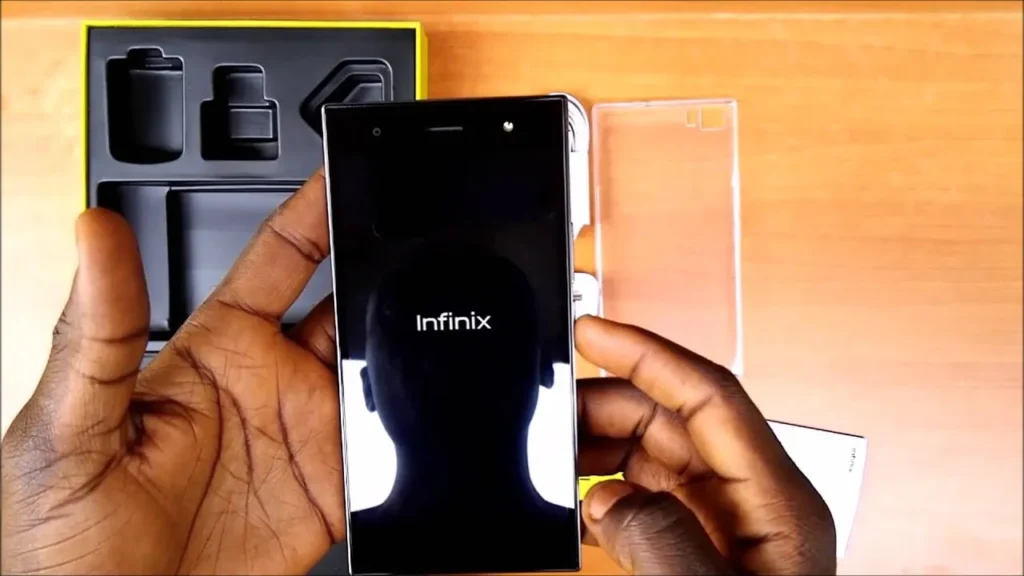
Introduction of Infinix Zero 3
The Infinix Zero 3 is a value-focused device that strikes a balance between a large display, competitive camera features, and dependable battery life. It’s optimized for everyday tasks: social, media, photos, and moderate multitasking. It is best for buyers who want a big screen and long battery life on a limited budget. It is not the best choice for people demanding flagship-grade compute performance or guaranteed multi-year OS support.
What the Infinix Zero 3 offers
Short bullets for scanners:
- Core strengths: Large display, capable camera (value-for-money), long battery endurance
- Known trade-offs: Older generation chipset vs contemporary flagships; limited long-term OS update assurances
- Best audience: Budget-aware consumers who prefer media consumption and camera utility over raw compute power
Design & Build
Look and feel
From a perceptual, tactile, and affordance standpoint, the Zero 3 is designed to convey premium cues at a budget price. Designers employ a narrow bezel strategy to maximize perceived screen-to-body ratio — an important visual affordance that increases perceived value on landing pages and thumbnails.
Physical affordances and ergonomics:
- Grip and reachability: The combination of width and weight creates a moderate single-hand usability profile. For users with medium or larger hands, the power and volume controls are reachable without a posture change.
- Surface finish: Many units have a metallic frame or alloy-like coating; this reduces the cognitive dissonance between price and perceived build quality.
- Camera module: The rear camera bump exists; without a case, it introduces a slight wobble during desk typing — an interaction detail useful to list on product pages (and to show in image gallery captions).
Durability & daily wear
This is not an IP68-rated rugged device; treat it as a consumer-grade handset. Recommended protective affordances:
- Apply a tempered glass protector to preserve the top-layer optics and touchscreen tactile response.
- Use a slim TPU case to avoid the camera wobble and to guard against drops — preserves resale value and battery health.
- For long-term retention (>2 years), consider occasional maintenance: battery calibration and cache cleaning to maintain runtime predictability.
Display
Attributes that influence perceived quality
- Size: Visual span for media and information density. Larger displays increase the token window — more text and UI elements visible.
- Resolution (pixel density): Determines textual clarity and UI crispness. Higher PPI reduces glyph aliasing.
- Panel type (AMOLED vs IPS): Affects contrast ratio and black level—AMOLED provides true black tokens, improving perceived contrast and battery gains with dark themes; IPS often yields better uniform brightness in daylight.
Real-world heuristics
- For long-form reading, slightly higher pixel density reduces eye fatigue by making glyph shapes crisper.
- For photos and videos, color gamut and dynamic range matter: richer gamut yields more saturated thumbnails, but overly saturated default profiles may mislead buyers when later comparing sample photos. Provide camera samples with both “default” and “natural” profiles in your gallery.
Practical tips for end-users
- Enable auto-brightness to align display luminance with ambient light — this dynamically optimizes the trade-off between visibility and battery consumption.
- Use built-in color temperature controls at night (warmer tone) to minimize circadian disruption.
- Lower maximum brightness during extended video playback to reduce thermal throttling and preserve battery longevity.
Performance
Expected performance envelope
The Zero 3 is tuned for everyday latency-sensitive tasks: messaging, browsing, social apps, and streaming. Heavy 3D games and the most demanding benchmarks will reveal throttling and lower sustained frame rates relative to Modern Flagships.
Practical load-management strategies
- Minimize background tokens (apps): Background apps consume RAM and CPU cycles; uninstall or freeze unused apps to reduce context-switching overhead.
- Lightweight launchers: If the UI animation budget is low (observed stutter), adopt a launcher that reduces draw calls and animation durations.
- Free storage margin: Keep 10–15% storage free as a cache reservoir—this reduces I/O thrashing, which commonly leads to stutter in list-heavy apps.
Cameras
Translate camera capability to user intents: social photos, low-light capture, portrait, and occasional cropping.
Imaging modes and use cases
- Auto / HDR: Default mode for dynamic scenes; HDR fuses exposures to increase highlight and shadow detail—useful for backlit portraits.
- Night / Low-light mode: Multi-frame exposure stacking reduces noise and improves dynamic range, but requires stabilization.
- Portrait mode: Simulates shallow depth-of-field with segmentation and blur synthesis—results depend on software segmentation accuracy.
Practical shooting tips
- Lens hygiene: Physical cleanliness dramatically affects low-level signal-to-noise ratio (SNR). Wipe the lens before capture.
- Tap to lock: Lock focus and exposure by tapping the focal region; this stabilizes the exposure token for the subject, particularly in high-contrast scenes.
- Natural lighting: For indoor portraits, position subjects near a window to increase available photons and improve sensor SNR.
Output and post-processing
Provide full-resolution samples and raw (when available). For editorial product pages, include both the camera’s default JPEG and a lightly processed alternative that shows what an average user might produce using a standard image editor or an automatic ML-based enhancer.
Battery life & charging
Consider the battery as an energy reservoir; app usage patterns and display brightness are the largest drains.
Understanding battery claims
mAh is a capacity token but not a predictor of runtime without factoring in display power, SoC efficiency, and software power management. Two phones with identical mAh can behave very differently.
Real-world battery
- Background sync: Frequent push sync (email, social) increases wake-up frequency and reduces standby time. Tune fetch intervals for longer standby.
- Battery saver thresholds: Enabling battery saver at 20–30% reduces background activity, and throttles refresh rates—useful for extending usable day length.
- Thermal management: Avoid gaming while charging; elevated temperatures accelerate chemical degradation.
Charging behavior
Charging speed depends on supported protocols and charger wattage. Use the supplied or certified charger to avoid overvoltage scenarios and ensure expected charging curves.
Software and updates
From an update lifecycle perspective, phones in this tier often offer a stable UI with Manufacturer Customizations but limited major OS release promises.
What to check before buying
- Update policy: Search for the manufacturer’s update commitments for your region/SKU.
- Bloatware surface area: Count preinstalled apps and audit permissions—some can be disabled or uninstalled to reclaim resources.
- Security updates cadence: Monthly security patches are preferable; a slow cadence increases long-term vulnerability exposure.
Practical tips
- Install the latest firmware on day one to receive bug fixes and performance improvements.
- Use system backup tools to export app lists and settings in case of a factory reset.
Connectivity, storage & extras
List features as discrete attributes for product pages.
- SIM configuration: Single or dual Nano-SIM. Dual-SIM is common in this class—note whether hybrid or dedicated.
- microSD support: Useful for photo/video heavy users; check maximum supported capacity.
- Headphone jack: Presence matters for buyers who prefer wired audio or aftermarket DACs.
- NFC: Required for contactless payments; presence is a competitive advantage in certain markets.
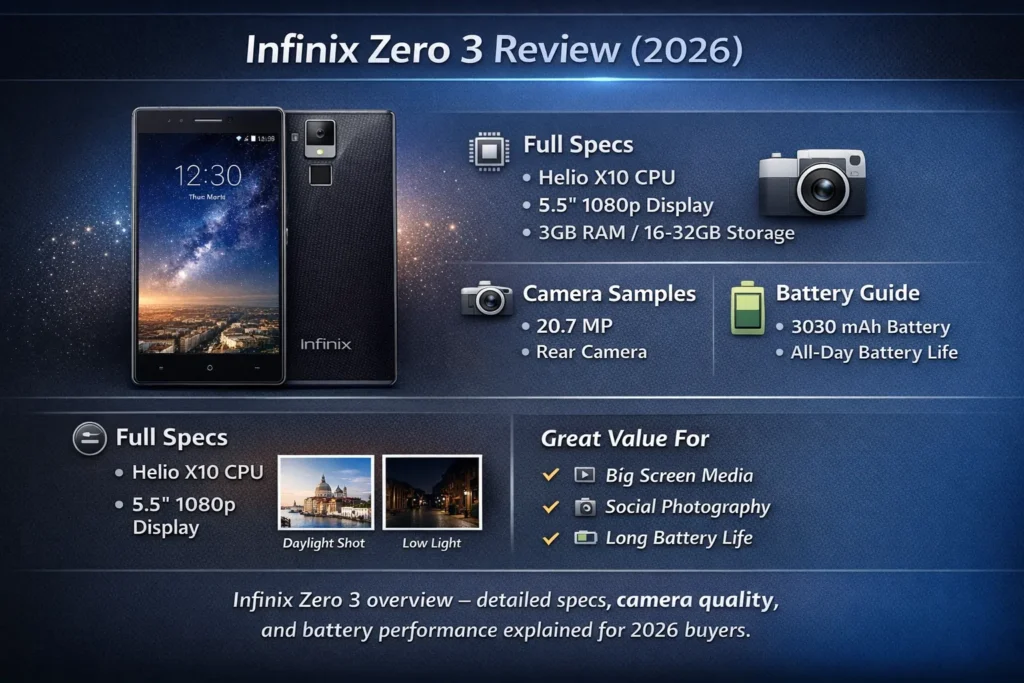
Who should buy the Infinix Zero 3
Buy if:
- You want a large display for media and multitasking.
- You prioritize battery life for a day of mixed use without a midday charge.
- You want a good camera value for social sharing and occasional prints.
Don’t buy if:
- You require the latest chipset for sustained high-end gaming at max settings.
- You want guaranteed multi-year OS upgrades for security and features.
- You need a very compact phone (the Zero 3 favors larger screens).
Alternatives & comparison table
| Feature | Infinix Zero 3 | Competitor A | Competitor B |
| Screen size | Large (media-friendly) | Similar | Smaller |
| Camera | Strong value-for-price | Similar | Better low-light |
| Battery | Long endurance | Similar | Shorter |
| Price (typical) | Budget–mid | Mid | Mid–high |
FAQs
A: Yes, for light and casual gaming. For heavy, graphics-intensive games, expect medium settings and moderate frame rates.
A: In normal use, it typically lasts a full day. Heavy use and gaming will drain it faster.
A: Many models in this family support microSD. Check the specific SKU on the product page.
A: Charging speed depends on the charger and phone variant. Use the original charger for best results.
A: Low-light results can be good if the phone has a dedicated night mode. For best results, hold the phone steady or use a tripod.
Final verdict
The Infinix Zero 3 remains a pragmatic value pick in 2026 for those prioritizing display real estate, dependable battery life, and a camera system tuned for social sharing. It is not a flagship substitute: if you require top-tier raw compute, the latest GPU performance, or multi-year OS guarantees, consider higher-tier alternatives. For budget-conscious media consumers and photography enthusiasts who prioritize price-to-feature balance, the Zero 3 is a solid daily driver.
