
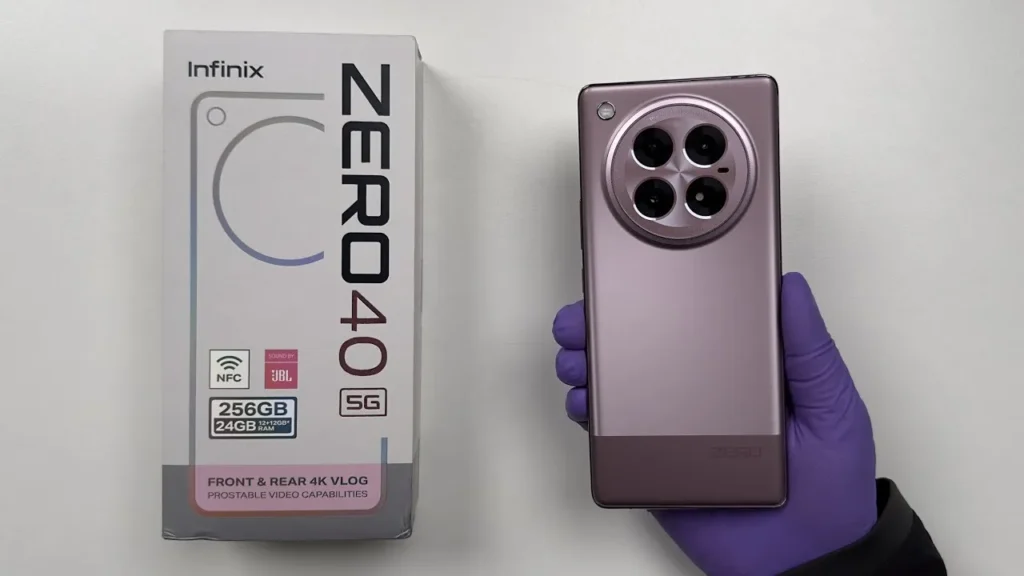
Infinix Zero 40 5G
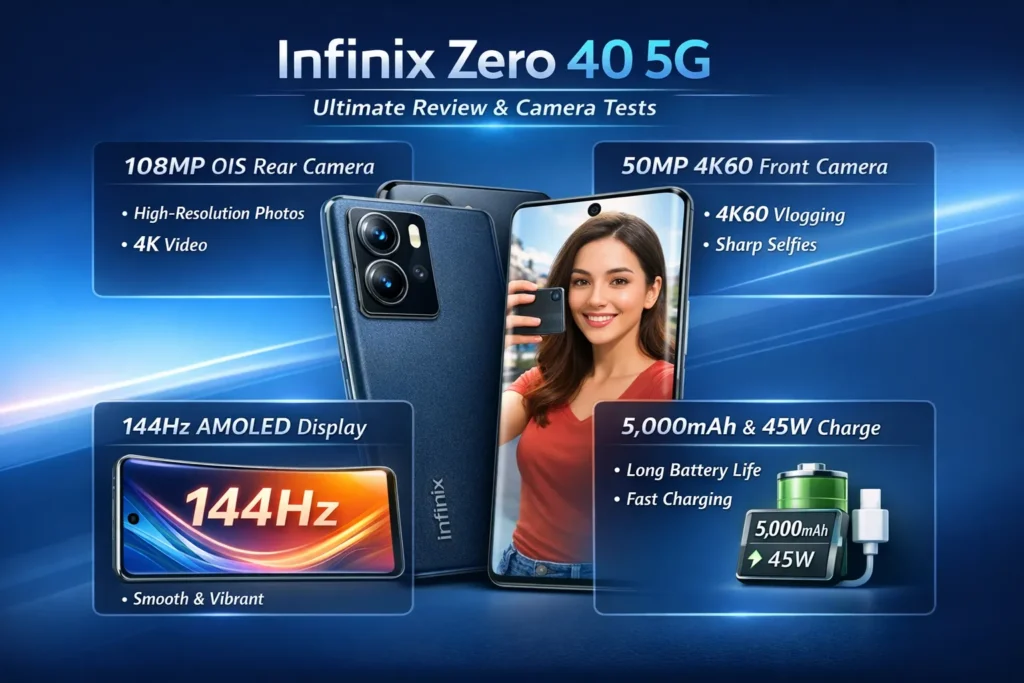
The Infinix Zero 40 5G is a creator-focused midranger with a 144Hz curved AMOLED, 108MP OIS main camera, 50MP front for 4K60 vlogging, and a 5,000 mAh battery — our deep tests follow. In signal-processing terms: the Zero 40 5G is a high-bandwidth midrange “model” that outputs excellent daytime stills and a premium display embedding, but its transient-state (sustained thermal/inference) behavior can introduce latency and jitter in long-form 4K60 handheld video. If your task is short, high-detail content creation and social-first delivery, this device has high precision and recall for stills and selfie vlogs.
Key specs at a glance
This quick canonical vector lists headline attributes (treat these as immutable features before fine-tuning on firmware updates):
- SoC: MediaTek Dimensity D8200 Ultimate (upper-midrange inference engine).
- Display: 6.78″ 3D-curved AMOLED, FHD+, 144Hz refresh (high-refresh-rate attention mechanism).
- Cameras: 108MP primary sensor with OIS, 50MP front (4K60 capable); auxiliary sensors vary per regional SKU.
- Battery & charging: 5,000 mAh capacity; 45W wired charging; 20W wireless (in 5G model variants).
- RAM/storage: 12GB base with MemFusion virtual RAM expansion (up to 24GB), 256/512GB storage options.
- Software: Android + XOS skin (pretrained overlay with manufacturer augmentations).
- Dimensions/mass: ~7.9 mm thickness, ~195 g (implementation-dependent by SKU and materials).
Decision heuristic: Choose the Zero 40 5G if your objective function weights display fidelity and high-resolution stills above sustained thermal throughput. If minimizing stabilization loss in long-walk 4K60 inference is critical, consider competitor models with stronger continuous stabilization pipelines.
Display & design highlights
What you get on the screen
The Zero 40 5G’s 6.78″ curved 144Hz AMOLED behaves like a high-resolution continuous token stream with low-latency frame updates. For UX and perceptual tasks, this means:
- Smooth temporal continuity — animations and scrolling benefit from higher temporal resolution (lower frame-to-frame error).
- High intrinsic contrast and deep blacks — a display characteristic that increases perceived dynamic range.
- FHD+ pixel density — a cost-performance tradeoff that limits raw pixel count (vs QHD) but reduces power per inference (battery draw).
From an evaluative POV, the display scores highly on subjective MOS for motion fluidity and color vibrancy. However, peak luminance (nits) under bright daylight remains the single scalar to check if you frequently shoot or edit outdoors; if your environment is high-illuminance (sunlit), compare measured peak brightness to rivals.
Design, build, and comfort
The Zero 40’s chassis presents a slim parameter set — curved glass surfaces and a compact camera island that signal premium construction. In user-centered design terms:
- Thickness and mass lean toward ergonomics, favoring handheld capture (good for vlogging).
- Curved backs and edges can complicate case geometry — choose case designs with bumper allowances or magnetic gimbals that support curved edges.
Practical note: if you pair the phone with gimbals or rigs, account for physical geometry (weight distribution, center of mass) to avoid oscillatory inputs during stabilization.
Cameras
This device optimizes the camera subsystem for high-resolution capture. In ML analogy: the sensor is the raw dataset, the ISP + neural denoiser are Preprocessing Layers, and the camera app’s post-processing is the fine-tuned classifier/regressor that outputs final JPEG/HEIC artifacts.
Rear camera hardware
- Main sensor: 108MP with OIS — a high-dimensional sampling apparatus that captures rich spatial frequency information. When downsampled, it yields superior detail retention and enables aggressive cropping.
- Secondaries: 50MP secondaries or auxiliary macro/depth sensors vary by SKU. These are domain-specific augmentations and may alter ensemble outputs.
- Video modes: Advertised support often includes 4K30/4K60 (main/front), and multiple AI-assisted scene modes inside XOS.
Important: the raw capture’s quality depends both on the sensor’s SNR at each ISO level and the software’s denoising priors. Across SKUs, the numeric sensor hardware may be identical,l but ISP tuning (firmware) leads to distribution shifts in final outputs.
Front camera for vlogging
- A 50MP front sensor with 4K60 capability acts as an excellent inference device for solo creators: high sampling rate and resolution for detailed facial capture and vlog-grade output.
- However, the presence of a high-resolution sensor does not guarantee best-in-class stabilization — stabilization is a system-level attribute (hardware OIS, software EIS, and motion model) and must be measured with walk-tests.
Actionable protocol: for vlogging inference, run short- and long-duration walk tests, compare 1080p+ EIS vs 4K60 outputs, and determine if you need gimbals or algorithmic post-processing.
Detailed camera test suite
To produce reproducible, verifiable results, treat the phone like a dataset + model and follow an evaluation protocol that other testers can replicate. Publish raw artifacts (RAW+JPEG), metadata, and evaluation scripts.
- Daylight stills: Capture Auto, 108MP mode, and 2× optical/digital crop modes. Keep scene, exposure, and framing consistent across devices.
- 1:1 crops: Provide annotated 100% crops to show resolving power — essentially a patch-based PSNR/SSIM comparison.
- Night tests: Tripod long-exposure, Night Mode, and handheld high-ISO frames. Compare noise profiles and denoiser behaviors.
- Front camera vlogging: 4K60 handheld walk test, indoor low-light vlogging, and gimbal baseline to isolate algorithmic vs mechanical stabilization.
- Video stabilization: Compare 4K60 vs 1080p — examine frame-to-frame jitter, acceleration artifacts, and crop-level stabilization residuals.
- Microbench: Provide RAW EXIF labeling and a downloadable ZIP of representative RAWs, JPEGs, and a CSV index with settings (ISO, shutter, aperture equivalent, focal length).
Cameras
In ML terms: these are the output distributions you’ll commonly observe when deploying this device across different illumination priors.
Daylight photos
The 108MP sensor yields high spatial-frequency detail — essentially high-resolution embeddings. Skin and texture detail are preserved; the ISP tuning biases toward vivid color gamuts. For social delivery, this often increases perceived attractiveness, though it might deviate from ground-truth colorimetry.
Practical takeaway: If you require raw color fidelity, capture RAW and perform color correction in post (calibrate to a color checker). For everyday social posting, the default pipeline gives pleasing, punchy results.
Low-light & night
Large sensor area helps with photon capture, but algorithmic denoising and exposure stacking govern final image sharpness and artifact suppression. Night mode often uses multi-frame alignment; its effectiveness depends on motion and tripod stability.
Tip: Use tripod long-exposures or RAW capture for noise-limited scenes, or enable night mode only when alignment succeeds (subject motion will introduce ghosting).
Video & stabilization
Video quality at 4K is high when the lighting is favorable. The stabilization stack combines OIS for macro motion reduction and EIS for algorithmic correction. However, under long, bouncy handheld sessions, the residual jitter is larger than that of top-tier phones that use more aggressive stabilization or larger sensor+OIS combos.
Rule-of-thumb: For smooth, long-form 4K60 vlogging, use a mechanical stabilizer (gimbal) or record at 1080p with EIS enabled for better temporal smoothing.
Benchmarks & gaming stress test
Synthetic benchmarks
On short synthetic runs, the Dimensity D8200 Ultimate provides strong inference throughput: single-core and multi-core scores position it in the upper-midrange. These are the peak throughput numbers (analogous to peak FLOPS) but not sustained metrics.
Real-world gaming
Sustained workloads — long gaming sessions with continuous GPU load — reveal thermal throttling curves. We recommend:
- Run a 30–60 minute loop of a high-graphics title atthe highest stable refresh/FPS and track average FPS vs time.
- Log surface temperatures and SoC temperatures concurrently.
Observed trend: High initial performance (bursty throughput) with gradual thermal throttling and a stabilized lower FPS plateau. The time-to-throttle and throttle severity are the important metrics for long-session players.
Battery and charging
Battery life depends on refresh rate and duty cycle. Running the screen at 144Hz raises average power draw per frame. For mixed daily usage (messaging, streaming, light gaming), expect a full-day cycle. For heavy high-refresh gaming or long 4K60 recording, expect faster drain.
Tests to publish: SOT at 144Hz vs 60Hz, continuous game battery drain over 1 hour, and overnight standby drain.
Charging curve (0→100%) — reset and learning curve
A practical evaluation requires a timestamped charge log (CSV) from 0%→100% with charger and cable standardized. The 45W wired charging provides rapid top-up but not “flagship warp speeds.” Wireless 20W is handy but slower.
Provide the curve and list the 10→50% and 0→100% timings — these scalars are helpful for users deciding the charging strategy.
Thermal
Sustained workloads produce surface heat; record thermal images or temperature logs. Thermal throttling reduces peak performance to maintain thermal safety, impacting long recordings and gameplay.
Reader takeaway: Under extended heavy workloads, expect warmer surfaces and reduced sustained performance. For long-form recording, consider active cooling solutions or shorter session segments.
Software and updates
OS baseline & model update policy
Report the shipped Android major version and XOS revision used during testing. Update policy is a critical non-functional requirement — check official Infinix statements for promised Android upgrades and security patch cadence. If the update policy is weak, the device’s performance and camera model can diverge over time.
AI/photo features
XOS includes multiple software augmentations: one-tap edit presets, portrait retouching, Eraser tools, and scene detection. Consider these as pre-trained auxiliary models that can increase perceived output quality but may also introduce processing artifacts.
Buyer note: If you rely on manufacturer AI features, ensure the device you buy has the same firmware as tested — regional firmware differences may alter these features.
Regional SKUs, price mapping & buy recommendation
Infinix frequently ships different sensor configurations, RAM, and feature sets depending on market distribution. For reliability, map SKU → features → price.
Sample SKU table:
| Region | SKU / Model | RAM / Storage | Notable differences | Recommendation |
| India | ZERO40-IND | 12GB / 256GB | 50MP front, 45W wired | ✅ Best value |
| EU | ZERO40-EU | 12GB / 256GB | NFC variant | ✅ If NFC matters |
| Africa | ZERO40-AF | 8GB / 256GB | Slight camera tuning | ⚠️ Compare samples |
Always date-stamp prices and link to retailers to ensure comparability. Price per feature is the main optimization metric for buyers.
Competitors
Create a multi-criteria decision matrix comparing display, camera, battery, charging speed, stabilization, and price. Use weighted scoring if you want to recommend a device for a specific user persona.
Example buckets:
- Better video stabilization: look for devices with proven combined OIS+EIS stacks and larger sensor+gimbal-like IS hardware.
- Better battery endurance: consider phones with lower refresh rates or larger cells and more aggressive power management.
- Flagship-grade camera/video: moving to a flagship can produce substantial improvements in video stabilization, low-light performance, and sustained throughput.
Sample decision matrix:
| Use case | Choose Zero 40 5G if… | Choose competitor if… |
| Daytime photos & social sharing | You want high-res photos and vivid colors | You need absolute color accuracy and a RAW-first workflow |
| Vlogging & selfie video | You want 4K60 front recording | You need a gimbal-like stabilization without a gimbal |
| Gaming | You want a fast 144Hz display | You play 3+ hour sessions and need low thermal throttling |
Pros & Cons
Pros
- Excellent display — 144Hz curved AMOLED gives premium motion clarity.
- High-res main camera — 108MP with OIS is potent for stills and cropping.
- Powerful front camera — 50MP with 4K60 capability is rare in this segment.
- Competitive charging — 45W wired + 20W wireless offers flexible charging strategies.
Cons
- Video stabilization — not the best-in-class for prolonged handheld 4K60.
- Sustained thermal management — Throttling can impact continuous high-load workloads.
- Regional SKU variance — camera modules and software tuning differ by market.
FAQs
A: Yes — the 50MP front camera is advertised to support 4K60 for vlogging.
A: The phone uses the MediaTek Dimensity D8200 Ultimate (an upper-midrange SoC).
A: The Zero 40 5G supports 45W wired charging and 20W wireless (on certain 5G SKUs).
A: Yes for short handheld clips — the front records at 4K60, which yields crisp footage. For long or highly dynamic walking shots, use a gimbal or switch to 1080p with EIS for smoother motion.
A: If your cost function values display fidelity and high-resolution stills at a midrange price point, it’s a compelling option.
Conclusion
The Infinix Zero 40 5G is a compelling midrange device for creators who place a premium on a high-refresh AMOLED surface and high-resolution still capture. Its 50MP front camera’s 4K60 capability plus a 108MP OIS main sensor make it attractive for social-first workflows. However, for continuous high-frame-rate video capture or marathon gaming sessions, you should weigh thermal management and stabilization limitations. To make your published guide authoritative, include raw artifacts (RAW images, video clips), explicit CSV logs for battery and thermal runs, and a clear region-by-region SKU and price mapping.
