
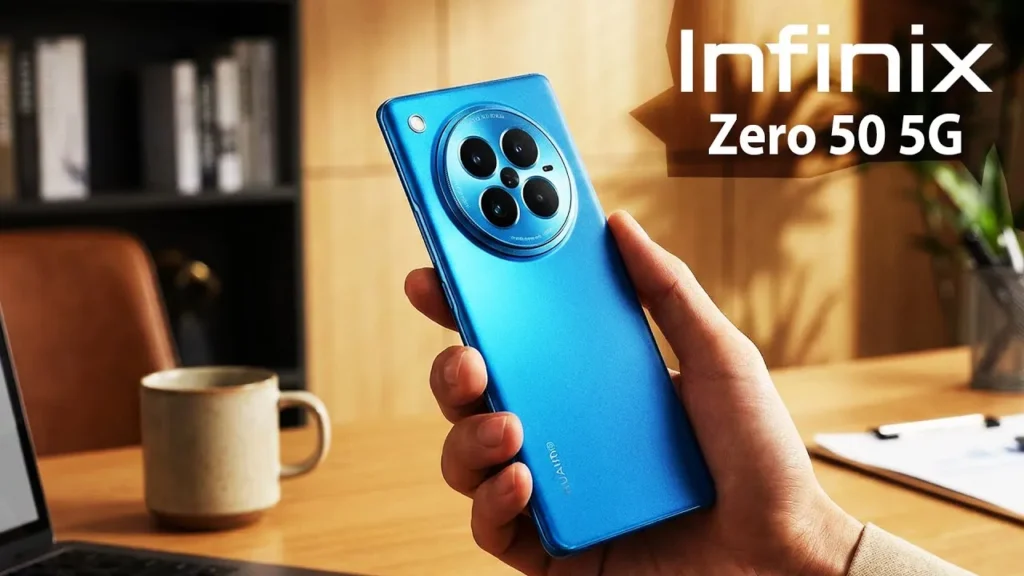
Introduction of Infinix Zero 50 5G
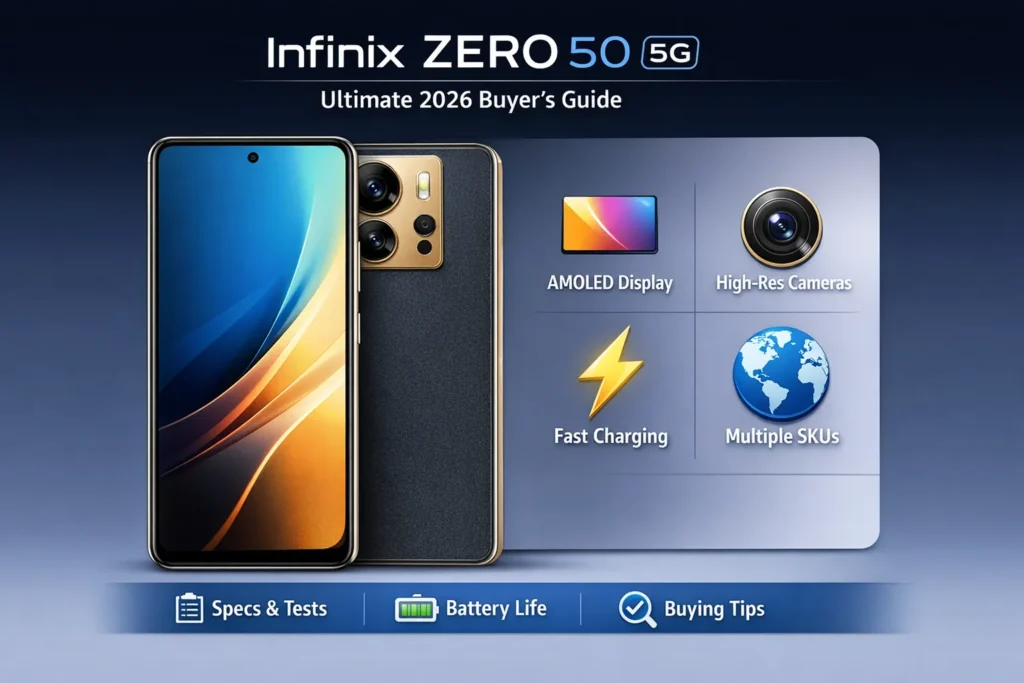
Choosing a midrange smartphone in 2026 is no longer simple. Models share similar names, specs change by region, and retailer listings often mix confirmed details with assumptions. The Infinix Zero 50 5G is a perfect example of this confusion. On paper, it promises a large AMOLED display, strong camera hardware, fast charging, and a modern design — all at a price far below that of flagship phones. In reality, the experience you get depends heavily on which SKU, chipset, and regional variant you buy.
Who this phone is for
- Casual creators: selfie/video-first users who want reliable front-camera video and simple vlogging features.
- Bargain buyers: shoppers seeking a flagship-like screen and charging value at a midrange cost.
- Screen lovers: people who care more about a vivid AMOLED and high refresh rate than raw CPU benchmarks.
- Not for: power users wanting the absolute fastest SoC, guaranteed long-term OS updates, or IP68-level water resistance without confirmation.
Quick spec snapshot
Model: Infinix Zero 50 5G
Display: Large AMOLED — high refresh, HDR-capable (exact Hz varies by SKU).
SoC: Regional variants (map SKU → chipset).
RAM / Storage: Multiple options; RAM type and storage bus vary by SKU.
Rear cameras: Multi-sensor array — primary high-megapixel + ultrawide + depth/macro.
Front camera: High-res selfie with advanced video modes (4K support depends on SKU).
Battery: Large cell (non-removable), fast wired charging supported (wattage varies).
OS: Android + XOS skin.
Price tier: Midrange / upper midrange.
Design and build
What to expect: The Zero 50 5G generally follows contemporary smartphone design language: glossy or glass-like back panels (some SKUs use plastic), narrow bezels, a centered punch-hole selfie cutout, and a slim profile given the battery capacity.
Key points:
- Weight & feel: Balanced for its battery class — not overly heavy.
- Materials: Glass front is typical; frames may be plastic or metal, depending on SKU. Don’t assume premium metal unless specified.
- Grip & protection: Many retail boxes include a basic TPU case — still pick up a higher-quality case for drops.
- Ingress rating: Most Infinix midrangers do not advertise IP67/68. If the spec sheet or box doesn’t state an IP rating, treat the device as not water-resistant.
- Buyer tip: Ask the seller for a photo of the box label (model code) to confirm the exact SKU before purchase.
Display
The display is one of the Zero 50 5G’s strongest selling points and often matters more in daily use than raw CPU speed.
What to check in the spec sheet
- Panel type: AMOLED is preferred for deeper blacks and higher contrast vs LCD.
- Size & resolution: Aim for at least FHD+ for sharp text and crisp video.
- Refresh rate: 90Hz or 120Hz delivers smoother UI and gaming; confirm the exact value per SKU.
- Touch sampling: Important for gaming. Higher sampling rates improve touch responsiveness.
- Brightness (nits): Look for high peak brightness (500+ nits typical; 1000+ nit peak helps HDR outdoors).
- HDR support: Useful for streaming HDR-enabled content.
- PPI (pixel density): >400 PPI is excellent at typical phone sizes.
Real-world display checks [Deep]
Color accuracy: Phones tuned for punchy colors may oversaturate skin tones. Compare photos and content with natural references.
Adaptive refresh: Confirm how aggressively the panel drops Hz to save battery; some UI layers default to 60Hz quickly.
PWM / flicker: Some AMOLED panels use PWM at low brightness; users sensitive to flicker should test in person.
Practical test: Open a white page at 50% brightness and step outside — text legibility is a practical indicator of outdoor performance.
Performance & chipset
Important note: Zero 50 5G may ship with different SoCs across regions. This affects raw performance, power efficiency, camera feature support, and video encoding capabilities. Map your exact SKU before buying.
What matters most
- CPU cores & clocks: Influence raw processing.
- GPU & gaming: GPU strength impacts game performance and sustained framerate.
- RAM type: LPDDR5 is notably faster than LPDDR4x and benefits multitasking.
- Storage type: UFS 3.x is much faster than UFS 2.1 for app loading and write speeds.
Practical performance checks
- Daily UI: Observe app switching and animation smoothness.
- Gaming: Run a long session to watch for thermal throttling and frame drops after 20–30 minutes.
- Benchmarks: Useful for head-to-head comparison, but treat them as synthetic; prioritize long-form usage tests.
Buyer tip: For gaming, prioritize SKUs with stronger GPU, LPDDR5 RAM, and UFS 3.x storage.
Cameras
Camera capability is a primary selling point for many Zero 50 5G buyers — especially selfie and front-video features.
Rear camera setup
- Main sensor: MP count alone isn’t everything — sensor size and aperture matter for low-light.
- Ultrawide: Watch for corner softness and color matching with the main camera.
- Macro/depth: Often secondary in value; optional for most buyers.
- OIS vs EIS: Optical stabilization (OIS) helps low-light stills and smooth video; Electronic stabilization (EIS) is software-driven and helps steady footage, but can’t replace OIS for long exposures.
Front camera
- Sensor & MP: A high-MP front camera can still be outperformed by a larger-sensor, lower-MP module.
- Video modes: If vlogging, confirm front 4K support — some SKUs only offer front 4K on particular SoCs or regions.
- Stabilization: EIS is common for front video — test walking shots to check stabilization quality.
Camera test matrix
For consistent, repeatable review samples, collect the following:
- Daylight: Wide shot + 1:1 crop; evaluate detail and exposure.
- Low-light/night: Same scene after sunset — assess noise and dynamic range.
- Ultrawide: Check corner sharpness and color shift.
- Portrait: Edge detection and synthetic bokeh quality.
- Video: 4K30/60 sample, stabilization walking test, and a short night video.
- Selfie video: 4K/30 or 4K/60 walking indoor/outdoor sample.
Battery & charging
Battery capacity is only a part of the story; display settings, SoC efficiency, and network behavior drive real-world endurance.
Spec vs real world
- Capacity: Listed in mAh (often ~4500–5000 mAh for this class).
- Cell type: Typically Li-Po; non-removable.
- Charging: Verify rated wattage and whether the phone uses standard USB PD or proprietary fast-charging protocol. Some markets include high-wattage bricks; others include lower-wattage chargers.
Battery tests to run
- Web browsing/video loop: Standardize at 50% brightness and set refresh rate for a repeatable baseline (60Hz, 90Hz, or 120Hz).
- SOT (screen-on time): Measure at different refresh rates and report averages.
- 0→100 charge time: Use the supplied charger and cable — log charging percentage at timed intervals and record device temps.
- Thermals while charging: Note if the phone gets warm during fast charging — thermal throttling may be applied to protect cells.
Quick advice: If advertising 60W+ charging, confirm that the included charger supports that wattage; some regions ship lower-watt chargers.
Software & updates (XOS & Android)
XOS is Infinix’s custom Android skin — it offers features but may include bloat and variable update cadence.
What to check on day one
- Android version & patch level: Record the shipped Android version and the latest security patch installed at unboxing.
- Preinstalled apps: Count obvious bloatware; identify apps that can and cannot be removed.
- Update policy: Check the Manufacturer’s promised update window. If not listed, assume limited guarantees.
Practical software checks
- Stability: Use the phone for at least a day — look for reboots, app crashes, or notification lag.
- Permissions & privacy: Inspect app permission controls.
- Software features: Game mode, Pro camera mode, video log settings, and DRM level (Widevine L1) for HD streaming.
Packaging & in-box contents
Most Infinix packages include essentials, but verify specifics for your market.
Common inclusions: Charger (confirm wattage), USB-C cable, SIM eject tool, basic TPU case, warranty card, quick start guide.
Buyer tip: If fast charging is a headline feature, ensure the advertised wattage corresponds to the included charger.
Pricing, availability & warranty
Launch price vs current market price: These change by region and over time. For live pages, include date-stamped price snapshots from 3–5 retailers per market.
Warranty: Infinix warranties vary by country — typically 12 months for device hardware, shorter for accessories. Confirm local service center locations.
Buyer tip: Import units might carry limited or no local warranty — check warranty stickers and local support documentation before buying.
Pros & Cons
Pros
- Strong, vivid display — bright and high-refresh.
- Good selfie and front-video features aimed at creators.
- Large battery with fast wired charging options.
- Excellent value for screen + camera combination.
Cons
- SKU fragmentation — hardware and features vary by region.
- Software update promises may be limited.
- No explicit IP rating in most listings — treat as not water-resistant.
- XOS can include non-removable bloatware.
Buying checklist
- Check the box model number in product photos or ask the seller for it.
- Verify charger wattage is included if fast charging is a headline.
- Confirm network bands for your country (4G/5G).
- Check local warranty and service center availability.
- Look for Widevine L1 for HD streaming.
- Validate RAM & storage type (LPDDR5 & UFS 3.x preferred).
- Inspect the return policy and delivery time.
Comparison & alternatives
If considering the Infinix Zero 50 5G, compare with:
- Competitor A: Similar display, stronger SoC — better for gamers.
- Competitor B: Slightly cheaper, weaker camera, but longer software support.
- Competitor C: Better water resistance and stereo speakers, but a smaller battery.
FAQs
A: If your priorities are a bright AMOLED display and strong camera features (especially front-facing video), the Zero 50 5G is a compelling value proposition in the midrange segment.
A: Camera performance varies by SKU due to different sensors and SoC-based processing pipelines.
A: Some SKUs do support 4K front video, but this is conditional on the chipset and firmware.
A: Battery life depends on refresh rate, display brightness, network usage, and SoC efficiency.
A: Most listings do not list an IP rating. If water resistance is critical, only buy a variant that explicitly lists IP67/68 on the official spec sheet.
Final verdict
The Infinix Zero 50 5G stands out as a well-balanced midrange smartphone that prioritizes the things most users actually notice every day: a large, colorful AMOLED display, capable cameras (especially for selfies and video), and fast wired charging that reduces downtime. For casual creators, entertainment-focused users, and buyers who want premium-style features without paying flagship prices, the Zero 50 5G makes a strong case. That said, this phone is not a one-size-fits-all purchase. The biggest caveat is SKU fragmentation. Performance, camera features, charging speed, and even connectivity can vary depending on the exact model code sold in your region. This means the buying decision shouldn’t be based on the name alone — it should be based on verified SKU details, the chipset inside, and what’s actually included in the box.
