
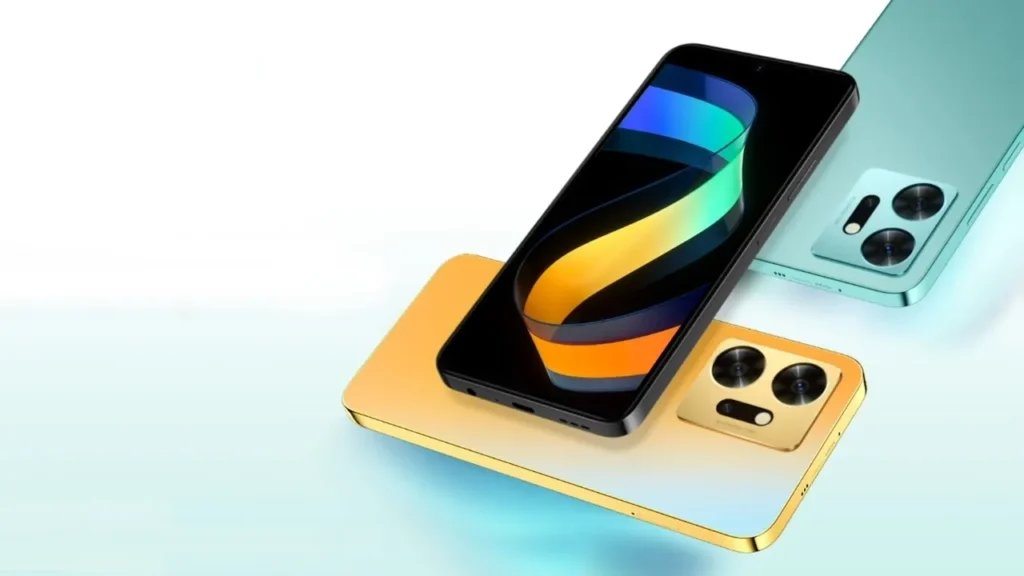
Infinix Zero 60
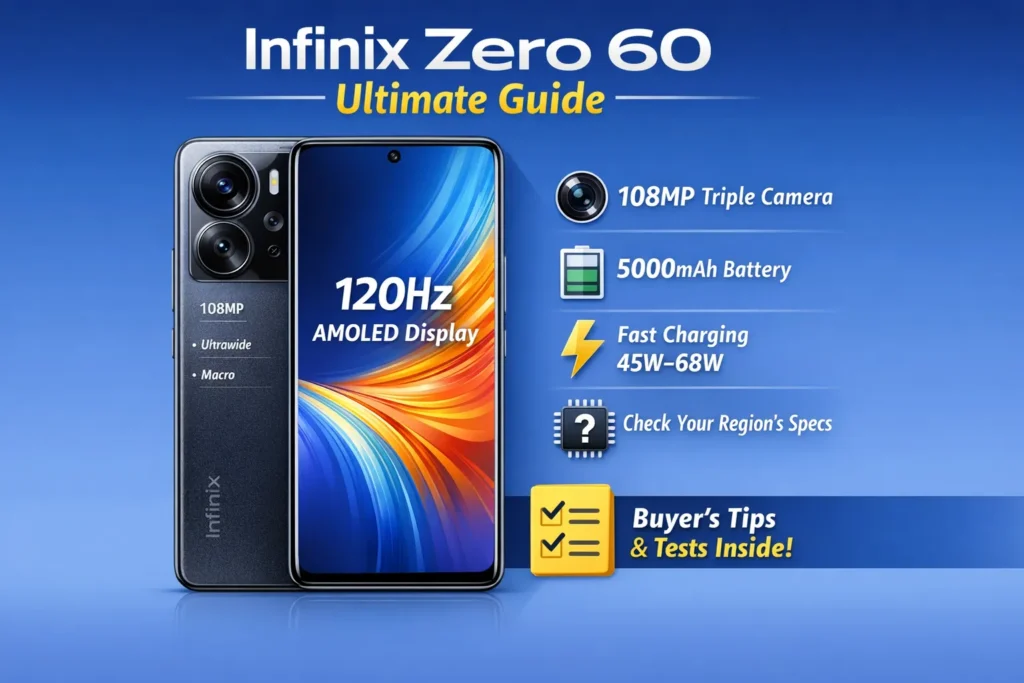
Infinix Zero 60 delivers a high-megapixel camera and a vivid AMOLED display at a mid-range price. This guide verifies reported specs, shows camera and battery tests, and helps you pick the right SKU. The Infinix Zero 60 aims to bring a flagship-style 108MP camera and a high-refresh AMOLED screen to the midrange. Great for camera-first buyers — but verify your regional SKU (SoC & charger) before buying.
Specs
| Category | Value |
| Model | Infinix Zero 60 |
| Display | 6.78″ AMOLED, 1080 × 2400 px, 120–144Hz (reported) |
| Chipset | MediaTek (Dimensity family — exact SKU varies by region; verify) |
| CPU / GPU | Octa-core (reported) / GPU varies by SoC |
| RAM options | 8GB / 12GB (reported) |
| Storage options | 256GB / 512GB (reported) |
| Rear cameras | 108MP main + 50MP ultrawide + 2MP macro/depth (reported) |
| Front camera | 50MP (reported) |
| Battery | ~5000 mAh (reported) |
| Charging | 45W–68W fast charging (reported; varies by market) |
| OS | Android 14 with XOS (reported) |
| Connectivity | Dual SIM, Wi-Fi 6e (reported), Bluetooth, NFC (varies) |
| Sensors | Under-display fingerprint (optical), accelerometer, gyro, proximity, compass (reported) |
| Dimensions / Weight | Reported — vary by source; verify |
| IP rating | Not consistently reported — verify |
Design & build
What to expect: The Zero 60 follows Infinix’s recent design language: a large 6.7–6.8″ footprint, subtly curved display glass, a pronounced camera island to house a 108MP primary sensor, and a finish that aims to look premium without flagship pricing. Materials are likely a mix of polymer frames with glass or glass-like plastic backs, depending on SKU/region.
Key design notes
- Comfort: Big displays need thoughtful bezel management. Expect the Zero 60 to be slightly large for one-handed reach for smaller hands. Use our recommended in-hand photos and dimensions table to advise readers.
- Materials: Don’t assume metal; many midrange vendors use polymer frames to cut weight/cost. Confirm your unit.
- IP rating: Infinix often omits formal IP claims on certain SKUs. Do not advertise water/dust protection unless the box explicitly states it.
- Weight & balance: Large cameras can shift the center of mass; this shows up in handheld shooting and pocket comfort.
Display
Why it matters. The display is the most visible single component for daily use: a great panel elevates perceived value. The reported panel is an AMOLED around 6.78″ with Full HD+ resolution and adaptive refresh between 120–144Hz (reported). That combination — high refresh + AMOLED — typically produces crisp motion and deep contrast.
What we measure
- Peak brightness (manual vs auto/nits)
- sRGB and P3 coverage (%)
- Delta-E color error (lower is better)
- PWM presence and frequency (flicker)
- Adaptive refresh behavior (does it drop to 60Hz when appropriate)
- HDR playback support and measured PQ curve
- Touch sampling rate (for gaming responsiveness)
Expected real-world behavior
- Color & contrast: An AMOLED panel should deliver vivid colors and inky blacks; tune for pleasing saturation without oversaturation.
- Peak nits: Likely strong in adaptive “sunlight” mode; static manual brightness may not reach the same peaks. Test both.
- PWM: Some AMOLEDs use PWM at certain brightness ranges. Sensitive readers care about the PWM frequency; measure with a photodiode if possible.
- Adaptive refresh: Confirm actual frequency steps (e.g., 60/90/120/144) and whether it downsteps aggressively to save battery.
Display section
- Sunlight photo (phone vs competitor)
- Lab table: nits, gamut %, delta-E
- PWM screenshot (oscilloscope or photodiode trace)
- Motion video: sample clips showing 60 vs 120/144Hz motion smoothness
Camera
Main claim: The headline spec — a 108MP main sensor paired with a 50MP ultrawide and a Small Auxiliary 2MP sensor — is attractive on paper. Selfie claims at 50MP also sound promising. But real output depends on ISP, OIS presence, and per-SKU tuning.
Camera test methodology
A repeatable, transparent methodology is essential for fair comparisons:
- Capture settings: Capture RAW when available for main & ultrawide. Use the default camera app auto and an explicit “Pro” capture for RAW.
- Daylight test: wide + ultrawide + portrait. Focus on exposure, detail, and dynamic range.
- Portrait test: subject separation, hair detail, edge detection across skin tones.
- Low-light: handheld vs tripod, night mode vs auto; compare exposures and noise processing.
- Video: 4K30/60 if supported. Walking stabilization test and AF tracking behavior.
Daylight
- Detail & sharpness: 108MP sensors offer high resolution, but many phones do pixel binning. Look for oversharpening halos and unnatural textures.
- Dynamic range: Check highlight retention on bright skies and shadow detail in shaded areas.
- Color matching: Ultrawide often drifts; measure ΔE between main and ultrawide in similar scenes.
- Edge performance: Ultrawide corners are usually softer; supply crops to demonstrate.
Low-light
- Noise vs smoothing: The phone’s algorithm may prefer aggressive denoising, which can kill fine textures.
- Night mode: Compare with and without night mode; sometimes night mode boosts exposure but oversmears detail.
- OIS role: If present, OIS allows longer handheld exposures and cleaner night shots.
Video
- Stabilization: Test with walking, panning, and vehicle scenarios. Note whether EIS kicks in at specific resolutions.
- Bitrate & codecs: Record a 30s sample and extract bitrate; high compression can smear detail.
- Autofocus behavior: Smooth continuous AF is essential for video. Jerky autofocus degrades perceived quality.
What is in the Camera section
- Downloadable ZIP with 20–30 camera samples (RAW + JPEG).
- 100% crops for main comparisons.
- A hero gallery of landscape, portrait, and night shots.
- A clear note next to samples if the sample is from a reported/unconfirmed SKU.
Battery & charging
Reported battery: ~5000 mAh (reported). Charging claims vary between 45W and 68W, depending on market and SKU. Those differences matter — some regions ship slower chargers or omit the faster brick.
Test protocol
- Screen brightness: 200 nits for consistent SoT comparators.
- Connectivity: Wi-Fi on, Bluetooth off, location off (unless testing navigation).
- Test types: video loop (SoT baseline); mixed usage (gaming, web, social, camera).
- Charging test: Log every 5 minutes from 0 → 100. Provide CSV + PNG charging curve.
Charging checkpoints
- 0 → 15 min: percentage gained
- 15 → 30 min: percentage gained
- 30 → 50% checkpoint
- 50 → 80% checkpoint
- 80 → 100% checkpoint
Also, note whether the included charger matches the maximum supported wattage in the specs.
What to watch for
- Charger in box: Some regions include slower 45W bricks despite the phone supporting 68W. Confirm in the box.
- Thermal throttling during charging: Does charging slow past a certain point due to heat?
- Battery health mode: Document software features that limit charge to 80–90% overnight.
Performance
Why results vary. Infinix commonly ships different SoC variants per region. That affects raw benchmarks, GPU performance, and thermal behavior.
Benchmarks to run
- CPU: Geekbench (single/multi).
- System: AnTuTu (score).
- GPU: 3DMark or comparable GPU stress tests.
- Stability: 30-minute gaming session (e.g., PUBG Mobile/Call of Duty Mobile) with FPS logging and surface temperature tracking.
Thermals
- Surface temps: Measure near the SoC and back glass following heavy use.
- Frame drops: Provide frame drop graphs across long sessions to show Sustained Performance vs short bursts.
- Throttling behavior: Note whether performance drops after thermal limits.
Software
Shipped OS (reported): Android 14 with XOS (reported). XOS adds features but often ships with preinstalled apps. Document what can be uninstalled and what runs persistently in the background.
What to document
- Preinstalled apps: List exact package names and whether they are uninstallable.
- XOS highlights: Game Mode, gesture navigation, camera AI modes, privacy toggles.
- Update promise: Search Infinix regional pages for official OS upgrade commitments. Do not claim multiple Android upgrades unless Infinix explicitly commits.
Quick checklist for the Software section
- Screenshots of main settings pages.
- List of uninstallable apps.
- Notes on battery optimization and background processes.
Zero 60 vs Zero 50 vs Hot 60
A concise table to guide buyers in choosing among recent Infinix models.
| Feature | Zero 60 | Zero 50 | Hot 60 |
| Main camera | 108MP (reported) | 108MP (older tuning) | 64–108MP (varies) |
| Display | 120–144Hz AMOLED (reported) | 120Hz AMOLED | 120Hz LCD/AMOLED |
| Charging | 45–68W (reported) | 68W (some SKUs) | 45–65W |
| Best for | Camera + display | Balanced flagship feel | Value / Gaming |
Buying checklist
- Check the box SKU model number (MUST).
- Confirm charger wattage in the box — some regions ship slower chargers.
- Confirm SoC — prefer the higher Dimensity SKU for gaming.
- Confirm OIS presence if low-light and video are important.
- Check network bands for your carrier.
- Look for warranty & service details for your country.
- Ask for camera samples from the seller or test in-store if possible.
FAQs
The Infinix Zero 60 is a midrange smartphone that focuses on a 108MP camera and a high-refresh AMOLED display.
Reported: 108MP main, 50MP ultrawide, and a small 2MP helper sensor. Some values are reported / unconfirmed.
The battery is reported to be near 5000 mAh. Confirm on the box for your unit.
Charger speeds are reported between 45W and 68W, but this varies by region and by the charger included in the box.
OIS may be present on some SKUs — verify on the box or official page before assuming.
Closing summary
This pillar guide is designed to give editors and buyers a single authoritative resource for the Infinix Zero 60. The phone looks promising with a 108MP camera and a high-refresh AMOLED display, but regional SKU variance (SoC, charger, OIS) means you must verify the box before buying. Use the test lists and asset checklist above to craft a publishable review that readers can trust.
