
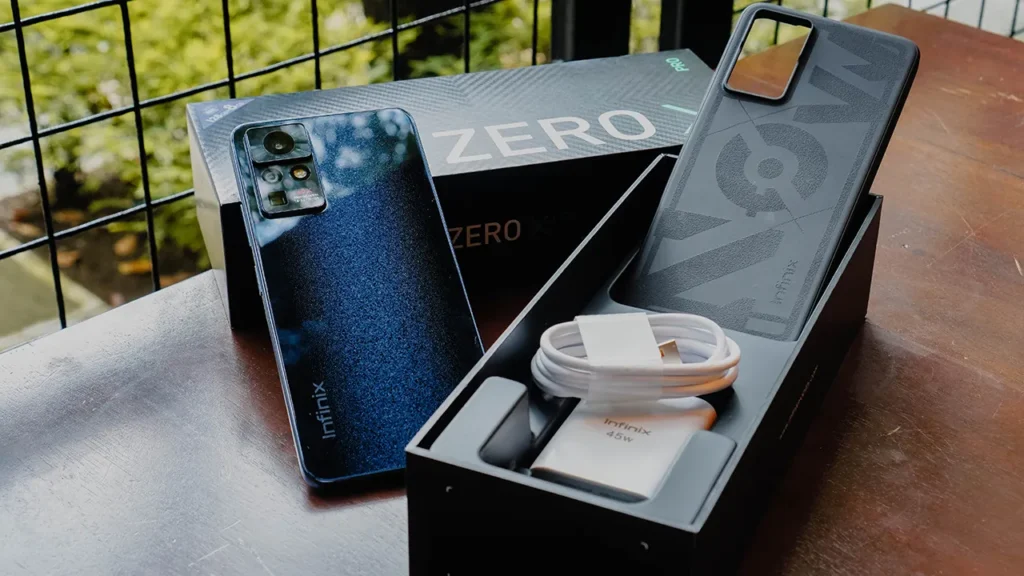
Introduction of Infinix Zero X
The Infinix Zero X is a value-packed mid-range device built around a strong imaging system, a smooth high-refresh display, and long-lasting battery life. For photographers on a budget and users who want a snappy daily experience without flagship pricing, the Zero X delivers excellent return on spend. It excels in camera features, everyday responsiveness, and endurance — though flagships will still win on peak raw CPU horsepower and longer software update guarantees.
Quick specs snapshot
| Feature | What to expect |
| Model | Infinix Zero X |
| Display | ~6.7″ AMOLED, FHD+, 120Hz refresh (varies by region) |
| SoC | Mid-range octa-core (MediaTek / Qualcomm variant depending on market) |
| RAM / Storage | 6GB / 8GB / 12GB RAM options; 128GB / 256GB UFS storage |
| Rear cameras | Triple: 64MP main + 8MP ultra-wide + 8–13MP tele / periscope (model-dependent) |
| Front camera | 16MP–32MP selfie |
| Battery | 4500–5000 mAh, fast charging (33W–68W depending on variant) |
| OS | Android with XOS skin |
| Connectivity | 5G, Dual SIM, Wi-Fi 5/6, Bluetooth 5.x, NFC (market dependent) |
| Extras | Stereo speakers, in-display fingerprint, microSD slot (depends on model) |
Design & build
The Zero X family aims to combine contemporary aesthetics with pragmatic ergonomics. Expect a 6.7-inch footprint that balances screen real estate with single-hand usability for most users. The chassis is typically a mixed-material construction: polycarbonate frames and a glass-like back (or matte plastic that mimics glass) for a lighter feel while keeping costs down. Button placement (power and volume) tends to be reachable with the right-hand thumb on typical grips, and the fingerprint sensor sits under the display for a modern look.
Materials & durability
Higher trims may use glossier finishes or fingerprint-resistant coatings; base models often opt for textured or matte backs to hide smudges. The Zero X line rarely ships with flagship-class IP68 water-and-dust ratings — that’s an area buyers should verify per SKU. If ingress protection is essential, select a retailer that lists the precise IP rating or add a snug case that covers ports.
Weight & balance
The phone typically feels well-balanced in a pocket or hand. Battery capacity contributes to mass; models with 5000 mAh cells will feel noticeably heavier than trimmed 4500 mAh versions. The center of gravity is optimized for prolonged browsing and gaming sessions.
Practical design
- Comfortable one-hand use for a 6.7″ device? Usually yes.
- Are buttons in reachable positions? Yes.
- Balanced weight for long sessions? Mostly yes.
- Official water resistance? Check SKU.
- Included accessories (charger, case)? Varies by market.
Display
The display is among the Zero X’s strongest assets. Most variants ship with AMOLED panels that provide vivid colors, deep blacks, and excellent contrast. A 120Hz refresh rate is common, which makes the UI and animations feel more fluid and responsive — especially noticeable when scrolling social feeds, navigating the OS, and playing compatible games.
What to expect
- Panel: AMOLED or premium LCD in some regions.
- Refresh rate: 120Hz for smooth scrolling.
- Resolution: FHD+ — sharp for text and video.
- Brightness: Adequate for indoor use; peak outdoor legibility varies between panels.
- Color: Punchy with wide gamut support on AMOLED variants.
Why it matters
For both human users and automated vision systems analyzing screenshots, a high-contrast AMOLED improves perceived quality for photo and video content. From an NLP/content perspective, sections about display quality should use clear comparative adjectives (e.g., “contrast,” “color accuracy,” “peak brightness”) so search intent aligns with queries like “Infinix Zero X display review” or “how bright is Zero X screen?”
Simple checklist for display quality
- Colors look natural and punchy?
- Smooth scrolling at 120Hz?
- Bright enough under sunlight?
Camera system
The camera cluster is the marquee capability that attracts many buyers to the Zero X line. This section dissects sensor hardware, computational behavior, and practical shooting tips so you can evaluate sample images properly and make a buying decision.
Camera hardware
- Main sensor: 64MP or larger on many models; often uses pixel-binning to produce cleaner 12–16MP images with better low-light behavior.
- Ultra-wide: 8–13MP — useful for landscapes and group shots, but typically softer than the main sensor.
- Tele / Periscope: 2x–5x optical or hybrid solutions are present on tele-equipped SKUs (particularly Pro models).
- Selfie: 16–32MP front-facing cameras with portrait and AI beautification modes.
Lab-style expectations vs real-world behavior
- Daylight: The main camera produces crisp images with good detail and contrast; color tuning is tuned for pleasing saturation rather than scientific accuracy.
- Ultra-wide: Useful but shows edge softness and less detail; still fine for casual wide scenes.
- Zoom: 2x optical or hybrid zoom gives clean results; higher multipliers (5x–10x) rely on clever software and crop, which produces usable but imperfect results.
- Low-light: Night mode and multi-frame stacking help a lot. Handheld low-light shots can be impressive, but will show noise if you push the ISO or if the light is extremely dim.
- Portraits: AI segmentation is generally good, but fine hair edges can show occasional errors.
Video capabilities
- Max resolution: Many models support up to 4K@30fps; some allow 4K@60fps depending on the SoC and thermal constraints.
- Stabilization: EIS is often present and effective for walking shots. OIS, if included on higher trims, makes gimbal-like stabilization for video and long-exposure stills.
- Slow motion: 1080p@120fps or higher for dramatic clips on compatible chips.
Camera test
- Shoot 1x daylight images and crop 1:1 to examine detail.
- Capture ultra-wide scenes and evaluate edge softness.
- Take portrait shots with tricky hair edges to test segmentation.
- Record low-light handheld and tripod shots to compare noise and detail.
- Run a Zoom ladder: 1x → 2x → 5x → 10x (if supported) to see quality drops.
Performance & gaming
Performance will vary by the exact SoC shipped to your market — some SKUs use MediaTek mid-range chips, others may use Qualcomm equivalents. Expect capable day-to-day performance and solid gaming at medium settings.
Real-world behavior
- App performance & multitasking: With 6–12GB RAM, the phone handles background apps and multitasking well.
- Gaming: Titles like PUBG Mobile, Call of Duty Mobile, and Asphalt will play smoothly; you may need to tweak graphics to maintain a stable high FPS.
- Thermals: Sustained gaming sessions produce heat and some level of throttling as the device protects Internal Components.
Synthetic benchmarks
- CPU tests (e.g., Geekbench): Mid-range single/multi-core scores — perfectly suitable for everyday tasks.
- GPU tests (e.g., 3DMark): Mid-level graphics scores that correspond to medium-high settings in mobile games.
Gaming checklist
- Run a 30-minute gameplay loop at medium-high settings and observe FPS stability.
- Monitor thermal behavior and frame drops — reduce settings if you see sustained dips.
- Use any included Game Mode to disable notifications and prioritize resources.
Tips to improve performance
- Close background processes before long gaming sessions.
- Avoid playing while charging to reduce thermal ramping.
- Use Game Mode or dedicated performance settings to free up CPU/GPU cycles.
- Consider a thin, ventilated case for long tournament sessions.
Battery life & charging
The Zero X series prioritizes longevity. Battery capacity ranges from roughly 4500 mAh to 5000 mAh, depending on SKU, and charging speeds vary widely (33W to 68W in some Pro models).
Typical real-world estimates
- Light use (calls, messaging, social): 1.5–2 days.
- Mixed use (web browsing, streaming, apps): Full day with 7–10 hours screen-on time (SOT) depending on refresh rate and brightness.
- Heavy gaming: 4–6 hours SOT depending on settings and thermal behavior.
Charging behavior
- Fast charging: 33W–68W depending on model; high-watt variants can reach ~50% in 20–30 minutes with the supplied charger.
- Battery care: For longevity, the standard advice applies — avoid repeated 0→100 cycles; keep charge between ~20%–80% for regular health.
Practical charging tips
- Use the official charger and cable for the best speed and safety.
- Avoid intense gaming while charging to reduce thermal stress.
- Turn on battery saver modes at night or during long travel days to stretch runtime.
Software & updates
XOS is the custom Android skin layered over the OS. It introduces features and personalization choices, but also includes a set of preinstalled apps that some users consider bloat.
What to expect
- Feature set: Game mode, gesture navigation, theme store, and some AI-style camera assists.
- Bloatware: A handful of preinstalled apps that can usually be disabled or uninstalled.
- Background management: Aggressive battery optimizations may require you to whitelist apps for consistent background activity (e.g., messaging push).
- Updates: Manufacturer update policies vary; expect security patches and occasional Android version updates depending on region and SKU.
Practical advice
- On first setup, adjust notification and battery optimization settings for critical apps.
- Check Settings → Apps → Special access to ensure important services (email, messaging) are allowed to run in the background.
- For users who prefer a cleaner Android experience, consider a third-party launcher.
Connectivity & extras
Connectivity features are competitive for the class.
- 5G: Supported on many international SKUs — verify band support in your country.
- Wi-Fi: Wi-Fi 5 or 6, depending on the model.
- Bluetooth: Bluetooth 5.x for improved accessory pairing and range.
- NFC: Present on some variants — confirm the SKU if contactless payments matter.
- Speakers: Stereo speaker setup is common and provides better media playback than single-speaker phones.
- Biometrics: In-display fingerprint and face unlock for convenient access.
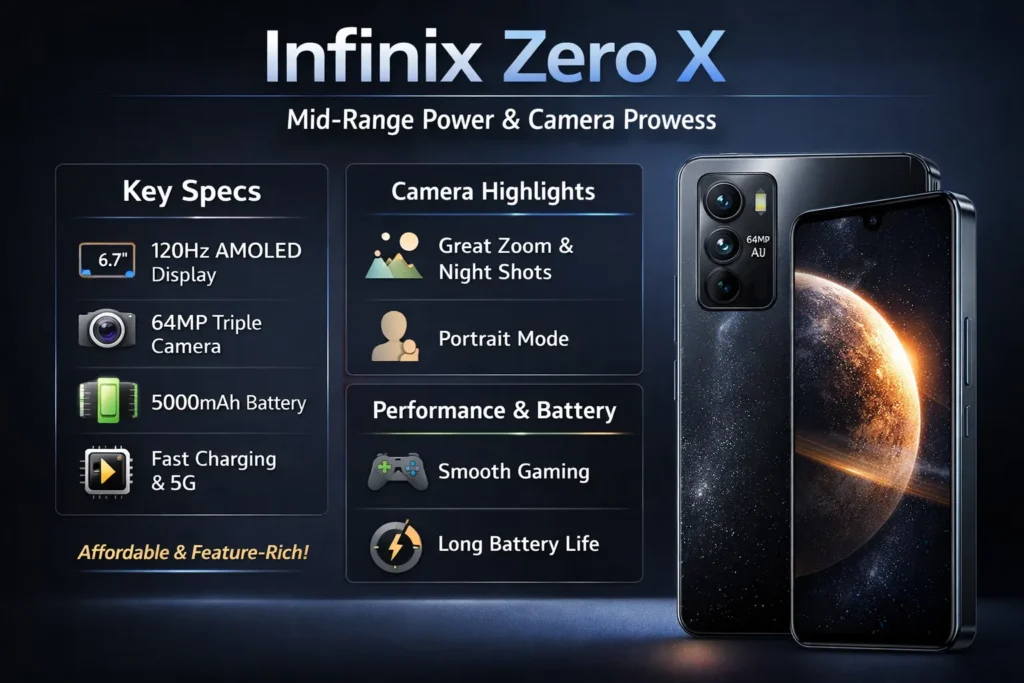
Benchmarks
The Zero X scores solidly within the mid-range cohort. Synthetic benchmarks will show respectable single-core performance and mid-level GPU throughput. Sustained loads reveal expected thermal responses and some throttling to protect components.
What to expect in long runs
- Thermal curve: Temperature rises during extended gaming/benchmarking; sustained performance tapers.
- Throttling behavior: Present but controlled — the phone remains usable under load, though peak frame rates may dip.
- Practical implication: For 1–2 hour gaming sessions, lower graphics by one notch for stability; for short bursts, the phone feels snappy and responsive.
Comparison table
| Model | Screen | Main Cam | Zoom | Battery | Fast Charge | Best for |
| Infinix Zero X | 6.7″ 120Hz | 64MP | 2–5x hybrid | 4500–5000 mAh | 33W–45W | Value camera + battery |
| Infinix Zero X Pro | 6.7″ 120Hz (better panel) | 108MP / larger sensor | 5x optical / periscope | 5000 mAh | 68W | Serious photography & faster charging |
| Rival (mid-range) | 6.5″ 90–120Hz | 64–108MP | 2–3x | 4500 mAh | 33W | Balanced power & brand name |
Who should buy the Infinix Zero X?
Buy it if:
- You want excellent camera features at a mid-range price.
- You need a long battery life for multi-day use.
- You like a smooth 120Hz display for browsing and gaming.
- You want a lot of hardware value for your budget.
Consider another phone if:
- You require the absolute highest CPU performance for pro-level tasks.
- You want top-tier OS support and multi-year major Android updates guaranteed.
- You need full IP68 waterproofing from the factory.
FAQs
A: Yes. It features a strong main sensor, useful telephoto options, and a good night mode. It competes well in its price bracket.
A: Expect a full day of heavy use or 1.5–2 days of light use with typical settings.
A: Most variants do. Always check the SKU and supported bands for your country.
A: Yes — 120Hz on most models, which makes the UI and games feel smoother.
A: Not commonly on base models. Some high-end variants or Pro models may offer more charging features.
Final verdict
The Infinix Zero X is a well-balanced mid-range phone that surpasses its price point in terms of camera capabilities, display quality, and battery longevity. It’s an excellent choice for users who prioritize photography and endurance without the premium cost of flagship devices. If your top priorities are the absolute best camera hardware and the fastest charging, consider stepping up to the Zero X Pro.
