
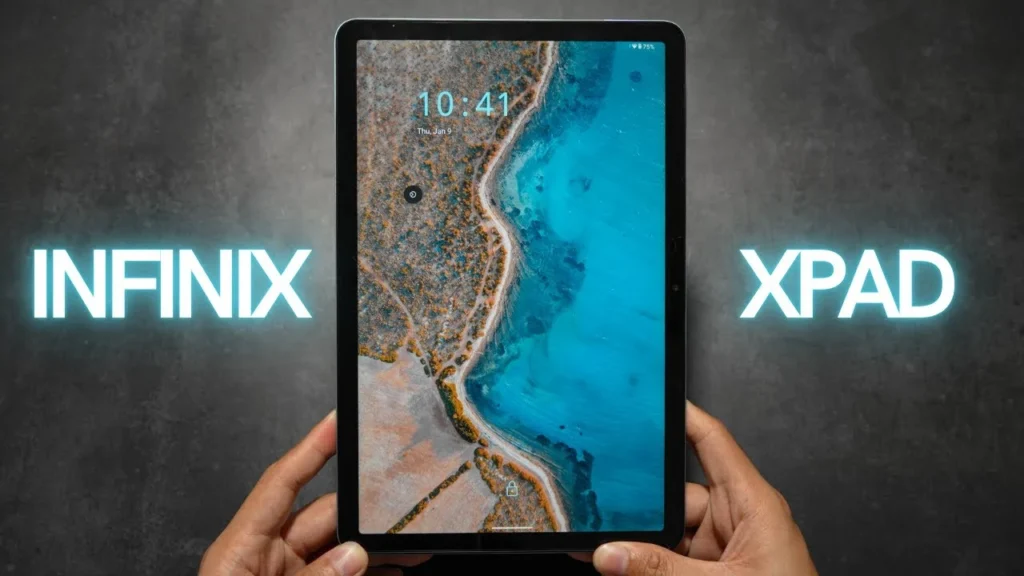
Introduction of Infinix XPAD 8
This guide is written with one clear objective: to help a real buyer decide whether the Infinix XPAD 8 is genuinely worth purchasing in Pakistan, not merely whether it looks good on a spec sheet. A lot of tablet pages can list hardware numbers, but they rarely help you answer the questions that matter in the final buying stage: Is the price justified? Which variant should you choose? Is the LTE model useful enough? Is the 8GB/256GB version really the smarter investment? Is this tablet a practical fit for students, media users, and everyday consumers? Or should you spend your money somewhere else?
That is exactly where it comes in.
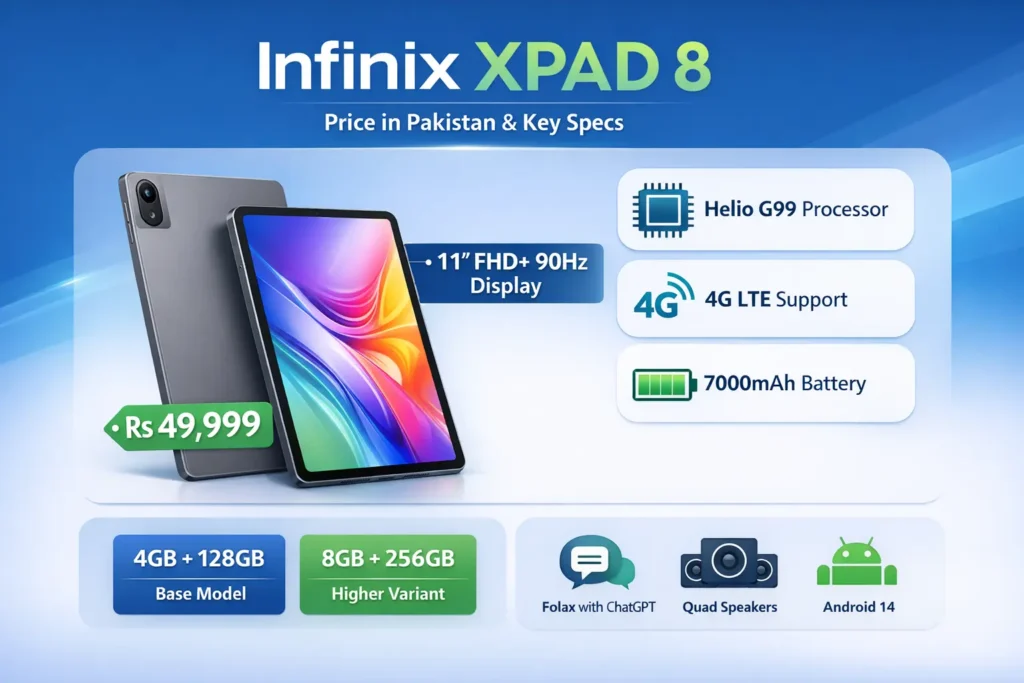
The current Pakistan listing places the Infinix Xpad X1101B at Rs 49,999, with both 128GB/4GB and 256GB/8GB options appearing in the market. Infinix’s official Pakistan page highlights a set of features that are highly relevant to buyers in this segment: an 11-inch 90Hz FHD+ display, Helio G99, 4G LTE, Folax Voice Assistant with ChatGPT, 4-speaker stereo sound, and Android 14 with security updates.
That combination matters because the majority of competing pages stop at surface-level specifications. They tell you what the tablet has, but they do not help you decide whether those specifications translate into actual value. This guide goes deeper. It focuses on the practical purchase logic behind the Infinix XPAD 8 price in Pakistan and addresses the exact buyer questions that most pages ignore: Which version is the best deal? Is the 4GB variant too limited? Is the 8GB model worth the extra money? Is the display strong enough for study and entertainment? Is the battery good enough for long usage? Who should buy it, and who should skip it?
What is the Infinix XPAD 8?
The Infinix XPAD 8 is a value-oriented tablet designed for everyday life. It is not built to compete with premium tablets in the flagship class. Instead, it is designed for users who want a large display, dependable performance, acceptable camera hardware, long battery life, and mobile connectivity without paying the premium prices that usually come with high-end tablets.
According to the official Pakistan page, the tablet offers an 11-inch 90Hz bright display, Helio G99 chipset, 4G LTE support, Folax Voice Assistant with ChatGPT, four speakers, and Android 14. That makes it a very sensible fit for students, casual entertainment, digital reading, light multitasking, note-taking, online classes, and basic productivity.
The simplest way to define it is this: the XPAD 8 is a practical tablet, not a luxury tablet. It is trying to deliver the most useful features for real-world users at an approachable price point. That positioning is important because it changes the entire way you should evaluate it.
If you expect a premium metal tablet with flagship performance and top-class cameras, this is not the device for you. But if you want a balanced, everyday tablet that does the important things well, the XPAD 8 begins to make a lot of sense. In value-driven categories, usefulness matters far more than prestige.
Infinix XPAD 8 price in Pakistan
The current Pakistan listing shows the Infinix Xpad X1101B at Rs 49,999, while a regular price is also shown at Rs 52,000. The same listing indicates two storage and memory configurations: 128GB / 4GB RAM and 256GB / 8GB RAM.
Price and variant breakdown
| Variant | RAM / Storage | Best for | Buying note |
| Base variant | 4GB / 128GB | Light users, note-taking, YouTube, classes | Buy only if the price gap is meaningful |
| Higher variant | 8GB / 256GB | Students, multitasking, more apps, more downloads | Best value for most buyers |
One important detail: the live Pakistan listings do not always present separate public prices for each variant in a neat, isolated format. However, they do make the existence of the variants clear enough to guide a decision. That alone is useful because tablet buyers often make the mistake of looking only at the headline price, when in reality the RAM and storage configuration can change the long-term value dramatically.
For most buyers, the 8GB/256GB variant is the stronger choice. The reason is simple and highly practical: tablets tend to remain in use for years, and both RAM and storage age more slowly when the device begins with a larger amount. More RAM helps with smoother multitasking, app switching, and future app demands. More storage helps with offline lectures, PDFs, app installations, downloaded videos, notes, presentations, and cached files. In other words, the larger variant buys you more comfort later.
My buying takes on the price.
At around Rs 49,999, the XPAD 8 sits in a serious value segment. It is not an entry-level tablet that you buy only because it is cheap. It is also not a premium tablet where you expect luxury materials and top-tier performance. Instead, it occupies that middle-value zone where buyers expect a device that can reliably support study, entertainment, communication, and general productivity.
That price becomes easier to justify when you consider the combination of features: LTE support, a large 11-inch display, a 90Hz panel, a sizable battery, current software, and a recognized brand presence. It becomes less attractive only if your main goal is to buy the cheapest possible tablet for basic streaming with no concern for future flexibility.
So the actual question is not “Is Rs 49,999 expensive?” The better question is “What kind of user gets enough value from this price?” That is where the buying judgment becomes more intelligent.
Infinix XPAD 8 key specifications
Here is a clean, practical specification snapshot of the Infinix XPAD 8 / Xpad X1101B, based on the official and retail information currently available:
| Spec | Details |
| Model | Infinix Xpad X1101B |
| Display | 11-inch, 90Hz, FHD+ |
| Chipset | Helio G99 |
| Connectivity | 4G LTE |
| RAM / Storage | 4GB/128GB, 8GB/256GB |
| Battery | 7000mAh |
| Charging | 18W |
| Rear Camera | 8MP |
| Front Camera | 8MP |
| Software | Android 14, XOS 14 |
| Speakers | 4-speaker stereo sound |
| Assistant | Folax Voice Assistant with ChatGPT |
| Body | Approximately 257 x 168.6 x 7.6 mm, 496g |
These specifications create a very clear product identity. The XPAD 8 is trying to be an all-rounder tablet for everyday usage. It is not pretending to be a creative workstation. It is not marketed as a gaming monster. It is not trying to win camera competitions. Instead, it is focused on practical daily utility.
That positioning is important because it helps you judge the tablet on what it is designed to do, not what you wish it could do. A lot of bad purchase decisions happen when people force the wrong expectations onto the right product category.
Design and display
The display is one of the most compelling features of the XPAD 8. Infinix highlights an 11-inch 90Hz FHD+ bright display, and that immediately places the tablet in a more attractive category than basic low-refresh budget tablets. For everyday consumption, the screen is the center of the experience. It is where you watch, read, type, learn, browse, and split tasks.
An 11-inch panel is a sweet spot for many users. It is large enough to feel genuinely comfortable, yet not so large that the tablet becomes inconvenient to carry. For students, that size is especially useful because it creates enough visual space for online lectures, PDFs, notes, and split-screen viewing. For entertainment users, it feels more immersive than a small display and makes YouTube, Netflix, and web content more enjoyable.
The 90Hz refresh rate is another meaningful advantage. It may not sound dramatic on a spec sheet, but in actual daily use, it improves the sense of smoothness during scrolling, app navigation, and page movement. When you are reading documents, switching between apps, or browsing websites, a higher refresh rate makes the tablet feel more responsive and current. That matters a great deal in a value segment, because a small fluidity upgrade can make a device feel more premium than it actually is.
The retail listing also suggests dimensions of about 257 x 168.6 x 7.6 mm and a weight of 496g, which indicates a tablet that is relatively slim and manageable. It is not a featherweight device, but it is reasonable for a tablet with an 11-inch screen and a large battery. That balance is important if you plan to hold it for long reading sessions, carry it in a backpack, or use it as a second screen around the house.
Why the display is a selling point
If your primary use case is studying, streaming, browsing, or reading, then the display is one of the biggest reasons to consider the XPAD 8. The visual comfort of a larger screen often matters more than people initially realize. A good display makes split-screen learning easier, helps with productivity, and simply reduces friction in everyday usage. In this tablet’s case, the display is not just a technical feature; it is one of the main reasons the device has market relevance.
Performance and gaming
The XPAD 8 is powered by the Helio G99 chipset, with Mali-G57 graphics referenced in the retail spec information. That places it in the mid-range performance bracket. It is not a top-end processor, but it is a capable and sensible choice for a value tablet.
For general use, the chipset should be comfortable. That means the tablet should handle browsing, study apps, document reading, social media, streaming, note-taking, messaging, and light multitasking without strain. For everyday users, that is exactly what matters most. A tablet does not need to be a benchmark winner if it can remain smooth in daily routines.
For gaming, expectations should remain realistic. The XPAD 8 is suitable for light and moderate mobile gaming, but it is not the right choice for someone who wants a tablet built around heavy gaming performance. Casual titles should be fine. Many mainstream games should run adequately at reasonable settings. But if you are looking for sustained high-frame-rate gaming or graphically demanding flagship-level experiences, this is not the product class you should target.
That is not a flaw. It is a category decision.
Is the Helio G99 good enough?
For the intended audience, yes. The Helio G99 is a strong enough chip for a value tablet because it balances performance, efficiency, and affordability. It is practical rather than extravagant. That makes it ideal for people who care more about steady everyday usability than raw speed records.
The right question is not whether it can outperform every other chipset on the market. The right question is whether it offers enough for study, entertainment, browsing, communication, and multitasking at the asking price. In that sense, the answer is yes.
Best use cases for performance
The XPAD 8 makes the most sense for users who plan to use it for:
- online classes,
- YouTube and streaming,
- note-taking,
- reading PDFs,
- browsing,
- light office tasks,
- split-screen multitasking,
- cloud-based productivity.
That is the tablet’s comfort zone. It is a device built around utility and consistency, not around bragging rights
Battery life and charging
Battery life is one of the strongest reasons to look at this tablet seriously. The live specifications show a 7000mAh battery paired with 18W charging. In tablet terms, that battery capacity is substantial and well aligned with long daily sessions.
A tablet is often used differently from a phone. People expect it to survive longer viewing periods, lecture sessions, reading blocks, travel use, and general content consumption. The 7000mAh capacity gives the XPAD 8 a good chance of doing exactly that. It supports the feeling of a “daily companion device,” rather than a gadget that always needs to be plugged in.
Why the battery matters
Battery capacity is not just a number. In real life, it affects how free you feel when using the tablet. A larger battery means fewer interruptions, less anxiety, and better usefulness throughout the day. For students, especially, this matters a lot. Nobody wants a tablet that dies in the middle of class or requires constant charging between lectures.
For media users, too, the battery is valuable. Long YouTube sessions, reading marathons, and casual browsing can quickly eat into battery reserves on smaller devices. A 7000mAh unit helps reduce that problem.
The honest part about charging
The trade-off is charging speed. 18W charging is not especially fast by modern standards. That means the tablet may last well, but it may not refill in a hurry. This is a common compromise in value tablets: battery endurance is emphasized more than ultra-fast recharging.
That said, the balance still makes sense. For most buyers in this category, a dependable battery is more valuable than a rapid top-up, especially when the tablet is used primarily at home, in school, or in casual professional settings.
Cameras and video calling
The camera hardware is functional, not exceptional. The live spec information points to an 8MP rear camera and an 8MP front camera. That is enough for standard tablet usage, but it should not be treated as a photography-focused setup.
The correct expectation is simple: the cameras are there for utility. They are good enough for video calls, online classes, document scanning, basic snapshots, and everyday communication. They are not the main feature that should decide your purchase.
What the cameras are good for
The camera setup is suitable for:
- Zoom classes,
- Google Meet calls,
- WhatsApp video calls,
- document capture,
- scanning notes,
- quick front-facing communication.
That is exactly the role tablet cameras usually play. Tablets are not typically bought for camera excellence, and the XPAD 8 follows that normal pattern.
What the cameras are not good for
Do not buy this tablet expecting a phone-level imaging experience. It is not designed for serious photography, advanced content creation, or professional visual work. If camera quality is a central priority, this device should not be your first choice.
That is a practical conclusion based on the 8MP/8MP setup. The cameras are serviceable, but they are not a flagship attraction.
Software, Folax, and Android 14
The software story is one of the more modern aspects of the XPAD 8. Infinix’s Pakistan page highlights Android 14, mentions 2-year security patch updates, and also promotes Folax Voice Assistant with ChatGPT, along with features like Multi-Device Collaboration / Click to Connect.
This is meaningful because software often decides how fresh, useful, and future-friendly a tablet feels. Hardware can look impressive on paper, but a current, well-supported software base is what helps the device remain pleasant over time.
Why this matters
Android 14 gives the XPAD 8 a current starting point. That means the tablet begins from a more modern software foundation than older Android versions, which is useful for app compatibility, interface familiarity, and long-term usability. For buyers who plan to keep their tablet for a while, this matters more than it might at first glance.
Security updates are also a reassuring detail. They do not make headlines as often as screens or processors, but they matter for the stability and trustworthiness of the device.
Is Android 14 enough?
Yes. For a value tablet, Android 14 is a strong and current software base. It gives the device a contemporary feel and helps it remain relevant for regular apps, normal usage patterns, and longer-term ownership.
8GB/256GB vs 4GB/128GB: which one should you choose?
This is one of the most important decision points in the entire buying process. The Pakistan listing clearly shows both 128GB/4GB and 256GB/8GB versions. If the price difference is not too large, the 8GB/256GB variant is the smarter and safer choice for most people.
Choose 4GB/128GB if:
You want the tablet for light browsing, basic media consumption, note-taking, and general casual use. It can work well enough for a budget-conscious buyer whose demands are modest. However, it leaves less room for future growth and heavier multitasking.
Choose 8GB/256GB if:
You want a smoother long-term experience, better multitasking, more app storage, more offline files, more flexibility, and less worry about space running out too quickly. This version is the more balanced option for students, working users, and families.
My blunt verdict
For most buyers, the 8GB/256GB model is the best-value version. It aligns better with the idea of buying one tablet and using it for several years. Tablets are often filled with downloads, PDFs, videos, cached files, class materials, and apps far faster than users expect. Extra storage saves frustration later. Extra RAM makes the experience feel more comfortable sooner.
Who should buy the Infinix XPAD 8?
This tablet is most suitable for people who need a large-screen device with balanced features and reasonable pricing. It is not trying to be an elite tablet. It is trying to be useful. That distinction matters.
Best use cases for students
Students are among the strongest target audiences for the XPAD 8. The 11-inch display is comfortable for PDFs, lecture notes, online classes, assignment reading, and split-screen use. LTE support is useful for moving between places, and the battery helps sustain long days of learning. For academic tasks, this is one of the clearest value arguments in favor of the device.
Best use cases for media and browsing
If your tablet usage revolves around YouTube, Netflix, reading websites, social media, and general entertainment, the XPAD 8 is well-positioned. The display size, 90Hz refresh rate, and four-speaker stereo sound combine to create a pleasant consumption experience for its price class.
Best use cases for light productivity
If you need a secondary device for email, documents, cloud notes, chat apps, file management, and light multitasking, this tablet fits that role nicely. It is not a laptop replacement, but it can be a highly convenient companion device. The software and assistant features also support that broader productivity identity.
Who should skip it?
The XPAD 8 is a good value tablet, but not everyone should buy it. If your expectations are rooted in premium performance or specialist use, it may disappoint you.
You should probably skip it if you want:
- serious gaming power,
- premium camera quality,
- a flagship-style tablet experience,
- very fast charging,
- advanced creative workloads,
- a device that feels premium in every material and performance dimension.
Pros and cons of the Infinix XPAD 8
Pros
- The 11-inch 90Hz FHD+ display is excellent for studying and media.
- Helio G99 is reliable for daily use and light multitasking.
- 4G LTE adds flexibility and portability.
- The 7000mAh battery supports long usage sessions.
- Android 14 makes the tablet feel current.
- 4-speaker stereo sound improves entertainment value.
- Folax with ChatGPT gives it a modern software appeal.
Cons
- 18W charging is only average.
- 8MP cameras are basic.
- It is not a premium gaming tablet.
- The base variant may feel restrictive for heavy users.
- It does not aim at flagship-level performance or materials.
Should you buy the Infinix XPAD 8?
The honest answer is yes, but only if your needs match the product’s strengths.
The XPAD 8 makes the most sense when you want a tablet for study, browsing, streaming, reading, communication, and light productivity. The value proposition becomes even more convincing when you consider the combination of a large display, LTE support, a big battery, current software, and a price that remains far more reachable than premium tablets.
At Rs 49,999, the tablet is not cheap in an absolute sense, but it is reasonably priced for what it offers. Its value is strongest when you judge it as a practical everyday tablet rather than a luxury or gaming device.
FAQs
Yes. The 11-inch display, 7000mAh battery, 4G LTE support, and 4-speaker sound make it a strong choice for classes, notes, PDFs, and video lessons. For students who want a practical and flexible tablet, it fits very well.
Yes. Infinix’s Pakistan page highlights Helio G99 with 4G LTE connectivity, and the retail specification listing also shows 4G/LTE support. That makes it more versatile than Wi-Fi-only tablets.
The 8GB/256GB model is the better overall option for most buyers because it provides more storage headroom and better multitasking comfort. The 4GB/128GB version is only a reasonable choice if the price difference is significant and your usage is light.
It is good for light to moderate gaming, but it is not a flagship gaming processor. The chipset is a practical mid-range choice, so performance expectations should stay realistic.
The tablet has a 7000mAh battery, which suggests strong endurance for long daily use. Actual battery life depends on brightness, LTE usage, gaming, streaming, and overall screen time, but the battery size is clearly one of the tablet’s strengths.
Conclusion
If you want a tablet for students, entertainment, browsing, notes, and everyday utility, the Infinix XPAD 8 price in Pakistan makes sense. If you have the choice between the two variants, the 8GB/256GB model is the better recommendation for most buyers. If your priority is high-end gaming, superior cameras, or flagship-grade refinement, this is not the right product class for you. That is the blunt buying verdict missing from many competing pages: the XPAD 8 is a strong value tablet for the right audience, but it is not a universal solution. For the right buyer, however, it can be an excellent and practical purchase.
