
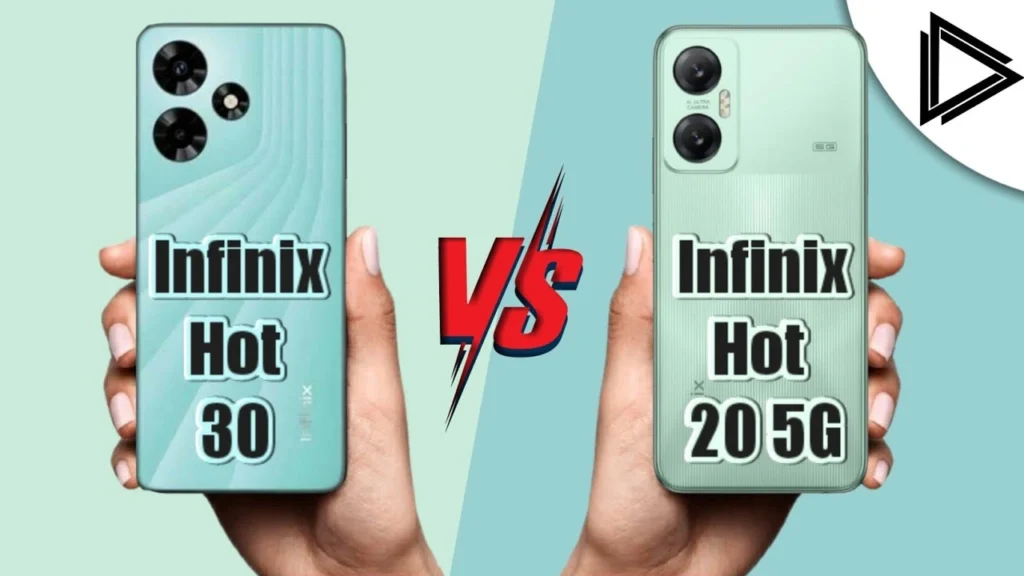
Introduction of Infinix Hot 20 vs Hot 30
When people search for Infinix Hot 20 vs Hot 30, they are rarely looking for a dry spec sheet. They are usually in the commercial-intent stage of the journey: they want a simple, practical answer that helps them decide which phone gives better value in Pakistan, which one feels better in day-to-day use, and which one is actually worth spending money on right now. Based on the current Pakistan listings and the core hardware gap between the two models, Infinix Hot 30 is the stronger buy for most people. It is listed as available in Pakistan at Rs. 34,999 on WhatMobile, while PriceOye currently shows Rs. 30,099 on its product page; Hot 20, by contrast, is marked discontinued on WhatMobile in Pakistan.
That verdict is not based on brand loyalty or marketing language. It comes from the actual user experience stack: Hot 30 gives you a sharper 1080 x 2408 display, the Helio G88 chipset, 8GB RAM plus extended RAM, and 33W fast charging, while Hot 20 sits behind with a 720 x 1640 display, Helio G85, 6GB RAM, and 18W charging. Those differences matter in the places buyers feel every single day: scrolling, reading, watching videos, switching apps, charging between classes or work shifts, and opening games without the phone feeling cramped.
Which one should you buy?
Buy the Infinix Hot 30 if your goal is a better all-around phone for Pakistan in 2026. It has the more refined display, the stronger processor, the larger memory cushion, and the faster charging setup, which together make it the more balanced real-world option. Buy Infinix Hot 20 only if the budget is extremely tight and you find it at a very low used price, because its hardware is still serviceable for basic tasks, but it is no longer the smarter, fresh-purchase choice. Hot 20 is now a legacy option in the local market, while Hot 30 remains the more current and easier-to-justify pick.
The cleanest way to frame it is this: Hot 30 is the value-forward choice, while Hot 20 is the fallback bargain choice. If the buyer’s intent is “I need a phone that feels modern enough for daily use without wasting money,” the Hot 30 fits that intent more naturally. If the buyer’s intent is “I only need the cheapest practical option for calls, WhatsApp, browsing, and light media,” Hot 20 can still serve, but only as a limited-budget compromise. That is the core decision layer this comparison should answer.
Price
Price is not a side note in this comparison; it is the first filter Pakistani buyers use. Right now, WhatMobile lists the Infinix Hot 30 at Rs. 34,999 and labels it an available smartphone, while PriceOye shows Rs. 30,099 on the Hot 30 page. That spread is not unusual in Pakistan because retail prices can vary by seller, warranty status, promotions, and stock movement. Meanwhile, WhatMobile marks Infinix Hot 20 as discontinued in Pakistan, which means it should be treated as an old-stock or used-market opportunity rather than a standard fresh retail choice.
At a glance
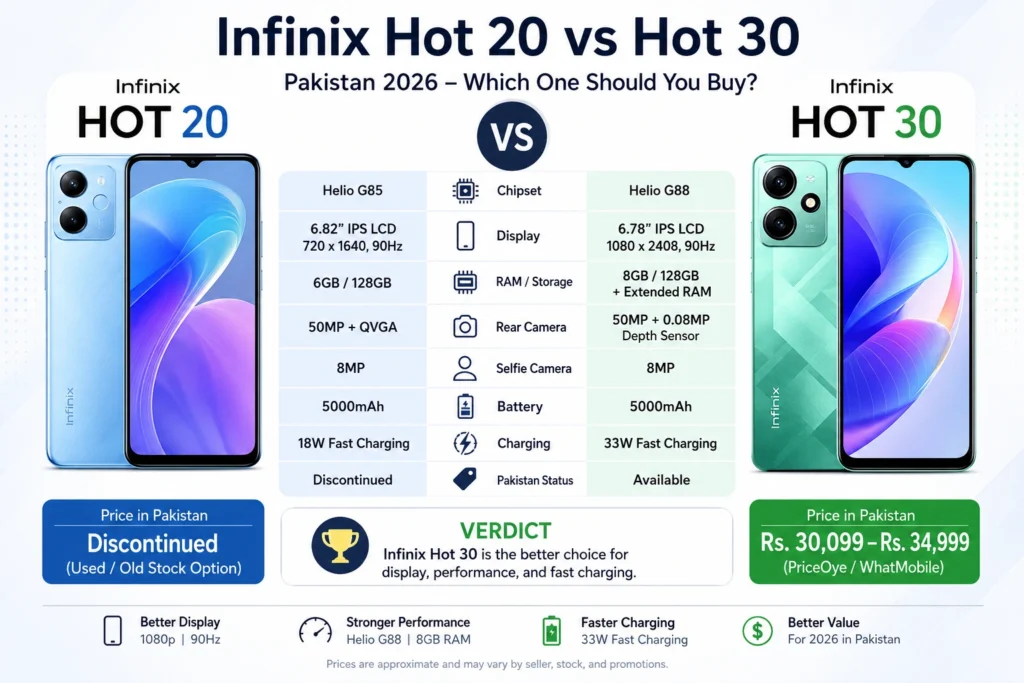
Here is the short version of the hardware gap, written in buyer language rather than database language. Hot 20 uses the Helio G85, a 6.82-inch IPS LCD, 720 x 1640 resolution, 90Hz refresh rate, 6GB RAM, 128GB storage, a 50MP main camera, an 8MP selfie camera, a 5000mAh battery, and 18W charging. Hot 30 moves up to the Helio G88, a 6.78-inch IPS LCD, 1080 x 2408 resolution, 90Hz refresh rate, 8GB RAM plus extended RAM, 128GB storage, a 50MP main camera with a 0.08MP depth lens, an 8MP selfie camera, a 5000mAh battery, and 33W charging.
Full comparison snapshot
| Feature | Infinix Hot 20 | Infinix Hot 30 | Better pick |
| Chipset | Helio G85 | Helio G88 | Hot 30 |
| Display size | 6.82 inches | 6.78 inches | Tie on size; Hot 30 on quality |
| Resolution | 720 x 1640 | 1080 x 2408 | Hot 30 |
| Refresh rate | 90Hz | 90Hz | Tie |
| RAM/storage | 6GB / 128GB | 8GB / 128GB + extended RAM | Hot 30 |
| Main camera | 50MP + QVGA | 50MP + 0.08MP depth | Hot 30 for the cleaner package |
| Selfie camera | 8MP | 8MP | Tie |
| Battery | 5000mAh | 5000mAh | Tie |
| Charging | 18W | 33W | Hot 30 |
| Pakistan status | Discontinued | Available listing | Hot 30 |
The table makes the decision plain: Hot 30 wins the parts of the comparison that affect actual satisfaction. Hot 20 only looks competitive if someone focuses narrowly on screen size or tries to force a low-budget angle. Once you judge the phones by daily comfort and 2026 relevance, Hot 30 pulls ahead very clearly. That is an inference based on the combined effect of the live listing status and the upgraded hardware.
Display comparison
The display is where the comparison becomes easy to understand, even for non-technical buyers. Infinix Hot 20 has a 6.82-inch IPS LCD with 720 x 1640 pixels and a 90Hz refresh rate. Infinix Hot 30 has a slightly smaller 6.78-inch IPS LCD, but it raises the resolution to 1080 x 2408 pixels, keeps the 90Hz refresh rate, and adds brightness figures that are more impressive for the class, with 500 nits typical and 600 nits peak listed on WhatMobile.
In practical terms, Hot 30 is the phone that feels cleaner to the eye. Text looks tighter, icons look more defined, and videos feel less soft. Hot 20 is still usable, and the larger panel can help people who simply like a bigger screen footprint, but size alone does not cancel out the lower pixel density. In other words, Hot 20 gives you more physical canvas, while Hot 30 gives you better visual clarity. For most users, clarity wins.
This difference matters especially for people who spend time on YouTube, TikTok, Facebook Reels, WhatsApp, browsing news sites, online classes, and PDF reading. A sharper screen reduces the feeling of strain and makes the device feel less budget-heavy. That is why Hot 30 is the better choice for daily consumption. Hot 20 can still work for light viewing, but it does not deliver the same polished feel.
Performance and gaming
The performance story is also straightforward. Hot 20 uses the MediaTek Helio G85 (12nm), while Hot 30 uses the MediaTek Helio G88 (12nm). Both are budget-friendly chipsets, but the G88 is the stronger and newer piece of silicon in this matchup. Hot 20 is paired with 6GB RAM on WhatMobile, while Hot 30 comes with 8GB RAM plus 8GB extended RAM, which gives it more breathing room for multitasking.
For gaming, the safest mental model is this: Hot 20 is acceptable for light games, while Hot 30 is better for light-to-moderate gaming and longer sessions. Neither phone is a flagship gaming machine, and neither should be marketed that way, but Hot 30 is simply more comfortable when the workload becomes a bit heavier. The sharper display also helps games look cleaner, which improves the perceived quality even if the frame rates are not dramatically different in casual titles. That is why Hot 30 is the more future-proof gaming recommendation.
In everyday speed, the difference becomes obvious in small moments rather than benchmark bragging rights. Hot 30 should feel more confident when launching apps, returning to previous screens, and juggling tasks. Hot 20 is fine for simple routines, but it is the older, more modest performer. For buyers who care about friction reduction and smoother handling, Hot 30 is the more rational pick.
Camera comparison
Neither of these phones is built to compete with camera-first devices. That Expectation needs to stay realistic. Even so, Hot 30 carries a more refined camera arrangement on paper: a 50MP main camera paired with a 0.08MP depth sensor. Hot 20 also offers a 50MP main camera, but it uses a QVGA secondary lens. On the front, both phones provide an 8MP selfie camera.
In simple buyer language, the camera difference is not about megapixel obsession. It is about how the whole imaging stack feels in ordinary use. Hot 30 is the fresher package, so it is the better bet for daylight shots, social media photos, and casual portrait-style snaps. Hot 20 can still produce usable pictures, but it is now the older and less attractive option in a comparison where the newer model is already stronger in several other categories.
For low-light photography, neither model is a miracle worker. These are budget phones, and budget phones usually need realistic expectations after sunset or indoors. The smarter content angle is not “which one is a camera king,” because neither is. The smarter angle is “which one gives the safer everyday image experience for the money.” On that metric, Hot 30 remains the more balanced choice.
Battery and charging
This part of the comparison is more subtle on paper but more important in real life. Both phones use a 5000mAh battery, so the raw battery capacity is equal. But the charging difference is substantial. Hot 20 supports 18W fast charging, while Hot 30 supports 33W fast charging. That is a meaningful upgrade because it reduces the amount of time the phone has to spend plugged in.
For a student, worker, rider, shopkeeper, or casual user who charges in short bursts, that difference matters a lot. A battery that charges faster changes the rhythm of the day. It makes a phone less annoying, especially when the user forgot to charge overnight or needs a quick top-up before leaving home. Hot 20 still offers decent battery size, but Hot 30 is the better fit for people who value charging convenience.
So the honest verdict is simple: battery life is roughly similar, but charging comfort is clearly better on Hot 30. In buyer terms, that means Hot 30 is the more practical choice even though the battery number is the same on paper. This is one of those cases where a spec upgrade looks small until you live with the phone. Then it becomes obvious very quickly.
Storage and RAM
Hot 20 comes with 128GB storage and 6GB RAM on the cited Pakistan listing, while Hot 30 comes with 128GB storage and 8GB RAM, plus 8GB extended RAM support on WhatMobile. That extra memory headroom is useful for people who keep many apps open, switch between social apps and browsers often, or leave background tasks running.
This is where the article should move from specification language into user language. More RAM does not magically turn a budget phone into a premium phone, but it does make the device feel less restricted. It can reduce the sensation of lag in routine work and help the phone stay more responsive over time. Hot 20 is still fine for light users, but if the buyer’s behavior includes multitasking, media consumption, and frequent app switching, Hot 30 is the better fit.
Design and build
Both phones are clearly part of Infinix’s budget-friendly Hot family. Neither one is trying to be a luxury object. Hot 20 is listed with Android 12 / XOS 12, dimensions of 170.7 x 77.4 x 8.3 mm, and a side-mounted fingerprint sensor. Hot 30 is listed with Android 13 / XOS 12.6, dimensions of 168.7 x 76.6 x 8.4 mm, and also keeps the practical, everyday-friendly shape that budget buyers expect.
The design discussion is not the main event here, but it still has SEO and conversion value because users often want reassurance that the phone will feel decent in hand. The honest answer is that both are sensible budget devices, but Hot 30 feels like the newer, more polished generation. Hot 20 is the older body style that did its job well at launch, yet now sits behind the more complete package of the newer model.
Different types of users
For students
Hot 30 is the better student phone. Its sharper display makes reading notes, watching lectures, and browsing course materials more comfortable. The faster charging also helps when the phone is used heavily throughout the day. Hot 20 can still work for a student on a strict budget, but Hot 30 is the more sustainable daily companion.
For gaming
Hot 30 is the safer gaming pick. The Helio G88 and higher RAM give it more room to breathe when gaming sessions become longer or slightly heavier. Hot 20 can manage light games, but the newer model is the smarter choice if even casual gaming matters.
Watching videos
Hot 30 wins clearly. The jump from 720 x 1640 to 1080 x 2408 is the kind of upgrade you notice immediately in YouTube, reels, and general video viewing. Hot 20 has the larger screen footprint, but Hot 30 has the more satisfying visual output.
Basic calling and WhatsApp
Both phones can handle basic communication, but Hot 20 only makes sense here when the price is very low. Since it is discontinued in Pakistan, the cleaner recommendation is still Hot 30 unless the buyer is shopping in a very narrow used-phone budget band.
Long-term use
Hot 30 is the better long-term buy. It is the current listing; it has the stronger display, the better chipset, the larger memory cushion, and the faster charging system. Hot 20 is older, discontinued, and more likely to feel dated sooner. That is the practical reason Hot 30 is the smarter future-facing choice.
Pros and cons
Infinix Hot 20 pros
It still offers a big 6.82-inch screen, 90Hz refresh rate, a 5000mAh battery, a 50MP main camera, and a practical side-mounted fingerprint sensor. For someone who only needs a basic, roomy phone, those features are still usable.
Cons: Infinix Hot 20
The biggest drawbacks are that it is discontinued in Pakistan, it uses the lower 720 x 1640 resolution, it has the older Helio G85, it comes with 6GB RAM, and it charges at only 18W. Those are not catastrophic flaws, but they do make it a weaker value in 2026.
Infinix Hot 30 pros
Hot 30 brings a much sharper 1080 x 2408 display, 90Hz refresh rate, the Helio G88 chipset, 8GB RAM plus extended RAM, 33W charging, and a current Pakistan listing. Those advantages create a more complete daily-use package.
Cons: Infinix Hot 30
It is still a budget phone, so it is not a flagship competitor, and the camera is good for its class rather than exceptional. Also, price differences across sellers mean that shoppers still need to compare stores before buying. Even so, these are soft drawbacks compared with the stronger upside it has over Hot 20.
Best choice by budget
Buy Hot 20 only if:
You find it much cheaper than Hot 30, and your use is limited to calls, WhatsApp, browsing, video, and very light photography. Even then, this only makes sense if you are comfortable buying used or leftover stock, because the phone is now discontinued in Pakistan.
Buy Hot 30 if:
You want the strongest practical value in this comparison: a cleaner display, better speed, more memory, and faster charging. In a 2026 Pakistan buying context, Hot 30 is the more convincing purchase for the majority of budget-conscious buyers. That conclusion follows directly from the live listing status and the hardware advantage.
FAQs
Infinix Hot 30 is better overall because it has a sharper 1080 x 2408 display, the Helio G88 chipset, 8GB RAM, and 33W fast charging. Hot 20 is older, discontinued in Pakistan, and weaker in display quality and charging speed.
Yes, for most buyers, it is worth it. The upgrade is not a small cosmetic change; it affects the screen, performance, multitasking, and charging convenience. That makes the higher price easier to justify in daily use.
Only in a limited way. Since it is discontinued in Pakistan, it makes sense mainly as a used or very low-priced option for basic needs. For a fresh purchase, Hot 30 is the smarter choice.
Hot 30 is better for gaming because it uses the Helio G88 chipset and comes with more RAM. Hot 20 can handle light games, but it is not the stronger option.
Hot 30 has the better display. Both phones offer 90Hz, but Hot 30 uses 1080 x 2408 resolution while Hot 20 uses 720 x 1640, so Hot 30 looks much sharper.
Final verdict
If you want the shortest honest answer, it is this: Infinix Hot 30 is the better phone for almost everyone in 2026. It has a stronger display, better chipset, more RAM, and faster charging, and it is still meaningfully present in the market. Infinix Hot 20 only makes sense if you find a very cheap used unit and your needs are basic. That is the fairest, most practical conclusion from the current evidence.
