
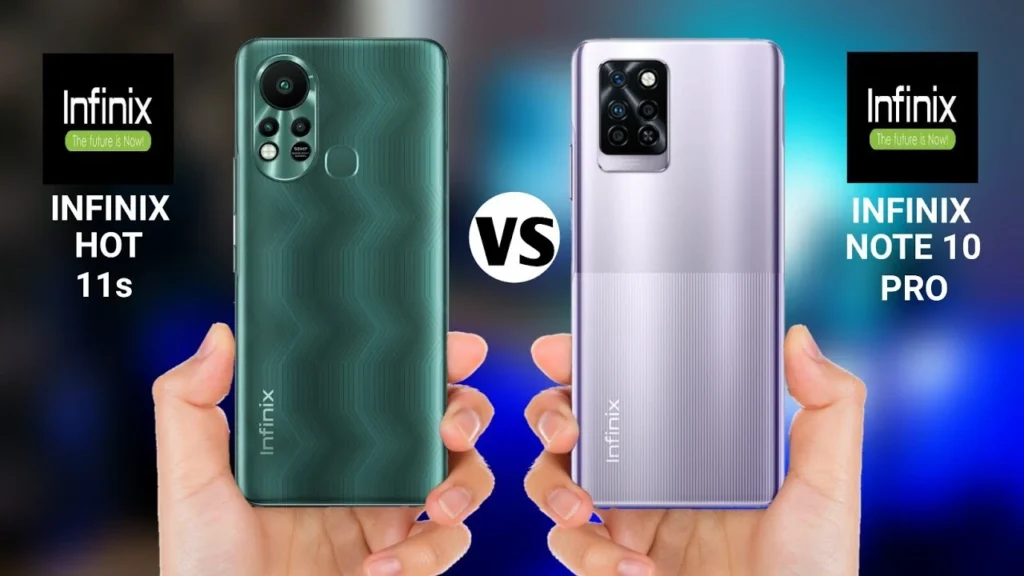
Infinix Note 10 Pro NFC vs Note 11S
If you are comparing the Infinix Note 10 Pro NFC vs Note 11S, the smartest way to judge them is not by looking at isolated numbers on a spec sheet. The real question is simpler: which phone matches your daily behavior, your buying intent, and the features you will actually use every single day?
That is where this comparison becomes more meaningful.
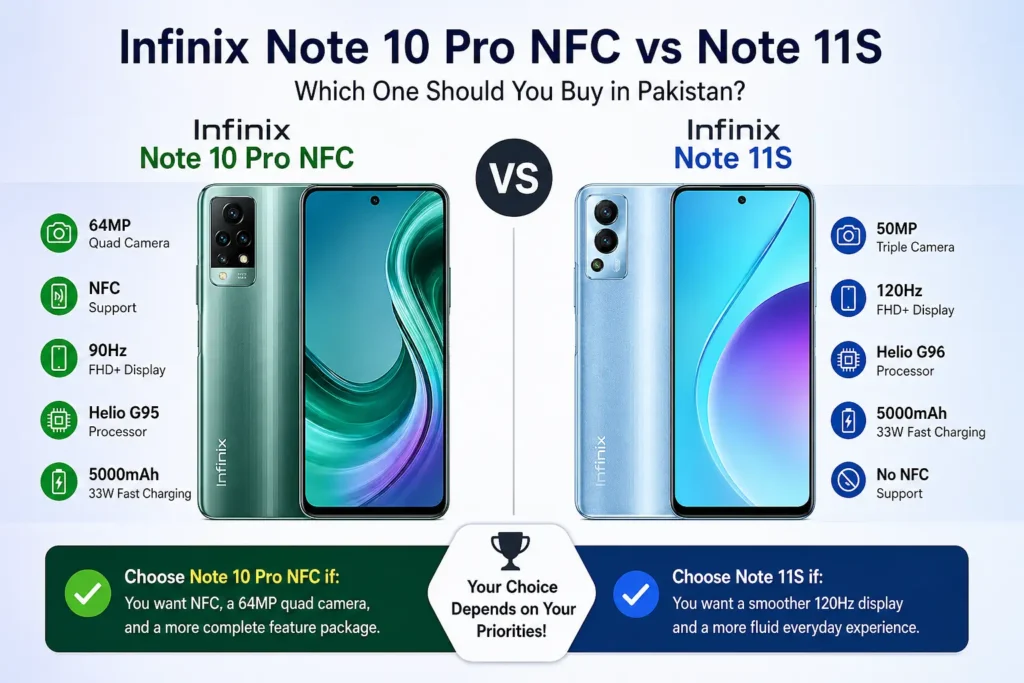
The Infinix Note 11S is the smoother-display option. It brings a 6.95-inch FHD+ 120Hz screen, the Helio G96, a 50MP triple rear camera, a 5000mAh battery, and 33W charging. It is built for people who value fluid motion, comfortable scrolling, entertainment, and a modern-feeling interface.
The Infinix Note 10 Pro NFC is the more feature-complete pick. It offers a 6.95-inch FHD+ 90Hz display, the Helio G95, a 64MP quad rear camera, a 5000mAh battery, 33W charging, and, most importantly, NFC. For buyers who want extra utility and a stronger rear camera package, that NFC advantage can be the deciding factor.
So the clean verdict is this: choose the Note 11S for smoother everyday use and a more fluid screen; choose the Note 10 Pro NFC if you want NFC and a more versatile camera setup. That is the buyer decision most people actually need.
Quick Verdict
The fastest way to narrow this down is to think in user intent, not just hardware labels.
Buy the Infinix Note 11S if your priority is display smoothness, effortless scrolling, social media browsing, video watching, and general day-to-day comfort. The 120Hz panel gives it a more responsive feel in apps, menus, and content feeds. The large screen, Helio G96, 50MP triple camera, 5000mAh battery, and 33W fast charging make it a well-balanced device for regular use.
Buy the Infinix Note 10 Pro NFC if you care more about camera flexibility and the practical usefulness of NFC. It keeps the same big-screen class and the same battery capacity, but it adds NFC, a 64MP quad camera, and the Helio G95. For many buyers, that makes it a more complete package, even though the display refresh rate is lower.
The easiest way to read the comparison is this:
Note 11S = smoother screen and lighter everyday feel.
Note 10 Pro NFC = stronger feature bundle and better camera hardware.
Price and Availability
Price is where many comparison articles become weak, because they treat one listing as if it represents the whole market. That is not how Pakistan phone pricing works in real life. Listings vary by seller, warranty, region, stock condition, and whether the model is still actively sold or effectively phased out.
For the Note 11S, the market can show very different figures depending on where you look. Some listings may place it around Rs. 26,499, others at Rs. 28,999, some around Rs. 35,999, and in certain places, you may even see it marked close to Rs. 40,000 or tagged as discontinued. That spread tells you one important thing: stock quality and seller reliability matter a lot.
For the Note 10 Pro NFC, the pricing signal is similarly mixed, but in a different way. A dedicated NFC listing may show Rs. 47,999, while non-NFC Note 10 Pro pages often appear lower, such as Rs. 33,999, Rs. 34,999, Rs. 37,600, or Rs. 37,999. That means you must read the exact variant name carefully, because the NFC version can cost noticeably more than the regular Note 10 Pro.
What this means for Pakistani buyers
The practical lesson is not to anchor your decision around one fixed number. A better way to think about it is like this:
- The Note 11S can look cheaper in some places, but its availability is inconsistent.
- The Note 10 Pro NFC may cost more, but the exact model name matters because there are different Note 10 Pro entries in the market.
- In Pakistan, price range and stock status are more reliable signals than a single screenshot from one retailer.
That is why a strong article should not pretend that the market is static. It should explain the reality: buying decisions are shaped by actual seller listings, current stock, and warranty conditions.
Display Comparison
Display is one of the most important experience signals in this matchup, and it is also the easiest one for users to feel immediately. When a person unlocks the phone, opens apps, scrolls through feeds, or watches videos, the display behavior becomes part of their emotional response to the device.
Note 11S display: smoother for daily use.
The Infinix Note 11S uses a 6.95-inch IPS LCD with FHD+ Resolution and a 120Hz refresh rate. That 120Hz panel is the headline advantage. In practical terms, it makes the phone feel more animated, more polished, and more fluid during scrolling, app switching, and menu navigation.
That matters more than many shoppers realize. A lot of people do not analyze frame rates or panel specifications technically. They simply feel whether a phone is fast and pleasant to use. The Note 11S gives a better answer to that feeling because the screen transitions look smoother.
For users who spend time on Instagram, TikTok-style feeds, YouTube browsing, web reading, and long chat sessions, the Note 11S creates a more comfortable interaction pattern. It is the kind of improvement that seems small on paper but becomes obvious in repeated daily use.
Note 10 Pro NFC display: still large, but less fluid.
The Infinix Note 10 Pro NFC also brings a 6.95-inch IPS LCD with FHD+ resolution, but the refresh rate sits at 90Hz instead of 120Hz. That still qualifies as a strong, budget-friendly, and mid-budget display experience. It is not sluggish. It is not old-fashioned. But it does not produce the same silky motion as the Note 11S when the user is scrolling quickly or flipping between apps.
So the display verdict is straightforward:
If the screen matters most, the Note 11S wins the display round.
If you are comfortable with 90Hz and want the extra NFC plus the more capable camera arrangement, the Note 10 Pro NFC still remains competitive.
Performance and Gaming
Performance is another area where many comparison pages overstate the gap. In reality, both of these phones are part of the same broad budget gaming and everyday multitasking category. They are not flagship powerhouses, but they are built for practical use.
Helio G96 vs Helio G95
The Note 11S runs on the MediaTek Helio G96, while the Note 10 Pro NFC uses the MediaTek Helio G95. Both chips belong to MediaTek’s Helio G family, and both are designed for affordable gaming-oriented performance, regular app use, and manageable multitasking.
This means the performance difference is real, but it is not the core reason most buyers should choose one phone over the other. The larger user-perceived change comes from the display refresh rate rather than from raw chip power.
In real-world behavior, the Note 11S often feels smoother because the 120Hz screen supports a more fluid visual flow. That can make the phone seem more responsive even when the actual processing difference is modest. On the other hand, the Note 10 Pro NFC gives you the comfort of a proven Helio G95 platform plus the more complete hardware set overall.
Gaming angle for ordinary users
For casual gaming, both phones are usable. They are suitable for lightweight to moderate titles, social entertainment, and general app-heavy behavior. The Note 11S gains an experiential advantage from the faster display, which makes menus, touch transitions, and visual motion feel more lively.
The Note 10 Pro NFC has respectable gaming credentials as well, but it does not offer the same visible smoothness advantage. That is why this comparison should not be framed as “which one is the best gaming phone?” It is better framed as: which device gives you the user experience you will appreciate more often?
For heavy gamers in 2026, neither model should be treated as the ideal long-term gaming solution. That makes the comparison less about brute-force performance and more about UX balance, convenience, and value positioning.
Camera Comparison
Camera is where the buyer intent becomes more segmented. Some people simply want decent daylight photos and casual portraits. Others care about rear camera flexibility, sensor count, and the impression of a more advanced imaging system.
Note 11S camera: simple, practical, and easy to live with
The Infinix Note 11S uses a 50MP triple rear camera configuration. In common listings, it is also paired with a 16MP front camera. This is a more straightforward setup, and that is not a weakness by default. For many users, a simple camera stack is actually easier to understand and easier to use.
The Note 11S is not trying to present itself as the camera champion of this comparison. Instead, it offers a practical imaging setup for daily snapshots, portraits, family photos, social uploads, and casual outdoor scenes. For most non-enthusiast buyers, that is enough.
Its camera behavior is designed around ordinary usage, not advanced photography experimentation. So the right way to describe it is this: the Note 11S has a good enough camera for regular life, but it is not the more advanced imaging phone in this matchup.
Note 10 Pro NFC camera: more versatile and more serious
The Infinix Note 10 Pro NFC uses a 64MP quad rear camera setup, commonly listed as 64MP + 8MP + 2MP + 2MP, and it also often appears with a 16MP front camera. That gives it a more detailed and more flexible rear camera system.
This is one of the strongest practical reasons to choose the Note 10 Pro NFC. Even if a normal user never touches every lens every day, the larger and more feature-rich camera arrangement still signals a more robust photography package. It gives the impression of a phone that is built with more imaging ambition.
For users who care about rear camera variety, sharper main-sensor emphasis, or simply want the stronger camera spec story, the Note 10 Pro NFC is the more appealing choice.
Camera winner
The camera result is clear and useful: Note 10 Pro NFC wins the camera section, while Note 11S remains acceptable but simpler. That kind of direct statement helps the reader make a decision faster, which is exactly what a buyer-focused article should do.
Battery and Charging
The battery is one of the easiest sections to explain because there is no dramatic difference between the two phones. That is useful for the buyer because it removes one more layer of uncertainty.
Same battery size, same charging class
Both the Note 11S and the Note 10 Pro NFC come with a 5000mAh battery and 33W fast charging. This means neither phone holds a major endurance advantage over the other on paper.
For normal daily use, a 5000mAh battery is generally enough to get through a full day of mixed tasks such as calling, messaging, browsing, video consumption, and social media usage. Since both phones also support 33W charging, the recharge experience is close as well.
So the correct interpretation is simple: battery is a tie. That is important because it prevents readers from overthinking a category that does not truly separate the phones.
Battery takeaway in plain language
The battery story is not exciting, but it is highly useful. It tells buyers that they are not comparing a strong battery phone against a weak one. They are comparing two phones that are both solid on battery, so the real buying decision should move to the better display, the stronger camera arrangement, and the presence or absence of NFC.
Design, Build, and Feature Set
Design and feature utility matter because many buyers do not shop for specs alone. They shop for how the phone fits into their life: how it feels in hand, what conveniences it includes, and whether it includes any lasting feature advantage.
What Note 11S brings
The Note 11S is positioned as a big-screen, entertainment-friendly daily device. It typically includes features such as a side-mounted fingerprint reader, a 3.5mm audio jack, and a clean, practical design language that fits ordinary use.
It is also commonly described without NFC support. That is important because NFC is one of those features that seems optional until a buyer actually needs it. Once a user values contactless convenience, local payment support, or quick short-range interactions, NFC becomes difficult to ignore.
What Note 10 Pro NFC brings
The Note 10 Pro NFC keeps the same large-screen form factor, but it stands out because it includes NFC and a more complete feature profile overall. Together with the Helio G95 and the quad-camera system, it feels like the more advanced utility-focused model in the pair.
That is the real appeal of the Note 10 Pro NFC: it offers one feature that many users cannot easily add later. NFC is built in. That can be a simple checkbox for some buyers, but for others, it is a real quality-of-life advantage.
Full Comparison Table
| Feature | Infinix Note 11S | Infinix Note 10 Pro NFC | Buying Meaning |
| Display | 6.95-inch IPS LCD, FHD+, 120Hz | 6.95-inch IPS LCD, FHD+, 90Hz | Note 11S feels smoother |
| Chipset | Helio G96 | Helio G95 | Both are close; display matters more |
| Rear Camera | 50MP triple camera | 64MP quad camera | Note 10 Pro NFC is stronger for camera flexibility |
| Front Camera | Commonly listed as 16MP | Commonly listed as 16MP | Selfie quality is not the main difference |
| Battery | 5000mAh | 5000mAh | Battery is a tie |
| Charging | 33W | 33W | Charging is a tie |
| NFC | No NFC on common specs | Yes, NFC | Major win for Note 10 Pro NFC |
| Best For | Smooth display, everyday use | Camera flexibility, NFC, richer package | Use case decides the winner |
Which One Should You Buy?
This is where the article should stop sounding like a spec mirror and start sounding like a real purchase guide.
Buy the Infinix Note 11S if…
Choose the Infinix Note 11S if your top priority is a more fluid screen experience. The 120Hz display is the most visible upgrade in daily life. It improves the feeling of smoothness in scrolling, browsing, social media use, content watching, and regular app navigation.
This is the right choice for students, casual users, and people who spend a lot of time on social platforms or reading content on their phones. It also keeps the same 5000mAh battery and 33W charging, so you are not sacrificing endurance just to get the smoother panel.
It can also be the better value choice when local pricing is lower, especially if you find a cleaner listing with a warranty and good stock conditions. Because Pakistan pricing can vary a lot, the Note 11S may sometimes appear more affordable, which helps it become the more budget-friendly option.
Buy the Infinix Note 10 Pro NFC if…
Choose the Infinix Note 10 Pro NFC if you want the more complete feature package. The main reasons are easy to understand: NFC, a 64MP quad camera, and a more feature-rich overall profile.
This phone makes more sense for someone who sees the camera as a serious part of the purchase, or for someone who knows they will actually use NFC. The 90Hz display is still good, but the Note 10 Pro NFC wins on utility, camera depth, and feature confidence.
For buyers who do not mind paying a bit more for those advantages, it is often the more future-friendly choice.
Best value summary
A simple one-line decision framework works well here:
- Note 11S = smoother screen and better everyday feel when the price is right.
- Note 10 Pro NFC = better camera package and NFC.
That is the clearest possible answer for most Pakistani shoppers.
Real Buyer Examples
A good comparison article becomes more convincing when it maps the phones to actual user profiles instead of repeating hardware labels.
Student and heavy social media user
A student who uses YouTube, Instagram, messaging apps, reading tools, and general web browsing will usually enjoy the Note 11S more. The 120Hz screen makes the interface feel quicker and more visually polished. In daily life, that matters a lot because the phone is being touched and seen constantly.
For this type of buyer, the battery is already strong enough, and the smoother screen gives more emotional satisfaction than an extra camera lens they may never use.
Buyer who wants NFC and a better camera setup
A person who pays attention to camera hardware or values NFC should look at the Note 10 Pro NFC first. The combination of NFC support and a 64MP quad camera gives the phone a stronger feature identity.
Even though the screen is only 90Hz, it still feels good enough for most ordinary use. The stronger camera arrangement and NFC convenience can be more important than the extra smoothness of the Note 11S.
Budget shopper with no NFC need
If the buyer does not care about NFC and finds the Note 11S at a meaningfully better local price, the Note 11S becomes the easier value win. This is especially true in markets where seller pricing fluctuates and stock availability shifts constantly.
The main insight is that this comparison is not about one phone being universally better. It is about choosing the right trade-off for the buyer’s real needs.
FAQs
The better choice depends on what matters more to you. The Note 11S is better for the smoother 120Hz display, while the Note 10 Pro NFC is better for NFC and the 64MP quad camera. For many buyers, the Note 10 Pro NFC is the more feature-complete phone, while the Note 11S is the more pleasant device for scrolling and daily use.
The Note 11S has a smoother display because it uses a 120Hz panel, while the Note 10 Pro NFC uses a 90Hz panel. Both are large 6.95-inch FHD+ IPS LCD screens, but the higher refresh rate gives the Note 11S the smoother feel.
The Note 10 Pro NFC has a better rear camera setup, offering a 64MP quad camera. The Note 11S has a 50MP triple camera, which is simpler and still adequate for normal use, but not as versatile.
For casual gaming, both phones are fine. The Note 11S feels smoother in the interface because of the 120Hz display, while the Note 10 Pro NFC has the Helio G95 and a strong overall hardware profile. For serious gaming, neither should be treated like a top-end gaming phone.
Battery life is basically a tie. Both phones use a 5000mAh battery and 33W charging, so the main decision is not battery capacity.
That depends on the store, seller, and stock status. The Note 11S appears across a wide range of Pakistan listings, including Rs. 26,499, Rs. 28,999, around Rs. 35,999, and even Rs. 40,000 / discontinued on some pages. The Note 10 Pro NFC appears at Rs. 47,999 on one NFC listing, while non-NFC Note 10 Pro pages often show lower figures in the Rs. 33,999–Rs. 37,999 range.
Final Verdict
The final decision is easy to express and easy for readers to remember.
If you want a smoother screen, go for the Infinix Note 11S. If you want NFC and the stronger camera package, go for the Infinix Note 10 Pro NFC. Both phones share the same large battery and the same charging class, so the real difference is not endurance; it is the feature set and the day-to-day experience.
