
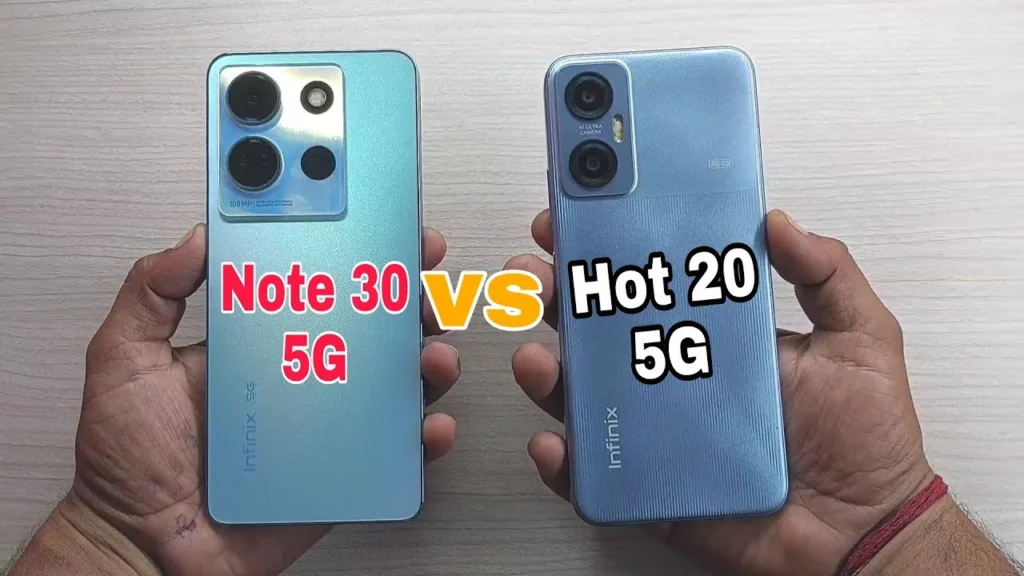
Introduction of Infinix Hot 20 5G vs Hot 30 5G
Choosing between Infinix Hot 20 5G vs Hot 30 5G is not as simple as checking a spec sheet and calling it a day. On paper, both phones sit in the same budget 5G lane, both offer smooth 120Hz displays, and both promise enough power for everyday use. In real buying terms, however, they do not deliver the same experience. One feels a little more compact and slightly sharper in raw CPU behavior, while the other feels more modern, more complete, and more forgiving for long-term use.
That is why this guide goes beyond the numbers. It compares the two phones the way real buyers think about them: display comfort, battery endurance, gaming stability, camera usefulness, software freshness, and overall value in Pakistan. If you are trying to decide which one deserves your money, this article gives you the practical answer, not just the technical one.
The short version is this: Hot 20 5G has a small spec-side edge in a few raw performance areas, but Hot 30 5G is the stronger all-around phone for most buyers in Pakistan. It offers a larger screen, a bigger battery, newer software, and more flexible RAM options, which together make it easier to recommend for normal daily life. The Hot 20 5G still has merit, especially if you find it at a noticeably lower price, but the Hot 30 5G is the more rounded purchase for most people.
Quick Verdict
If you want the phone that makes the most sense for the widest group of buyers, Infinix Hot 30 5G is the better choice. It is the more practical package because it gives you a larger 6.78-inch display, a 6000mAh battery, Android 13, and RAM options that go as high as 8GB in Pakistan-market coverage. That combination matters more than a tiny CPU clock advantage on the older model.
The Hot 20 5G is still worth considering if you care about a slightly lighter feel in hand, or if you see a strong discount and want to save money. It also has a respectable Dimensity 810 chipset, a 120Hz screen, and a capable 50MP main camera. But in a direct buying decision, the Hot 30 5G is the cleaner and safer long-term choice.
Full Specs Comparison
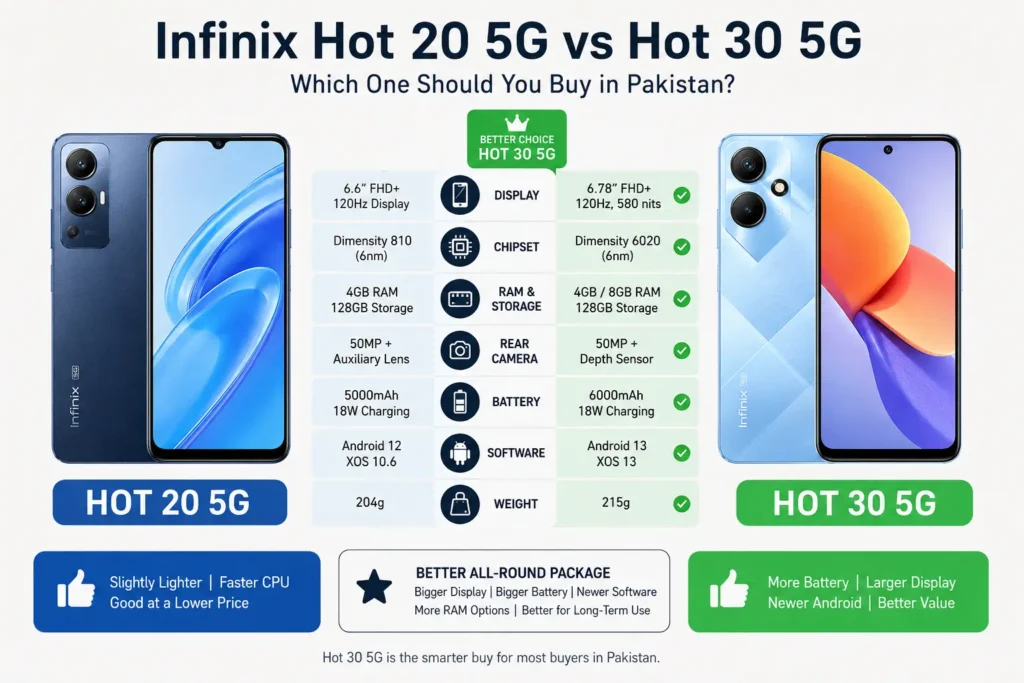
Before getting into the real-world differences, here is the easiest way to compare Infinix Hot 20 5G vs Hot 30 5G specs side by side.
| Feature | Infinix Hot 20 5G | Infinix Hot 30 5G | Better Choice |
| Display | 6.6-inch IPS LCD, FHD+, 120Hz, 240Hz touch sampling | 6.78-inch IPS LCD, FHD+, 120Hz, 580 nits peak brightness | Hot 30 5G |
| Chipset | MediaTek Dimensity 810, 6nm | MediaTek Dimensity 6020, 6nm | Hot 20 5G on paper |
| CPU | 2×2.4GHz Cortex-A76 + 6×2.0GHz Cortex-A55 | 2×2.2GHz Cortex-A76 + 6×2.0GHz Cortex-A55 | Hot 20 5G slightly |
| GPU | Mali-G57 MC2 | Mali-G57 MC2 | Tie |
| RAM / Storage | 4GB / 128GB | 4GB or 8GB / 128GB | Hot 30 5G |
| Rear Camera | 50MP + auxiliary lens | 50MP + depth sensor | Hot 30 5G |
| Selfie Camera | 8MP | 8MP | Tie |
| Battery | 5000mAh | 6000mAh | Hot 30 5G |
| Charging | 18W | 18W | Tie |
| OS | Android 12, XOS 10.6 | Android 13, XOS 13 | Hot 30 5G |
| Weight | 204g | 215g | Hot 20 5G |
| Pakistan Price Context | Older launch-era estimates around Rs. 33,000 to Rs. 39,000; current listings may be inconsistent | WhatMobile lists an expected Rs. 44,999 in Pakistan | Depends on stock |
Design and Build
Hot 20 5G: lighter and easier to handle
The first thing many buyers notice is not the processor or the camera. It is how the phone feels in the hand. On that front, the Hot 20 5G has an immediate practical advantage because it weighs 204 grams. That is not dramatically light by modern standards, but it is still easier to manage than a heavier, large-screen device.
This matters in everyday life more than people admit. A phone that is easier to hold can feel less tiring during long calls, late-night scrolling, messaging marathons, and one-handed browsing. The Hot 20 5G also carries a straightforward budget design language with a vertical rear strip style, waterdrop notch, dual rear cameras, dual speakers, and a microSD slot. It is not trying to look premium, but it does try to look neat, and that is enough for many budget buyers.
The overall feel is simple: the Hot 20 5G behaves like a no-nonsense phone that does not get in the way.
Hot 30 5G: bigger and more modern-looking
The Hot 30 5G moves in a different direction. At 215 Grams, it is heavier and larger, and that immediately changes the personality of the device. It feels more like a media-focused phone than a compact daily carry device. For people who spend a lot of time on YouTube, TikTok, Instagram, news feeds, or mobile gaming, that extra size can feel like an upgrade rather than a burden.
Its appearance also leans more toward the current budget-phone style. The larger frame, side-mounted fingerprint sensor, and bigger screen give it a more up-to-date presence. It may not be the most elegant or luxury-looking handset, but it feels more aligned with what buyers expect from a modern value 5G device.
Which design makes more sense?
This is not really a beauty contest. It is a comfort test.
The Hot 20 5G makes more sense if you prefer a slightly lighter phone that is easier to slip into a pocket or use in one hand. The Hot 30 5G is the better fit if you want a more expansive, modern, and multimedia-friendly phone that gives you more room for video, reading, and gaming. In other words, Hot 20 5G is the easier physical carry; Hot 30 5G is the better visual and usage experience.
Display Comparison
Hot 20 5G display
The Hot 20 5G uses a 6.6-inch FHD+ IPS LCD panel with a 120Hz refresh rate and 240Hz touch sampling. That combination is solid for a budget 5G phone. It means scrolling feels fluid, app transitions look cleaner, and touch response is quick enough for casual gaming and rapid navigation.
A 120Hz screen still feels premium in daily use, even when the panel itself is IPS LCD rather than AMOLED. For buyers moving up from older 60Hz phones, the upgrade is easy to notice. The Hot 20 5G was also notable at launch because Infinix pushed it as the first Hot-series 5G phone with a 120Hz display. That gave it a fresh identity in the market.
Hot 30 5G display
The Hot 30 5G keeps the same 120Hz refresh rate, but it stretches the experience across a 6.78-inch FHD+ IPS LCD. That bigger screen changes everything from video watching to reading, scrolling, and game visibility. It gives you more room without forcing you to sacrifice smoothness.
One useful detail is brightness. Launch coverage for the Hot 30 5G highlighted 580 nits peak brightness, which improves outdoor readability and makes the display easier to use under brighter conditions. That matters in everyday Pakistani use, especially if you spend time outside or rely on your phone in daylight.
Which display is better?
For most people, the Hot 30 5G display is the better one. It is larger, more immersive, and better suited to entertainment-heavy usage. The Hot 20 5G still offers a good panel, and its 120Hz refresh rate keeps it pleasant, but the Hot 30 5G is the one that feels more generous and more modern in actual use.
If you care about streaming, browsing, and reading comfort, the Hot 30 5G wins. If you prefer a slightly smaller body and a less bulky screen, the Hot 20 5G remains perfectly usable.
Performance and Gaming
Hot 20 5G performance
The Hot 20 5G runs on the MediaTek Dimensity 810, a 6nm chipset with two Cortex-A76 cores clocked at 2.4GHz, and six Cortex-A55 cores clocked at 2.0GHz. On paper, that is a respectable budget 5G chip. It was a major selling point when the phone launched because it gave the device a stable, modern foundation for everyday work.
In practical use, the phone should handle calling, social media, light multitasking, browsing, video streaming, and moderate gaming without major friction. For most standard users, the Dimensity 810 is still strong enough to feel responsive, especially if the phone is kept relatively clean and not overloaded with apps.
Where it becomes more interesting is the CPU setup. Those higher clocked big cores give the Hot 20 5G a small theoretical edge in certain bursts of performance. That means app launches, short processing tasks, or some CPU-sensitive workloads can feel a little snappier.
Hot 30 5G performance
The Hot 30 5G uses the MediaTek Dimensity 6020, also on a 6nm process. Its core structure is similar, but the big cores are clocked at 2.2GHz, not 2.4GHz. That means the Hot 20 5G can still claim a narrow raw-performance advantage on paper.
But performance is not only about clock speed. The Hot 30 5G balances its slightly lower CPU peak with a more future-friendly software package and better memory flexibility. In Pakistan-market coverage, it is available in 4GB and 8GB RAM variants, which can make a noticeable difference when switching between apps, keeping tabs open, or simply reducing stutter over time.
Gaming comparison
For gaming, the two phones are closer than many people expect because both use the Mali-G57 MC2 GPU. That means the graphics side is not dramatically different. Neither phone is built to compete with dedicated gaming devices, but both can handle typical budget gaming workloads.
The Hot 20 5G may feel a touch sharper in CPU-heavy moments, which can matter in some games and heavier multitasking scenarios. The Hot 30 5G, however, has a very important gaming advantage: endurance. Its bigger battery makes longer sessions less stressful, and the additional RAM options can help smooth things out during extended use.
Real buying takeaway for performance
If your focus is benchmark-style comparison and you care most about small technical advantages, the Hot 20 5G has a modest edge in core clock behavior. But if your real-world use involves gaming, video streaming, app switching, social media, and long battery life, the Hot 30 5G is the more balanced and less frustrating phone.
The truth is simple: most buyers do not need the last bit of CPU sharpness nearly as much as they need a phone that stays comfortable, smooth, and dependable throughout the day. That is why Hot 30 5G ends up being the smarter performance pick overall.
Camera Comparison
Rear camera
Both phones come with a 50MP main rear camera, which is the most important part of the camera system for budget buyers. This means everyday shots, such as people, street scenes, food, indoor images, and casual outdoor photos, can all be captured with reasonable detail, especially under decent lighting.
The difference lies in the supporting sensor arrangement. The Hot 20 5G uses a 50MP camera with an auxiliary lens, while the Hot 30 5G uses a 50MP camera with a depth sensor. On a practical level, this means the Hot 30 5G has a more conventional and useful supporting setup for portrait-style photos and general imaging behavior.
Another advantage in launch coverage is that the Hot 30 5G was presented with 2K video recording support for the rear camera. That gives it a small but meaningful edge for users who care about video capture quality more than just still photos.
Selfie camera
The front camera is identical on both devices: 8MP. That means selfies, video calls, online meetings, and quick social shots are handled at a basic but acceptable level. Neither phone is trying to be a selfie-centric machine, and neither is likely to beat more camera-focused models.
For buyers who are choosing purely based on selfie quality, there is no major reason to favor one over the other. Both are serviceable, both are budget-appropriate, and both are fine for general front-facing use.
Which camera is better?
The Hot 30 5G has a slight camera advantage because it brings a newer package, the depth sensor setup, and stronger video credentials. That said, this is not a giant leap. The camera difference between these two phones is not the kind of gap that should dominate your whole buying decision.
These are budget 5G phones, and their cameras should be treated as useful everyday tools rather than major selling points. If you take the right expectations into the comparison, both will satisfy ordinary users reasonably well. The Hot 30 5G simply gives you a little more confidence overall.
Battery and Charging
Hot 20 5G battery
The Hot 20 5G comes with a 5000mAh battery and 18W charging. That is a safe, reliable, mainstream battery setup. It should comfortably cover a normal day for moderate users, especially those who mix calling, messaging, social media, and some browsing without pushing the phone too aggressively.
For its time, this battery size was a solid advantage. Even today, 5000mAh is still good. But when compared against newer phones with larger batteries, it no longer stands out the way it once did.
Hot 30 5G battery
The Hot 30 5G takes a noticeable step forward with a 6000mAh battery while keeping the same 18W wired charging. That bigger battery is one of the strongest reasons to choose the phone. It gives you more freedom, more comfort, and less anxiety about finding a charger during the day.
That matters especially for people who use mobile data frequently, watch a lot of video, play games, or spend long hours away from a power outlet. Even if charging speed remains unchanged, having more battery capacity means fewer top-ups and less disruption.
Which one lasts longer?
The answer is clear: Hot 30 5G lasts longer. The larger battery gives it a genuine endurance advantage that most buyers will notice quickly. In a world where battery life often matters more than raw speed on paper, this becomes a big deal.
If you hate charging your phone multiple times a day, or you simply want a handset that feels more dependable during heavy use, the Hot 30 5G is the stronger option by a meaningful margin.
Price and Value
Pakistan pricing context
This is the part where a buying guide becomes truly useful. Specs matter, but price often decides the final choice.
The Hot 30 5G has a clearer Pakistan price reference. WhatMobile lists an expected price of Rs. 44,999. The Hot 20 5G, being the older model, has more inconsistent current local coverage. Launch-era estimates placed it roughly in the Rs. 33,000 to Rs. 39,000 range, depending on the source and timing, but current availability can vary more widely.
That means the Hot 20 5G may be found at a lower effective market price, but it is also more likely to be seen as older stock or less consistently available. The Hot 30 5G, by comparison, has the advantage of being the more current and easier-to-justify purchase.
Which one gives better value?
This is not only about which phone is cheaper. Value is the balance between cost and long-term usefulness.
The Hot 20 5G makes sense only if the discount is meaningful enough to justify its older software, smaller battery, and less future-friendly overall package. If you can find it substantially cheaper, it becomes interesting for budget-focused buyers.
The Hot 30 5G gives better value for most people because it bundles together the things people actually feel every day: a larger screen, longer battery life, newer Android 13 software, and more RAM flexibility. Those gains matter more in normal use than a tiny CPU advantage on the older device.
Which phone is the smarter buy?
For most buyers in Pakistan, the smarter buy is Hot 30 5G. It feels more current, more complete, and more comfortable to live with over time. The Hot 20 5G is only a better deal if you find a clearly lower price and do not mind the trade-offs that come with older hardware and software.
FAQs
Not for most buyers. The Hot 20 5G does have a small CPU advantage on paper, but the Hot 30 5G wins in the areas that matter more in daily life: battery life, display size, software freshness, and overall usability. That makes the Hot 30 5G the more balanced and more sensible phone for most people.
The Hot 20 5G can edge ahead slightly in raw CPU performance, but the gaming difference is not massive because both phones use the same Mali-G57 MC2 GPU. For longer gaming sessions, the Hot 30 5G is easier to recommend because the bigger battery keeps it going for longer and helps reduce battery stress during extended play.
Yes. The Hot 30 5G has a 6000mAh battery, while the Hot 20 5G has a 5000mAh battery. That extra capacity should translate into noticeably better endurance in everyday use, especially if you stream videos, browse the web, or game frequently.
Both phones offer a 50MP rear camera and an 8MP selfie camera, so the difference is not huge. The Hot 30 5G gets the slight edge because of its newer overall camera package and stronger video positioning. Still, neither model is a camera-first phone, so this should not be the main reason to choose one over the other.
Yes, but only in the right situation. It is still worth buying if you find a strong local deal and the price gap is large enough to justify the older software and smaller battery. Since it is an older model and current Pakistan availability can be uneven, it is best treated as a discount option rather than the default recommendation.
Final Verdict
Best pick for most buyers
The Infinix Hot 30 5G is the better option for most people. It is larger, lasts longer, looks more modern, and feels more like a phone designed for current-day use. Its 6000mAh battery is especially important because battery life is one of the biggest daily pain points for budget users.
It also runs on newer software and offers more RAM flexibility, which makes it easier to live with over time. Even though the Hot 20 5G has a small raw CPU advantage in some technical comparisons, that advantage is not enough to outweigh the overall balance of the Hot 30 5G.
Best pick for power users
For users who care about speed on paper, compact handling, or a slightly lower-weight device, the Hot 20 5G remains relevant. Its Dimensity 810 still has enough strength to deliver solid day-to-day responsiveness, and it is not a weak phone by any means.
But “power user” in the budget 5G category is usually less about chasing benchmark superiority and more about getting a phone that does not feel limited after a few months. That is where the Hot 30 5G becomes the safer long-term recommendation.
Final word on buyer intent
If the question is “Which one should I buy?”, the answer is Hot 30 5G.
If the question is “Which one is slightly faster on paper?”, the answer leans toward Hot 20 5G.
But if the question is “Which phone gives me the best mix of display, battery, software, and overall comfort in Pakistan?”, the answer is clearly Hot 30 5G.
