
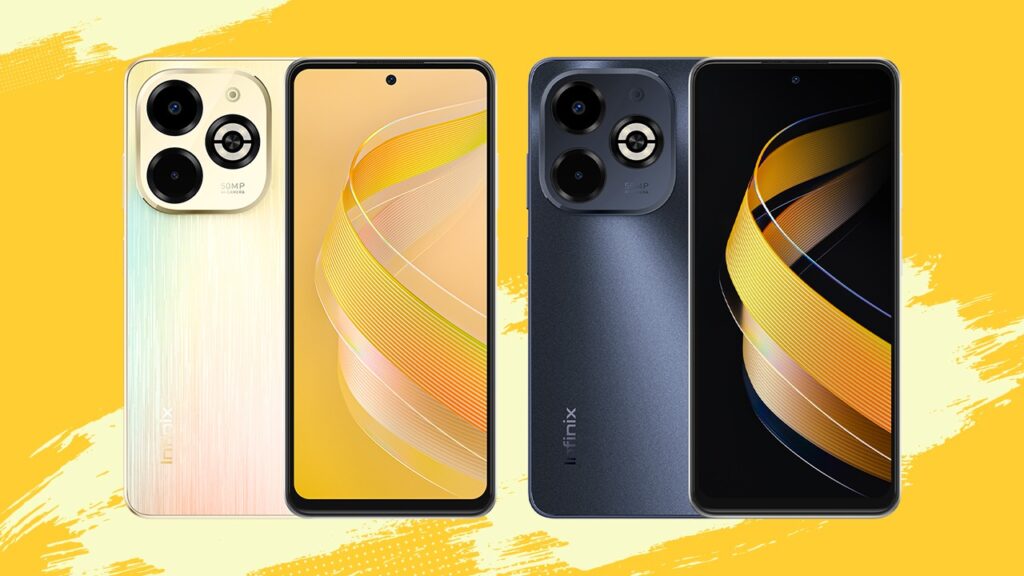
Introduction of Infinix Smart 8
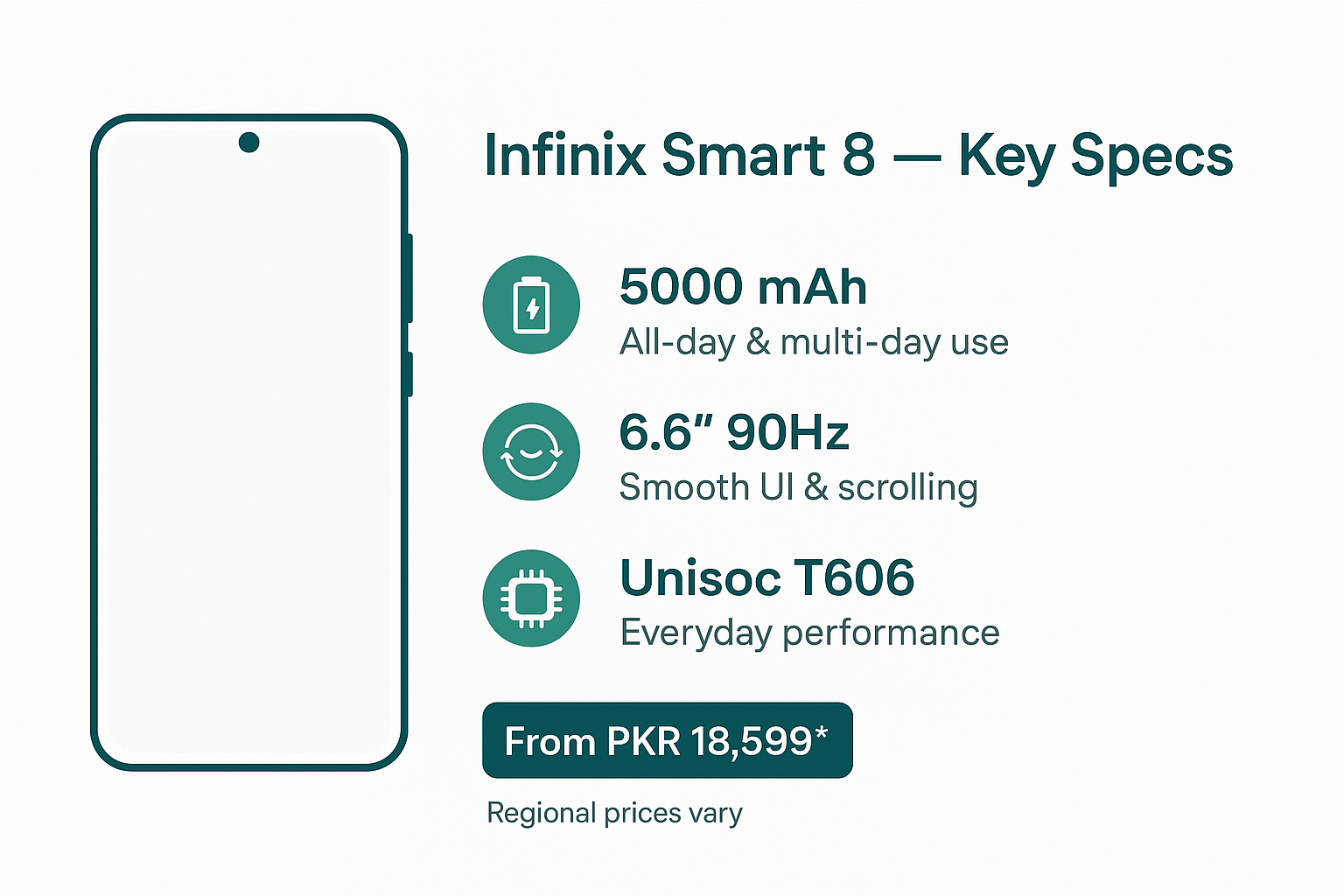
Infinix Smart 8 is an interesting low-cost smartphone designed to be used on a daily basis without failure. It has a huge 6.6-inch 90 Hz display, a massive 5000 mAh battery, and a powerful Unisoc T606 chipset that makes it a great value in its category. The Smart 8 is created to appeal to users who are looking to experience the best social media and video streaming capabilities. Users will have a long battery life, as well as balanced daily functionality at an affordable price
Quick facts
Model: Infinix Smart 8
Launch / Release: Late 2023 (regional rollouts in November 2023)
OS: Android 13 with XOS skin
Display: 6.6″ IPS LCD, 720 × 1612 (HD+), 90Hz, ~500 nits peak
SoC: Unisoc T606
Memory / Storage: 2 / 3 / 4 GB RAM options with 64 GB storage; microSD slot
Battery: 5000 mAh, Type-C charging
Cameras: Rear 13 MP (main) + AI lens; Front 8 MP
Approx. retail price (example market — Pakistan): ~PKR 18,600–23,500 (date-checked Nov 2025)
Design & build — what to expect
Summary: As does the Smart 8, which is based on the traditional budget-phone formula: plastic shell, glass front with slim bezels, and a camera that is reminiscent of more expensive designs, but not made of expensive materials. A balance is provided by the huge 5000 mAh cell – you will feel its added bulk over slender flagship phones, yet it still fits comfortably in the hand.
Materials & finish: Expect a polycarbonate back and frame with either a glossy or matte finish, depending on color. This keeps manufacturing costs down and makes the phone more impact-resistant — scratches may mar glossy finishes more easily, but replacement parts are usually cheap.
Layout & ergonomics: The side-mounted fingerprint sensor doubles as a power button — a convenient placement that’s fast and reliable in daily use. The camera island is visually prominent but not protrusive to the point of wobble when the phone lies flat.
Durability: There’s no IP rating; splash Resistance is limited. If you’re clumsy or often outdoors, a case and screen protector are recommended. For everyday knocks and drops, polycarbonate is forgiving and relatively cheap to replace.
Design pros/cons:
- Pros: Clean, minimal rear; side-fingerprint for quick unlock; light enough for daily carry.
- Cons: Plastic construction (not premium); finishes may show micro-scratches; no official water resistance.
Display
Panel details: 6.6″ IPS LCD, HD+ 720 × 1612 resolution, 90Hz refresh rate, peak brightness ~500 nits on spec. This is one of the phone’s key value propositions: a large, fluid display at a budget price.
Readability & sharpness: On a 6.6-inch canvas, an HD+ pixel count is visibly less crisp than Full HD. Text and UI elements are perfectly usable, but you may notice pixel edges in close viewing or when reading small fonts. If you’re used to FHD panels, the difference will be apparent; if you’re upgrading from a lower-tier 60Hz device, the jump to 90Hz will feel delightful.
Refresh rate (90Hz): The higher refresh rate makes scrolling and animations feel smoother. Keep the phone set at 90Hz for a noticeably more pleasant UI experience — the trade-off is slightly higher battery use versus 60Hz, but the large battery offsets this for most users.
Color & contrast: Typical IPS color reproduction: accurate but not punchy like OLEDs. Good for streaming and casual content consumption. Blacks will look grayer in dim rooms compared to OLED panels.
Brightness & outdoor usability: The phone’s peak brightness (~500 nits) handles common outdoor scenarios. Direct sunlight will still wash the image; auto-brightness helps, but the panel lacks HDR support that makes some titles pop.
Performance
Chipset overview: The Unisoc T606 is a mid-to-entry level SoC that tries to strike a balance: decent CPU cores to get by and sufficiently powerful GPUs to play light games. Here in this phone comes with a RAM of 2/3/4GB and a storage capacity of 64GB, which is expandable by use of a microSD drive.
CPU & GPU: The T606 architecture (2 higher-performance cores + 6 efficiency cores) suits basic multitasking and app usage. The GPU is a single-core Mali-G57 MP1 — fine for casual titles but not for games demanding consistent 60 fps at high settings.
Benchmarks: AnTuTu and aggregate reporting. Community-sourced AnTuTu and aggregate reports tend to have T606 in the low-mid price range – approximately between 150k and 260k based on test build, drivers, and firmware.
Every day performance: Browsing, social applications, video streaming, and light multitasking are fluid. The weakness of T606 and limited RAM is evident in heavy multitasking (a large number of running applications) and applications that have high RAM requirements.
Gaming & thermals: Lightweight titles run well. More demanding games (PUBG Mobile, Call of Duty Mobile) are playable only at lowered graphical presets; frame drops and stuttering are likely at higher settings.
Memory management advice: If you pick 2GB of RAM, expect background app kills and slower app switching. 3–4GB is the sweet spot for practical day-to-day use.
Camera — what the 13MP main and 8MP selfie deliver
Hardware recap: 13 MP main rear sensor, accompanied by an AI lens, and an 8 MP front shooter.
Daylight shooting: The main sensor captures usable detail in bright scenes. Colors tend to be slightly saturated out of the box for social-ready photos, and detail holds up well enough for 12–20 MP crops.
Low light & night: The Smart 8’s sensor and ISP are not specialized for low-light photography. You’ll see increased noise, softer detail, and reduced dynamic range in dim conditions.
Portraits & secondary lens use: The AI lens helps with background differentiation, but don’t expect bokeh levels of higher-end dual-lens systems. Edge detection is average; results are fine for social images at arm’s length.
Selfie camera: The 8 MP front camera is serviceable. Skin tones are rendered with mild smoothing, and detail is acceptable for video calls and selfies in good light. Low-light selfies suffer from the same noise and softness as the rear camera.
Video capture: Video quality is adequate for casual clips. Electronic image stabilization (EIS) may be available depending on firmware; don’t rely on it for cinematic footage.
Battery & charging — what to expect and how to test
Capacity & endurance: 5000 mAh is one of the Smart 8’s strong suits. Expect all-day battery life with moderate use and multi-day life for light users. The combination of a large battery and an efficient chipset helps the phone stay functional through heavy messaging, streaming, and some gaming.
Charging: The phone charges through USB-C. Charger power and the device includes or does not include an in-box adapter, depending on the market; the device is not promoted as being a flagship with ultra-fast charging. Charging times will be largely dependent on the charger that comes with it, as well as whether the model has speedier in-box chargers in the area that you are in.
Realistic expectations: Average usage and 90Hz active means that many users will comfortably watch a full day and be able to watch much more. The switch to 60Hz and reduced brightness extends the runtime significantly. Provided that the charging time is of importance to your audience, list the charger specifications and measured times explicitly.
Software & updates — XOS on Android 13
Out of the box: Ships with Android 13 skinned by Infinix’s XOS. Expect preinstalled utilities, a degree of bloatware, and added “features” like optimizers, game modes, and UI theming.
Update policy & reality check: Infinix’s update cadence varies by model and region. Historically, Infinix offers security patches and occasional feature updates, but long-term OS promises are not consistent across all models. For buyers needing long OS longevity, check Infinix’s regional support pages before purchase.
Customization:
- Disable or uninstall unnecessary preinstalled apps via Settings → Apps.
- Be cautious with “optimizer” tools that promise better RAM — they often kill background services and push immediate speed gains at the expense of background functionality.
- Use the app permissions manager to restrict battery-hungry background processes like location and auto-sync for less-used apps.
Connectivity, sensors & extras
Cellular: 4G LTE support. Make sure to verify SKU-specific bands for your carrier before buying — band support can differ by region.
Wi-Fi & Bluetooth: Standard modern Wi-Fi and Bluetooth versions are supported on most SKUs. Exact versions should be confirmed on the product page for technical precision.
NFC: Availability varies by market. If contactless payments matter to you, confirm NFC presence on the SKU you intend to buy.
Sensors: Side-mounted fingerprint (fast and accurate for the price), proximity, ambient light, gyroscope — adequate for AR and navigation.
Ports: USB-C and often a 3.5mm headphone jack on many SKUs — a welcome inclusion for wired audio users.
Audio & media
Speaker quality: The price bracket is characteristic of loudness and clarity, which are sufficient in calls, video, and casual music. There is not so much bass, and the distortion is at full blast. Bluetooth or wired headphones will be more suitable in the case of critical listening.
Headphone jack: The presence of a 3.5mm jack on many variants is convenient for users who prefer wired listening and low-latency audio for gaming.
Streaming: The large size and 90Hz panel are very suitable when it comes to video streaming, but the HD resolution implies that 720p/HD content should be considered as something satisfactory, but not a sharp display like the FHD screens are. A competitor with a higher resolution needs to be taken into consideration in case it is important that the quality of streaming (sharpness) increases.
Price
Snapshot (example market — Pakistan, Nov 2025): The Smart 8 typically retails between ~PKR 18,599 and PKR 23,499, depending on RAM SKU and retailer promotions.
Pros & Cons
Pros
- Long battery life (5000 mAh) that supports multi-day light usage.
- Smooth 90Hz UI experience on a large 6.6″ panel.
- Clean, minimal design and convenient side-mounted fingerprint sensor.
- Very affordable price point — strong value for daily drivers.
Cons
- HD+ resolution on a large screen — visible pixel structure for detail-oriented users.
- Limited RAM options (2–4GB) — multitasking constraints for power users.
- Camera performance is basic, especially in low light.
- No 5G; only 4G LTE.
One-liner verdict: If you want an inexpensive daily driver with long battery life and a smooth UI for social apps and media, the Infinix Smart 8 is a smart, pragmatic choice — but skip it if you demand razor-sharp displays, sustained high-frame-rate gaming, or flagship-level low-light photography.
Suggested alternatives & short comparison table
What to look for in alternatives
- Better display: look for FHD+ panels in this price band if display sharpness matters.
- Gaming: choose phones with Helio G85, Snapdragon 6-series, or similar GPUs for better sustained gaming.
- Camera: Phones with a 48MP or higher main sensor in the same budget class will deliver stronger daylight detail.
Quick comparison
| Model | SoC | Display | Battery | Typical Price |
| Infinix Smart 8 | Unisoc T606 | 6.6″ 90Hz HD+ | 5000 mAh | Budget |
| Competitor A (e.g., Redmi/Note budget) | Helio G85 | 6.5″ FHD+ | 5000 mAh | Slightly higher |
| Competitor B | Snapdragon 6xx | 6.4″ FHD+ | 5000 mAh | Varies |
FAQs
The 13MP main is fine in daylight for social media; low-light performance is limited.
Yes — a dedicated microSD slot is available on most SKUs.
Typically 2/3/4 GB RAM with 64 GB storage; regional SKUs differ. Confirm on the official page or retailer.
The Unisoc T606 is an entry-mid-budget SoC; AnTuTu scores vary across sources (~150k–260k depending on opt.), suitable for daily use but not heavy gaming.
Local retailers and major e-commerce platforms (prices change often). Example retailers are listed in the Price & Availability section.
Conclusion
The Infinix Smart 8 continues to stand out as a budget-friendly all-rounder in 2025. It delivers excellent battery life, a smooth 90Hz display, and reliable day-to-day performance thanks to the Unisoc T606 chipset. While it won’t satisfy heavy gamers or photography enthusiasts, it’s a dependable daily driver for social media, streaming, and basic multitasking. For under PKR 18,000, the Smart 8 offers solid value — especially for users seeking a stylish, durable, and power-efficient phone that simply gets the Job Done.
