
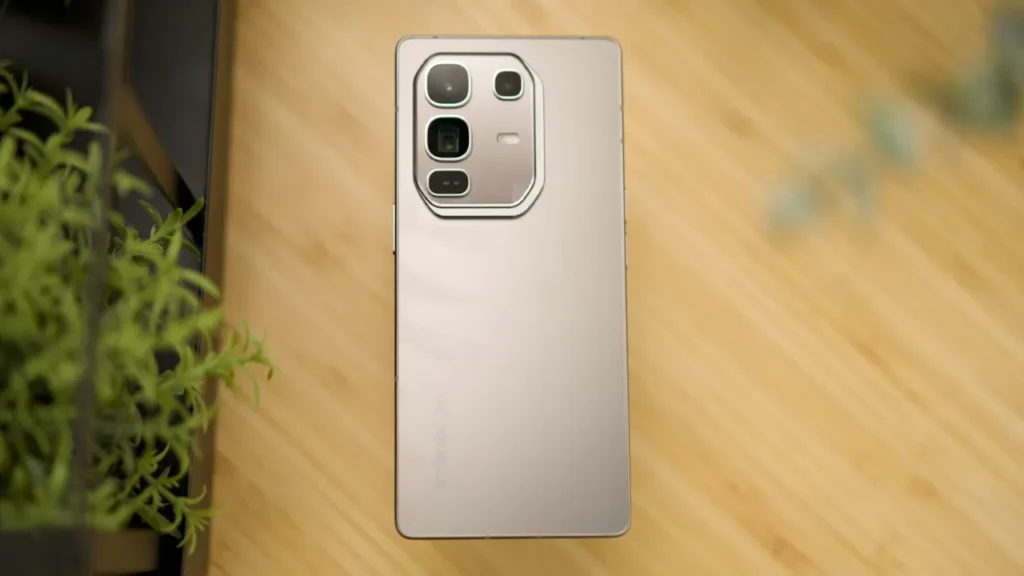
Introduction of Infinix Note 50 Pro
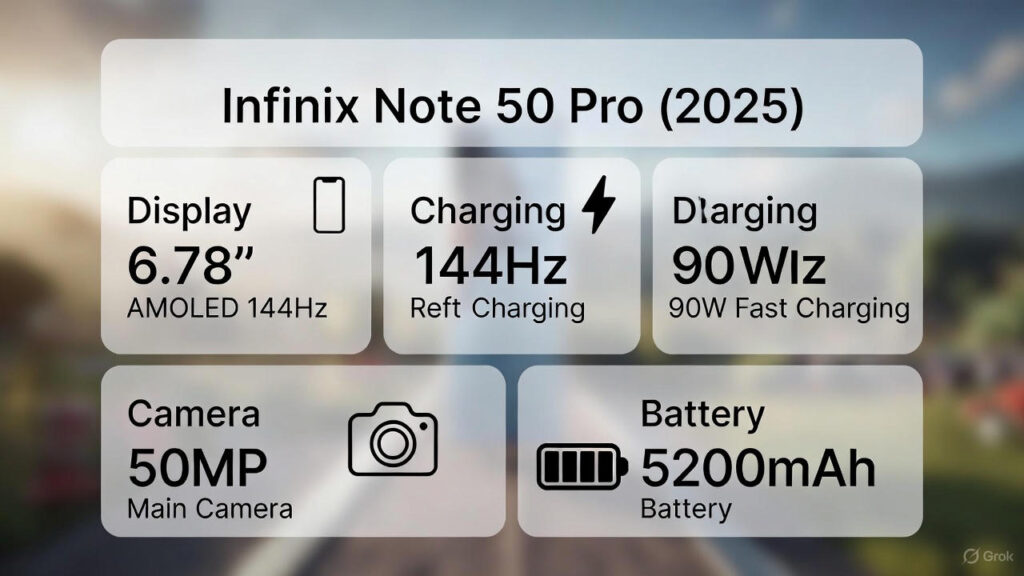
Infinix Note 50 Pro (2025) comes as one of the most loaded mid-range phones of the year, with a combination of a 6.78-inch 144Hz AMOLED display, 90W charging, and a main camera that has a 50MP sensor and enhanced imaging algorithms. The device will be released on March 3, 2025, and will be aimed at those who aspire to have flagship-like images, fast charging, and powerful daily usage without having to pay high prices. The Note 50 Pro with its 5200mAh battery, optional wireless charging of up to 30W on selected SKUs, and XOS-enhanced Android 15 features is one of the smoothest Infinix launches to date.
Quick specs at a glance
| Spec | Infinix Note 50 Pro |
| Launch date | March 3, 2025 |
| Display | 6.78″ AMOLED, 144Hz, FHD+ (~1080×2436) |
| SoC | Market-dependent (MediaTek Helio / Dimensity-class — SKU-dependent) |
| RAM / Storage | Up to 12GB / 256GB (some SKUs support extended RAM) |
| Rear camera(s) | 50MP main (+ 8MP ultrawide / macro depending on SKU) |
| Front camera | 32MP |
| Battery | 5200mAh; 90W wired; ~30W wireless on selected SKUs |
| OS | XOS on Android 15 |
| Extras | In-display fingerprint, IP64 splash resistance, some boxes include a wireless charging pad (market dependent) |
Design & build
The Note 50 Pro aims to appear and feel premium while holding value as its anchor. Key impressions:
- Ergonomics: Surprisingly narrow bezel and a comfortable one-hand reach for a 6.78″ device. Reported weight ~198 g — light for a large-screen phone with a big battery.
- Materials & finish: Aluminum-like frame (often alloy or polycarbonate with metallic finish) and either glossy glass or matte back, depending on colorway. Popular finishes include Enchanted Purple, Racing Edition, Shadow Black, and Titanium Grey.
- Buttons & ports: Tactile power/volume buttons with predictable actuation. Centered punch-hole selfie camera keeps symmetry.
- Seal & durability: IP64 splash resistance claims protect against light splashes but not submersion; still useful for everyday accidents.
Display
The Note 50 Pro’s display is its main differentiator. Many reviewers praise the screen, but few publish measured numbers. To exploit that gap, publish precise measurements.
What to measure
- Peak brightness (nits / cd/m²): Both manual and HDR peak. Give APL (average picture level) numbers and small-window HDR peaks. Readers want to know outdoor legibility.
- Color gamut & accuracy: Report DCI-P3 coverage (%) and Delta-E (median/lab). Lower Delta-E = better accuracy — essential for creators and colour-sensitive buyers.
- PWM / flicker: Measure frequency and amplitude at low brightness. PWM can cause eye strain for sensitive users.
- Adaptive refresh behavior: Demonstrate whether refresh rate truly scales down (e.g., 30→144Hz) and list scenarios where it locks higher. Many competitors talk about 144Hz but omit how the driver scales power.
- Response time & ghosting: Gray-to-gray response times matter for gamers; publish ghosting artifacts and sample videos.
- Screen uniformity & off-axis brightness: Show uniform gray photos and contrast at oblique angles.
- Device settings: Auto-brightness off; default color profile.
- White point & meter: Use a calibrated spectroradiometer/colorimeter. Measure white luminance at 100% and 50% APL.
- HDR test: Play HDR10 clip; measure small-window HDR peak (e.g., 10% APL patch) and full-screen APL.
- PWM test: Use an oscilloscope/light sensor at 1–10% brightness and record the frequency.
- Adaptive refresh logs: Use a frame-timing / refresh logging tool or ADB logs to show when the display drops to 60/30/1Hz and under which apps.
Performance & benchmarks
- Geekbench (single & multi): Run three times, report median values, and CPU temperature at the end of the run.
- 3DMark Wild Life and stress: Report score and throttling percentage over the stress run.
- GFXBench (onscreen): Use the onscreen test to compare GPU outputs across devices with the same resolution.
- Sustained throttling run: 30-minute CPU burn (stress-ng) — log temperature and Performance drop every 5 minutes. Produce a Throttling graph.
- Gaming test: 30-minute loop in PUBG/CoD/Asphalt with frame-time logs (average FPS, 1% low, 0.1% low). Plot FPS vs time and include device skin temperature measured by an IR thermometer.
- Storage & thermal: Run read/write I/O tests (e.g., AndroBench) and notify readers about thermal throttling behaviour under high sustained load.
Charts & data
- FPS vs time (gaming loop)
- CPU/GPU temps vs time during CPU burn and gaming
- Battery drain vs time during gaming vs video playback
Camera system
The Note 50 Pro’s 50MP main camera is strongest in daylight; low-light remains a weakness compared to flagship devices. Use a sample-first gallery so readers can instantly verify claims.
Camera analysis
- Daylight: Sharp, detailed, pleasing color; HDR works well to retain highlights and midtones. Good for social sharing and prints.
- Ultrawide: Useful framing option but lower detail and higher noise than the main module; publish crops.
- Night: Night mode improves exposure and shadow detail, but processing sometimes smooths fine textures and can introduce smudging; show 1:1 crops for evidence.
- Selfies: 32MP unit gives good detail, but XOS defaults may apply aggressive skin smoothing — include before/after screenshots of beauty toggles.
- Video: Stabilization is adequate for casual recording; test both 4K and 1080p variants and include mic samples to judge audio fidelity.
Video tests
- Stabilization comparison: Note 50 Pro vs a flagship (same scene, same walk).
- Bitrate & codec notes: Report recorded bitrate and encoder (HEVC vs AVC).
- Audio samples: One clip with an internal mic, one with an external mic (if possible) to compare clarity.
Battery & charging
5200mAh plus up to 90W wired charging is the phone’s other headline. Some SKUs also support ~30W wireless charging and may even ship with a wireless pad in select markets.
Real tests to run
- Charge log (0→100): Record timestamps at 0, 10, 20, 30, 40, 50, 60, 80, 100% — run once with phone off and once under a 4K video loop (airplane mode off). Report wall power draw (meter) and charger temperature.
- Screen-on time (SoT) tests:
- Video loop at 150 nits until shutdown (report % hours).
- Web browsing script (fixed loop of pages) until 20% battery.
- Gaming loop: 30-minute segments to evaluate drain rate per hour.
- Wireless charging log: If your SKU has wireless, measure negotiated wattage and the pad’s surface temp. Test third-party pads and measure charge time differences.
- Thermal measurements: IR Thermometer readings of the back and near charge connector every 5 minutes during charging.
Comparisons — Note 50 Pro vs three rivals
| Phone | Display | SoC | Camera (main) | Battery + Charging | 5G | Launch price (IN / PK / NG / KE) |
| Infinix Note 50 Pro | 6.78″ AMOLED 144Hz | Helio / Dimensity (SKU) | 50MP | 5200mAh, 90W wired, ~30W wireless (SKU) | Some SKUs lack 5G | (fill live) |
| Rival A (e.g., Redmi) | 6.67″ 120Hz AMOLED | XYZ | 64MP | 5000mAh, 67W | 5G | (fill live) |
| Rival B (Realme) | 6.7″ 120Hz AMOLED | ABC | 50MP | 5000mAh, 80W | 5G | (fill live) |
Who should buy the Note 50 Pro — and who should skip it
Buy if you want:
- A top-tier 144Hz AMOLED in this value bracket.
- Very fast wired charging (90W) and long battery endurance.
- Strong daytime photography without flagship prices.
Skip if you:
- Need consistent, best-in-class low-light camera results — flagships still lead.
- Require global 5G in every SKU; some variants lack 5G.
- Prefer a stock Android experience — XOS customizations and bloat may annoy you.
Deep-dive
Display test protocol
- Device settings: Auto-brightness off; default color profile.
- Use a spectroradiometer/colorimeter. Measure white point luminance at 100% and 50% APL.
- HDR: play HDR10 video and measure HDR peak window brightness.
- PWM: Use an oscilloscope/light sensor at low brightness and record frequency.
- Adaptive: capture refresh-rate logs using ADB or system logs.
Battery test protocol
- Use the stock 90W adapter and cable.
- Charge 0→100 with phone off; record timestamps and wall power with a wattmeter.
- Charge 0→100 during a video playback loop at 150 nits (report differences).
- Video loop SoT: run until shutdown and average across two runs.
Camera test protocol
- Use a tripod for controlled daylight/low-light shots, plus handheld night shots for real-world.
- Save raw files (if available) and JPEGs.
- Night shots: tripod + handheld sequences; keep exposure notes.
- Video: record 4K30 & 1080p60, with and without stabilization.
FAQs
A: The Note 50 Pro launched on March 3, 2025.
A: Up to 90W wired fast charging; published measured 0→50 and 50→100 numbers for accuracy.
A: Some SKUs support ~30W wireless charging; availability varies by market — check your specific SKU.
A: Some variants lack 5G — confirm the SKU/region before buying.
A: 50MP main rear camera, paired with an 8MP ultrawide (depending on the SKU).
Conclusion
The Infinix Note 50 Pro hits major value notes: an outstanding 144Hz AMOLED, very rapid 90W wired charging, a big 5200mAh battery, and capable daylight cameras. The chief compromises are SKU fragmentation (connectivity & wireless charging vary by market) and camera consistency in low-light scenarios. For buyers who prioritize screen quality and battery/charging, the Note 50 Pro is a compelling package. For camera purists or those needing universal 5G, Consider Alternatives.
