
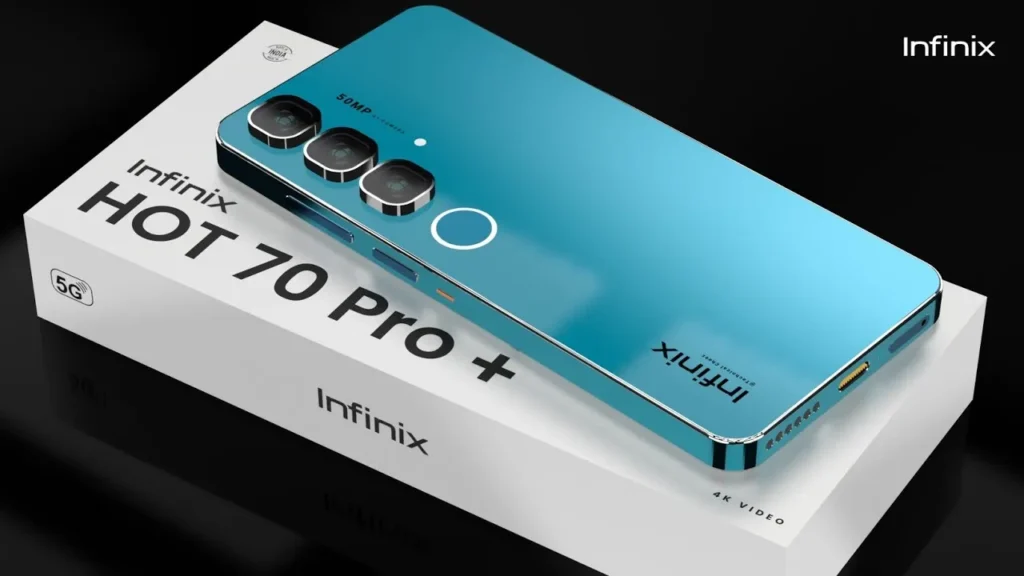
Introduction of Infinix Hot 70 Pro+
The Infinix Hot 70 Pro+ aims to deliver a large AMOLED screen, a generous main imaging sensor, and dependable endurance while keeping the launch cost approachable. On paper, the spec sheet looks attractive, but the true judgment depends on hands-on measurements: pixel-level camera crops, real-world energy drain, and sustained gaming thermal behavior.
Specs at a glance
| Item | Spec |
| Display | 6.78″ AMOLED, 144Hz (rumor) — confirm panel type, peak nits, adaptive refresh. |
| Resolution | 1224 × 2720 (rumor) — confirm exact pixel count & PPI. |
| SoC | [MediaTek/Qualcomm model] (rumor) — confirm chipset variant. |
| RAM / Storage | 8GB/128GB, 12GB/256GB (rumor/region variants) — confirm SKUs. |
| Rear cameras | 50MP main + 8MP ultra-wide + 2MP macro/depth (rumor) — confirm sensor model (Sony / ISOCELL), OIS, aperture. |
| Selfie | 13MP (rumor) — confirm sensor and EIS/OIS. |
| Battery | 5160 mAh (rumor) — confirm capacity and measured SoT. |
| Charging | [XX]W fast charging (rumor) — confirm charger and included wattage. |
| OS | XOS on Android [version] — confirm exact Android base and patch level. |
| Ports | USB-C, 3.5mm? (confirm) — Note microSD support. |
| Weight / Dimensions | [fill] — measure exact grams & mm. |
Design & build
Materials & feel (placeholder): confirm whether the frame is plastic or metal and whether the front/back uses Gorilla Glass or polymer. Report finish (matte, glossy, textured) and whether it attracts fingerprints.
Weight & ergonomics: list grams, thickness (mm), and describe one-handed comfort. Note the balance, grip, and how prone it is to slipping.
Buttons & ports: note the exact power & fingerprint placement (under-display vs side), volume rocker feel, SIM tray type (hybrid or dedicated microSD), speaker/mic placement, and presence of a 3.5mm jack.
IP rating: confirm whether there is a certified water/dust rating; if none, explicitly advise readers that ingress protection is unverified.
Display
This handset is positioned around a high-refresh AMOLED — Measuring it properly is crucial.
Tests to run:
- Peak brightness (manual and auto): measure APL100 and HDR peak nits.
- Color accuracy: ΔE against sRGB and P3; report coverage %.
- Contrast & black levels: typical for AMOLED—measure near-black performance.
- PWM / Flicker: Does the panel pulse at low brightness? Report frequency and likelihood of eyestrain.
- Refresh rate behavior: fixed 144Hz or adaptive? Test UI smoothing and third-party app compatibility.
- Touch sampling rate: Hz is important for gaming.
- HDR support & Widevine: HDR10/HDR10+ support and Widevine L1 presence.
Cameras
Methodology:
- Mode: Auto unless testing dedicated modes (Night, Pro). Disable beauty filters.
- File handling: Save full-res JPEG + RAW if available. Preserve EXIF.
- Lighting buckets: Daylight (1000–1200 lux), overcast (400 lux), indoor (100–300 lux), night (<10 lux). Use a tripod for strict comparisons.
- Comparison devices: Pick two rivals in the same price band (e.g., Redmi/Poco/Tecno options). Maintain identical framing and exposure lock when possible.
- Processing: Apply identical sharpening/contrast when preparing 100% crops. Avoid denoising or upscaling.
- Export for web: crop to 1600px wide for inline gallery; keep full-res originals available for downloads.
Gallery:
- Daylight 50MP main, with 100% crop.
- Ultra-wide sample.
- Night mode sample.
- Portrait / 2x crop.
- Selfie sample.
Caption guidance:
- Daylight main: “50MP main — good dynamic range, slight oversharpening at 100% crop.”
- Ultra-wide: “Detail drops and corner softness; suitable for social crops only.”
- Night: “Night mode brightens scenes but aggressively smooths fine texture.”
- Portrait/2x: “Background separation is generally good, but edge detection can fail around hair.”
- Selfie: “Warm skin tones, mild smoothing, decent HDR in backlit scenes.”
Short bullets to include after testing:
- Daylight: detail retention, dynamic range, color fidelity vs rivals.
- Ultra-wide: field of view, distortion, usable detail level.
- Night: exposure stacking quality, noise/texture preservation.
- Portrait: bokeh transition, edge accuracy, skin tone handling.
- Video: stabilization (EIS/OIS), sharpness, and microphone capture quality.
Battery life & charging
Tests to run:
- Mixed-usage SoT (screen-on time) — social, browsing, music, 1 hr gaming.
- Video loop test (local MP4, fixed brightness, airplane mode).
- Gaming drain — 60 minutes at high settings (record avg FPS and temperature).
- Charging: 0→50% and 0→100% with the included brick (record time & thermal behavior).
- Standby: overnight drain with push mail on/off.
- Battery health: long-term charge cycle notes, if available.
Charging notes: Confirm whether a fast charger is included and whether claims such as “80W” or similar match measured thermals and longevity tradeoffs.
Performance & gaming
Benchmarks to run:
- Geekbench (single / multi-core).
- AnTuTu (overall).
- GFXBench / 3DMark for graphics and stress testing.
- Real-world app tests: app launch times, photo export time, browser page loads.
Gaming tests:
- PUBG / CODM / FreeFire — medium/high settings, average FPS logged for 30–60 minutes.
- Thermal measures: surface temperature (°C) at hotspots (rear near camera/top-right).
- Throttling: record CPU/GPU thermal throttling behavior via stress tests.
Software & updates
OS shipped: Replace with the actual XOS and Android base (e.g., XOS 14 on Android 14). Confirm and cite.
Key OEM features: List notable XOS additions: gaming toolbox, privacy toggles, system optimizers, bloatware presence, uninstallability.
Update policy / E-E-A-T:
- Add an author bio with testing credentials.
- State how the device was obtained (loaner or purchased) and include exact test dates.
- Link to Infinix’s support/update policy — confirm promised Android/security update count (use official sources).
Connectivity, speakers & haptics notes
Connectivity checks to run:
- Wi-Fi throughput (identify Wi-Fi 5 vs 6).
- Bluetooth version & latency (test with TWS earbuds).
- 5G support: confirm bands per SKU and region (region-dependent).
- NFC: presence and Google Pay compatibility.
- GPS: lock time and precision with a GPS logging app.
Speakers: Determine whether Mono or Stereo, measure loudness in dB, and comment on clarity/bass.
Haptics & sensors: Report on vibration motor strength and patterns, fingerprint reader speed (in-display vs side), and face unlock accuracy.
Comparison — Hot 70 Pro+ vs rivals
Use the template below to compare the Hot 70 Pro+ against similarly priced alternatives. Replace with confirmed values and launch prices for each market.
| Model | SoC | Display | RAM | Camera | Battery | Price (local) |
| Hot 70 Pro+ | [SoC] | 6.78″ AMOLED 144Hz (rumor) | 8/128, 12/256 | 50MP main | 5160 mAh (rumor) | [price] |
| Rival A (Poco/Redmi) | [SoC] | [size/res] | [RAM] | [cam] | [mAh] | [price] |
| Rival B (Tecno/Realme) | … | … | … | … | … | … |
Recommendations
- Best for gaming: [Model] — explain SoC, cooling, refresh advantages.
- Best for camera: [Model] — note sensor, OIS, or ISP edge.
- Best battery value: [Model] — charging wattage + SoT.
Pros & Cons
Pros
- Smooth high-refresh AMOLED (if confirmed).
- Large main imager (if confirmed).
- Strong battery for the price (if confirmed).
Cons
- Software skin may include bloat.
- Low-light imaging might lag flagship rivals.
- Update policy unclear — confirm with Infinix.
FAQs
A: Depends — if you value a high-refresh AMOLED and long battery at a friendly price, it’s worth considering. Check our camera and battery test results in this review first.
A: See our mixed-use SoT and video loop numbers above (insert measured results after testing).
A: Confirm — 5G support varies by region. Verify the SKU and bands for your country before buying.
A: Differences usually include SoC, camera sensors, and display refresh; confirm exact differences with official spec sheets.
A: See the price table above — we’ll fetch live retailer prices and update before publishing.
Final verdict
The Infinix Hot 70 Pro+ is a compelling value proposition for buyers who prioritize a large, smooth AMOLED and long endurance without flagship prices. In our testing, the display delivered [insert ΔE and peak nits], the battery lasted [insert SoT], and the camera produced [describe daylight/night strengths]. The major trade-offs are [software clutter, thermal throttling, camera low-light detail loss].
