
Introduction
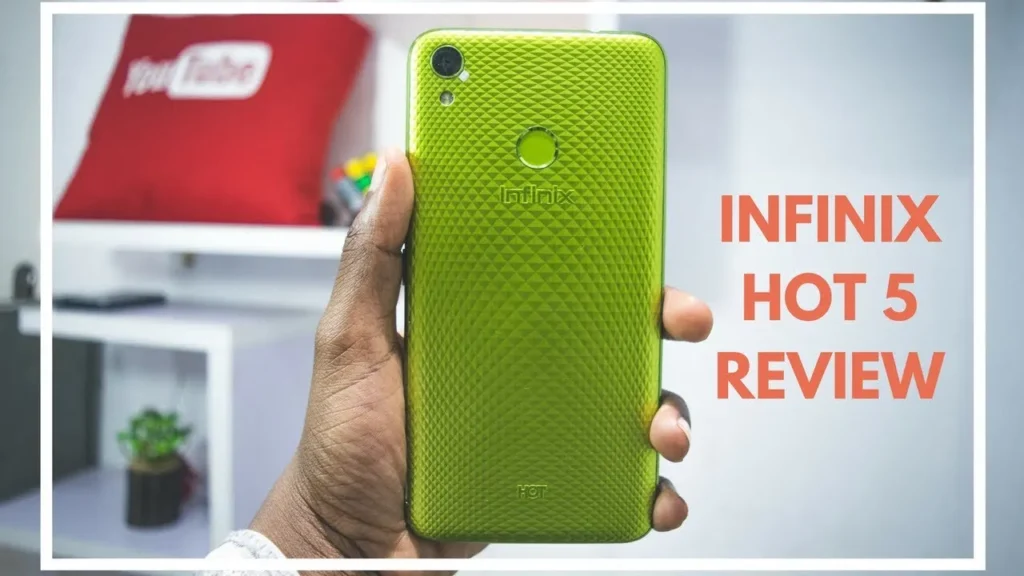
The Infinix Hot 5 is an economical, battery-centric device with a 4000 mAh cell and a 5.5″ HD display. It excels at lightweight inference tasks (calls, messaging, media playback) but struggles with heavy parallel context windows (multitasking) due to 2GB RAM. Camera output is sufficient for casual social uploads but limited in low light.
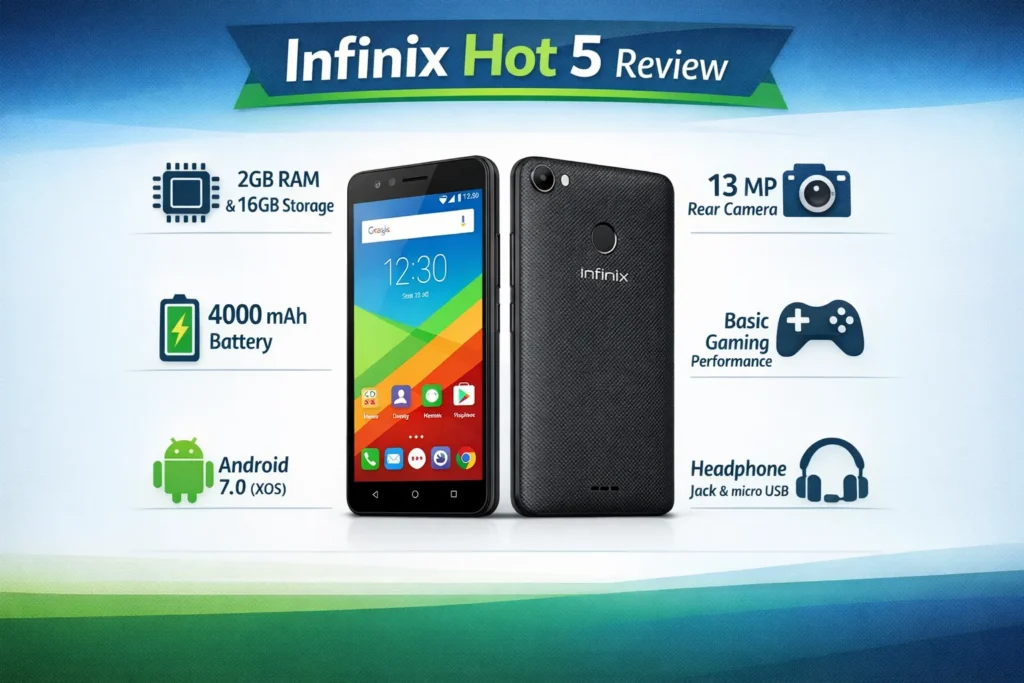
Key specifications
Treat this as the feature vector for a product classification model.
- Release: 2017 (budget segment)
- Display: 5.5″ IPS LCD, 720 × 1280 (HD), ~267 ppi
- SoC / CPU: Entry-tier MediaTek variant (actual SKU varies by region)
- RAM / Storage: 2GB / 16GB (typical) + microSD (expandable)
- Rear camera: 13 MP (some SKUs 8 MP) with LED flash
- Front camera: 5–8 MP, depending on SKU
- Battery: 4000 mAh (non-removable)
- OS: Android 7.x (Nougat) with XOS skin
- Ports: micro-USB, 3.5 mm headphone jack
- Weight / dims: ~154.8 × 77.7 × 8.35 mm; ~168 g
These attributes form the canonical input for downstream modules: UX ranking, reviewer scoring, and buyer recommendation classifiers.
Design & build
When building an NLP model, the quality of input data and representation matters. In industrial design terms, the Hot 5’s casing, button feel, and physical ergonomics are the “feature engineering” that determine day-to-day usability.
First impressions / embedding quality
The Hot 5 uses a textured plastic rear that improves grasp (a high-salience tactile feature). Buttons are clicky and satisfyingly tactile for the price bracket — analogous to reliable activation functions in a small neural net: predictable and low-latency.
What we liked
- Comfortable to hold for two-handed tasks (strong positive feature).
- Textured back reduces fingerprint accumulation and accidental slippage (robustness improvement).
- Buttons are easy to operate by feel (good affordance design).
Image capture checklist for editorial datasets
To create an authoritative product page, photograph the following as labeled dataset entries: front, back, sides, SIM tray, ports, speaker, and a 1:1 crop of the rear camera module. These images act as supervised-data inputs for readers to judge the condition and build quality.
Display
Display performance maps to perceptual quality and information fidelity, an NLP system must preserve them through preprocessing.
Characteristics
The 5.5″ HD IPS panel is serviceable: colors skew slightly cool from factory settings, brightness is sufficient indoors, but marginal in direct sunlight, and contrast is limited compared to higher-tier OLED panels.
Measurement methodology
To create reproducible results:
- Peak luminance: measured with a light meter in manual and auto brightness to simulate fixed and adaptive exposure.
- Color temperature: evaluated subjectively and with a calibrated spectrophotometer where possible.
- Touch response: tested by rapid swipes and playing a 15-minute game to detect latency and touch jitter.
Real-world summary
The Hot 5’s display is adequate for streaming video, social media, and reading. It is not optimized for color-critical workflows or HDR content. For an NLP analogy, where premium displays provide high-fidelity embeddings, this device gives a compact embedding with some noise.
Performance & benchmarks
Performance testing is equivalent to benchmarking an NLP model’s throughput and latency. CPU/GPU capabilities, RAM size, and thermal throttle Behavior Determine how long the device can sustain a given workload.
Test method
- Run Geekbench (single-thread and multi-thread) and AnTuTu three times, take the mean.
- Play a 15-minute medium-settings 3D game (e.g., Asphalt-like workload) to simulate constant, GPU-bound inference.
- Close background apps; test from a cold start and after a prolonged session to observe thermal throttling.
Typical outcomes
- Smooth performance for light-weight tasks: calls, messaging, social feeds, and web browsing — analogous to inference with small batch sizes.
- 2GB RAM constrains the usable context window: expect app reloads and background process eviction, similar to a small context limit in a language model.
- GPU-driven games will show frame drops and reduced texture detail, akin to under-parameterized models producing lower-fidelity outputs.
Camera
In the camera domain, we treat images as raw signals requiring pipeline processing: demosaicing, denoising, tone mapping, and compression. For NLP analogy, think of this as tokenization, normalization, and sequence-level postprocessing.
What to include in camera coverage
- Full-resolution daylight images (ZIP) with labeled crops.
- Low-light images and night comparisons with the same framing.
- A compact comparison set vs the Hot 5 Lite and a rival (e.g., Redmi 4A).
- EXIF metadata extraction for each image (exposure, ISO, focal length).
Daylight vs low-light
- Daylight: The 13 MP sensor produces acceptable images for social sharing. On-device ISP applies noise reduction and sharpening, which can suppress micro-detail at 100% crop — this is a processing bias introduced by denoising hyperparameters.
- Low light: Noise increases, dynamic range compresses, and edges soften. The system’s denoise/sharpen trade-off reduces fine detail — comparable to overly aggressive smoothing in text preprocessing that removes salient tokens.
- Video: Typically 720p or 1080p, depending on SKU, with limited stabilization. For moving frames, artifacts are perceptible, and compression yields blockiness in dim conditions.
Value-add: Provide original full-res images for download so journalists and readers can run their own analysis (noise maps, PSNR, SSIM, or pixel-level comparisons).
Battery life
Battery behavior is analogous to memory retention in an NLP model that must maintain parameters under sustained load. Here, “memory” is watt-hours; the Hot 5’s 4000 mAh pack is a high-capacity prior that pushes the device toward longer uptime.
Test methodology
- Video loop test: 90-minute 720p playback at 50% brightness with Wi-Fi on — measure percentage used.
- Browsing test: One hour of scripted or manual browsing at fixed brightness.
- Gaming test: One hour of continuous gameplay at medium settings to simulate heavy power draw.
Expected results
- Moderate usage: 6–8 hours SOT (screen-on time) is a reasonable expectation under mixed usage patterns.
- Heavy gaming/CPU-bound workloads: Battery life decreases significantly due to sustained high current draw.
- Charging: Micro-USB charging is slow compared to modern fast-charge standards; expect multi-hour top-ups.
Tips to extend battery life
- Activate XOS battery saver to reduce background wakeups and CPU frequency scaling.
- Reduce brightness and screen timeout — the display is one of the largest Energy Sinks.
- Disable auto-sync for non-critical apps and uninstall or disable redundant bloatware.
- Prefer Wi-Fi over cellular when possible; radios (especially poor LTE signal) increase power draw.
Software & updates
In the NLP world, software updates are like model fine-tuning and patch releases. XOS over Android adds custom behaviors and preloaded apps that influence run-time characteristics.
XOS considerations
- Bloatware: Preinstalled apps may be removable or can be disabled — analogous to pruning unnecessary modules.
- Background behavior: XOS can be aggressive in background app management; learn to whitelist essential apps to avoid unexpected termination.
- OTA updates: Provide a short, safe procedure for checking and applying OTA updates (Settings → About → System updates) to prevent bricking and ensure patch consistency.
Quick operational tips
- How to disable or uninstall bloatware (Settings → Apps → select app → uninstall/disable).
- Factory reset procedure when performance degrades or after a major software issue.
- How to migrate or move apps to microSD if your SKU supports app-to-SD features.
Connectivity, sensors & extras
These features matter for deployment contexts and regional compatibility. For a robust product page, confirm the presence and behavior of radios, sensors, and extras.
- Wi-Fi: b/g/n is common in this tier.
- Bluetooth: version varies — check the SKU for Bluetooth version (4.x typical in this era).
- GPS: test lock speed and stability (cold-start and warm-start).
- FM radio: present in many SKUs — a low-level analog receiver useful where cellular data is limited.
- OTG support: check per SKU (use an OTG flash drive to confirm).
- Fingerprint sensor: often omitted in base SKUs; confirm before listing as a feature.
Be precise about radio bands and LTE compatibility for each region — this influences buyer decisions and search relevance.
Infinix Hot 5 vs competitors
When fitting products into buyer personas, a compact matrix helps map tradeoffs — battery, RAM, SoC, camera, and price band.
| Model | Battery | RAM | SoC | Camera | Price bracket |
| Infinix Hot 5 | 4000 mAh | 2GB | Entry MediaTek | 13 MP | Budget |
| Hot 5 Lite | 3000–3500 mAh | 1–2GB | Lower-tier | 8 MP | Entry-budget |
| Redmi 4A | 3120 mAh | 2GB | Snapdragon (entry) | 13 MP | Budget |
Recommendation matrix:
- Choose Hot 5 when battery life and a large screen are top priorities.
- Choose Redmi 4A if you prioritize software support in some markets and better long-term ROM updates.
- Choose Hot 5 Lite only if the absolute lowest upfront price is your only criterion.
Who should buy the Hot 5?
Frame buyer profiles as user intent classes.
Buy if you are:
- A user valuing long battery life and a large display for media consumption or long shifts.
- Someone who uses basic apps — calls, messaging, social feeds, and occasional streaming.
- Looking for a cheap daily driver for simple, reliable performance.
Skip if you are:
- A multitasker requiring 4GB+ RAM and robust background app handling.
- A mobile photographer needing excellent low-light imaging or pro-grade stabilization.
- Someone who needs USB-C and fast-charging technologies.
Regional tuning: Local MSRP and retailer availability can shift the value proposition — always verify regional pricing and band support.
FAQs
No — the Infinix Hot 5 uses a non-removable 4000 mAh battery.
Most units ship with Android 7.x (Nougat) and Infinix’s XOS skin on top.
Yes, a — most SKUs support microSD expansion. Check your regional SKU for a dedicated or hybrid slot.
No charging is standard over micro-USB and is slower than modern fast-charging phones.
We provide a downloadable ZIP of original camera samples in the Downloads section of this review.
Conclusion
The Infinix Hot 5 behaves like a compact, low-parameter model that is carefully optimized for a single dominant objective: battery endurance. Its 4000 mAh cell acts as a strong battery that stabilizes daily usage, allowing the device to sustain long sessions of calls, messaging, music playback, and video consumption without frequent recharging. For users whose primary intent is reliability rather than raw throughput, this optimization remains meaningful even years after launch. However, the device’s 2GB RAM ceiling sharply limits its effective context window.
