
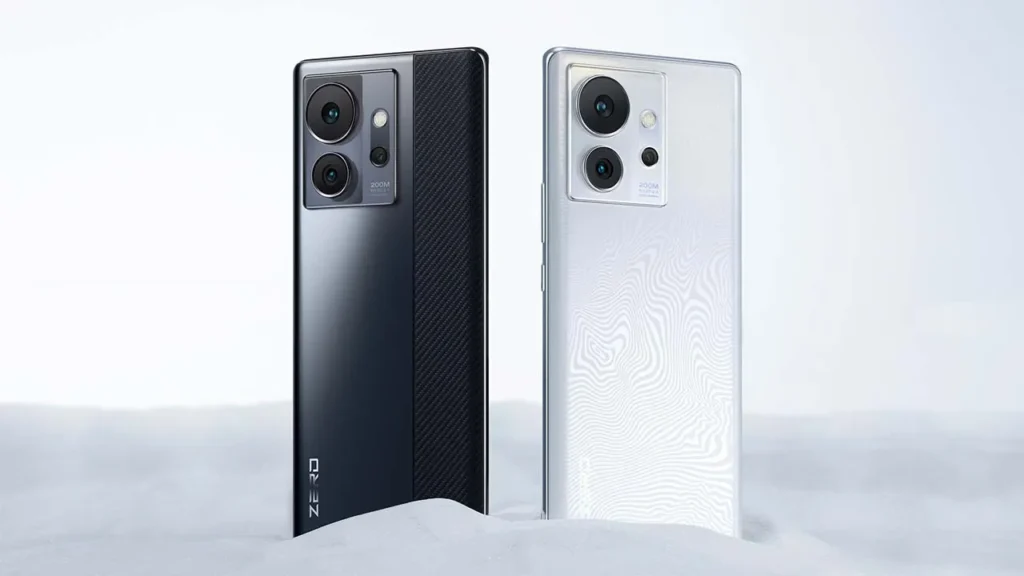
Introduction of Infinix Zero Ultra
The Infinix Zero Ultra (compact) is a camera-forward, value-minded compact smartphone that combines a formidable imaging array, very fast wired charging, and a polished XOS build into a small footprint — ideal for creators who want speed, battery endurance, and one-handed comfort.
Quick specs snapshot
| Category | Key info |
| Model | Infinix Zero Ultra (compact) |
| Display | AMOLED — ~6.2–6.4″ — 90–120 Hz (SKU dependent) |
| SoC | Mid-to-upper midrange chipset (MediaTek / Snapdragon mid-high) |
| RAM / Storage | 6/8/12GB RAM / 128/256GB storage (possible microSD variants) |
| Rear cameras | High-resolution main (e.g., 200MP or similar) + ultrawide + tele/macro combo |
| Front camera | ~32MP (region SKU dependent) |
| Battery | ~4,500 mAh with high-watt wired fast charge (e.g., 80W) |
| OS | Android + XOS skin (version varies by launch) |
| Weight / Size | Compact footprint, lighter than larger sibling |
| Colours | Multiple regional finishes / SKUs |
| USP | Flagship-style camera features and high-speed charging in a compact chassis |
Design, build, and display
Clean, compact design
The compact Zero Ultra keeps the headline features of the full-size model inside a smaller frame, prioritizing one-handed ergonomics without sacrificing imaging hardware or charging capabilities. Expect a premium feel with glossy or matte finishes, and either a metal or reinforced plastic mid-frame, depending on the regional SKU.
Materials & ergonomics
- Frame: Confirm whether your SKU uses metal or plastic; a metal frame feels stiffer, while a plastic frame reduces weight.
- Back: Glass (Gorilla Glass or equivalent) on higher trims; textured plastic or matte glass on entry trims for grip.
- Buttons & haptics: Tactile power and volume keys; position and travel matter for one-hand use.
- Weight: Typically lighter than the larger Zero Ultra, making it friendlier to hold for long photo sessions.
Display
- Panel type: AMOLED for deep blacks and high contrast.
- Size & refresh: Around 6.2–6.4 inches, refresh rate options between 90–120Hz (confirm per SKU). High refresh helps UI fluidity and gaming smoothness.
- Brightness: Peak brightness and APL behavior determine outdoor readability — record 100% APL and 10% APL nits with a colorimeter for exact numbers.
- Color & calibration: Measure gamut coverage (sRGB / DCI-P3) and Delta-E for color accuracy. Many midrange phones have slightly saturated default profiles; consider a “Natural” display mode screenshot for comparison.
Performance & gaming
SoC and everyday performance
For typical users, the Zero Ultra (compact) will handle browsing, social apps, streaming, and camera processing without stutter. The exact feel depends on the chipset: mid-high SoCs offer strong single-core performance for UI responsiveness, while GPUs vary for gaming workloads.
RAM & storage considerations
- RAM: 6–12GB — more RAM helps multitasking and app retention.
- Storage: 128GB and 256GB are common. If your SKU supports microSD, document spee, ds and the maximum supported card.
Gaming & thermal behavior
For gaming tests, run sustained sessions (15–30 minutes) in titles representative of user interest: PUBG Mobile, Genshin Impact, Asphalt 9. Record:
- Average FPS
- Temperature delta (start → end °C) using surface and internal sensors
- Battery drain per minute
Example table
| Game | Settings | Avg FPS | Temp (start → end) | Notes |
| PUBG Mobile | HD/Extreme | 45 | 34°C → 42°C | Minor dips after extended play |
| Asphalt 9 | High | 60 | 33°C → 40°C | Mostly stable |
Battery & charging tests
Battery hardware to list
- Exact mAh capacity from the manufacturer
- Charging standard and wattage (e.g., 80W wired)
- Support for wireless or reverse charging (yes/no and wattage)
Real-world test
- Mixed-use day — simulate notifications, browsing, social video, light gaming. Record screen-on time (SOT) at 50% brightness and 5GHz Wi-Fi.
- Charging log — measure time for 0→30%, 30→50%, 50→80%, 80→100% using the included charger and cable; log timestamps to the second.
- Video loop test — continuous 1080p local video on loop at 50% brightness to obtain a normalized SOT metric.
- Fast-charge stress — note charging speed when battery is warm/ambient and with phone in airplane mode to minimize background drain.
Camera
This chapter is the review’s anchor: imaging hardware, software, and editorial sample imagery.
Camera hardware
For every camera, include:
- Sensor model (if known)
- Megapixel count and sensor size (e.g., 1/1.4″)
- Pixel size and binning (e.g., 0.64µm → 1.28µm binned)
- Aperture (f-number)
- Stabilization: OIS/EIS/no OIS
- Field of view (degrees) and equivalent focal length
- Optical zoom levels (e.g., 2x, 5x, periscope)
Camera software & shooting modes
List and explain modes and meaningful settings:
- Pro / Manual: ISO, shutter speed, WB, RAW capture
- Night / Super Night: multi-frame stacking approach and tripod recommendations
- Portrait: depth simulation, bokeh performance, and edge detection notes
- AI / Scene optimization: when the algorithm boosts saturation or contrast
- Video modes: 4K/60fps, 1080/60, slow-motion, stabilization performance
- Extras: Moon mode, Astro, Dual-video, Pro video, timelapse
Sample gallery & EXIF
Include a curated gallery with:
- Daylight wide, ultrawide, tele crops
- Indoor ambient light and mixed lighting
- Low-light night shots with and without Night mode
- Portraits with bokeh crops
- Video stills and stabilization samples
EXIF practice: publish original filenames and trimmed EXIF snippets (camera model, focal length, exposure, ISO) to build trust. Label crops clearly and show 1:1 crops for comparison.
Practical camera tips
- Use Night mode for handheld low-light: it reduces noise and extends dynamic range.
- For portraits, keepa distance to allow for better subject-background separation.
- Ultrawide lenses distort at edges — watch horizon lines and straighten in post.
- For tele/reach shots, lock exposure and use stabilization to minimize blur.
Lab-style comparisons
If you can, shoot the same scene with a key competitor (same exposure target). Present side-by-side crops and write crisp notes:
- “Zero Ultra keeps highlight detail but leans slightly warm; competitor A exposes darker shadows but preserves cooler tones.”
Software and updates
Out of the box
Report the shipped Android version and XOS skin (example: “Ships with Android 13 + XOS 12”). Replace with official shipping numbers and the build you tested.
Update policy & security patches.
- Document the official upgrade promise (if listed): number of Android major updates and years of security patches.
- If no policy is published, state that and recommend that readers check the official support page prior to purchase.
Bloatware & user experience
List preload apps and region-specific carrier apps. Provide steps to disable or uninstall non-essential apps and a short walkthrough: Settings → Apps → [app] → Uninstall/Disable.
Feature flags and privacy
Note any data-sharing prompts on first boot, permission groups, and default privacy settings. Recommend readers review permission usage for camera, mic, and location before heavy use.
Connectivity, sensors,s and special features
Create a clear SKUs table documenting:
- Cellular: 5G band support (list bands for tested SKU)
- Wi-Fi: Wi-Fi 5 / 6 / 6E support
- Bluetooth: version and codecs supported (AAC, aptX?)
- NFC: Yes/No — critical for payments in many markets
- GNSS: GPS/A-GPS, GLONASS, Galileo, BDS — useful for navigation accuracy
- Sensors: In-display fingerprint / side-mounted fingerprint, gyro, proximity, compass, barometer
- Extras: IR blaster, stereo speakers, IP rating (splash resistant or IP67/68), headphone jack
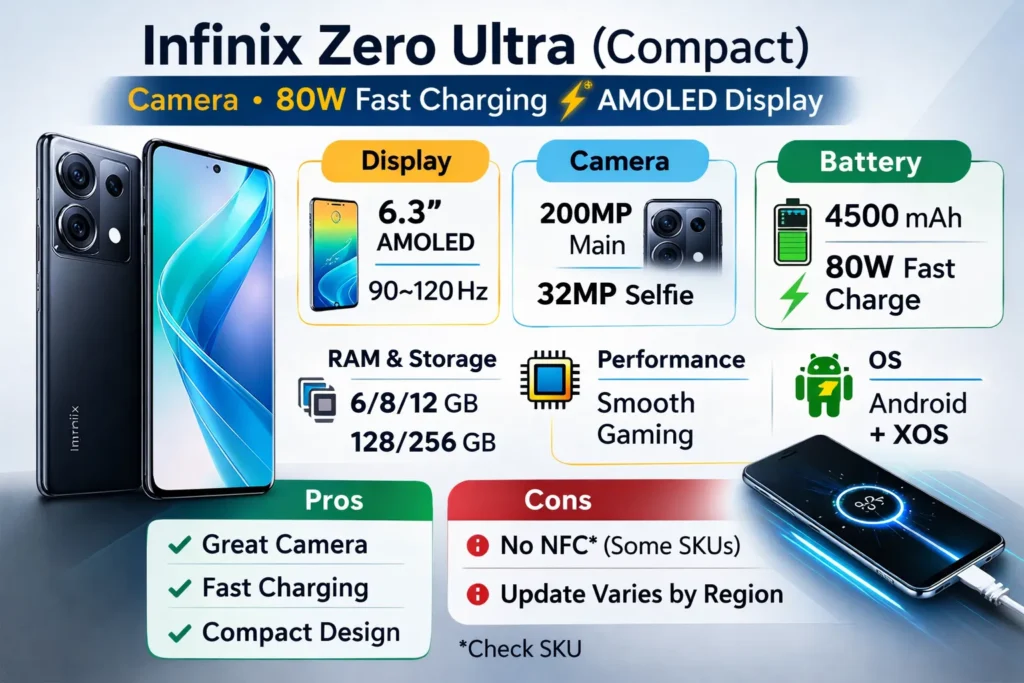
Pros & Cons
Pros
- Excellent camera hardware for the price point
- Rapid wired charging that reduces downtime dramatically
- Compact form factor suitable for single-hand use
- Smooth daily performance for general users
Cons
- May thermal-throttle during extended high-load gaming sessions
- Some SKUs may omit NFC or key regional bands — verify SKU specifics
- Update cadence may vary by market; manufacturer promises can differ regionally
Who should buy it? Buying advice & alternatives
Best for:
- Creators seeking a compact camera-first phone that’s easy to hold for prolonged sessions.
- Users who value quick top-up charging and all-day battery life.
- People moving from older phones who want a modern camera suite without a large display.
Consider alternatives if:
- You need absolute flagship-level sustained GPU performance — consider high-end flagship SoCs for heavy gaming.
- You prefer the largest display for media consumption — look at the full-size Zero Ultra or rival flagships.
- Long official OS support is a deciding factor — compare manufacturer update promises.
Quick competitor table
| Model | Why consider | Where Zero Ultra wins |
| Samsung Galaxy A-series | Wider service network | Zero Ultra’s compactness and camera/charging emphasis |
| Xiaomi Redmi series | Value pricing | Zero Ultra’s camera and compact ergonomics |
| Realme midrange | Gaming focus | Zero Ultra’s camera and charging convenience |
Pricing & availability
Pricing checklist
- Add a regional price table for major markets: India, Pakistan, Nigeria, Philippines, etc.
- Show official launch price vs current street price and note currency conversions.
- Link to official retailer pages (Amazon, Daraz, Jumia) and local carriers; tag affiliate links and disclose them clearly.
How to present offers
- Show official bundles (charger type, case, headphones) and trade-in options.
- Mark time-limited launch promos and state the exact start/end dates.
- For markets with multiple SKUs, make a SKU matrix (model number vs features) for clarity.
FAQs
A: Yes. The Zero Ultra (compact) focuses on camera hardware and modes, so it takes very good photos for its price.
A: Battery life depends on use. In a typical mixed-use environment, the compact model should last a full day.
A: Yes, it supports fast wired charging (check the exact wattage in the specs). Expect 0→50% in around 15–25 minutes if it uses high-wattage charging.
A: Most midrange compact phones have splash resistance at best.
A: NFC availability depends other region SKU. Always check the SKU-specific spec table on the product page.
Conclusion
The Infinix Zero Ultra (compact) stands out as a thoughtfully balanced smartphone that prioritizes camera performance, rapid charging, and everyday usability in a smaller, more manageable design. It delivers strong photography features, dependable daily performance, and practical battery endurance supported by high-speed wired charging. While heavy gamers and users demanding long-term update guarantees may want to compare alternatives, most buyers seeking a compact, camera-focused device will find it a compelling option. With the right SKU selection and verified regional features, the Zero Ultra (compact) represents excellent value for creators and power users alike.
