
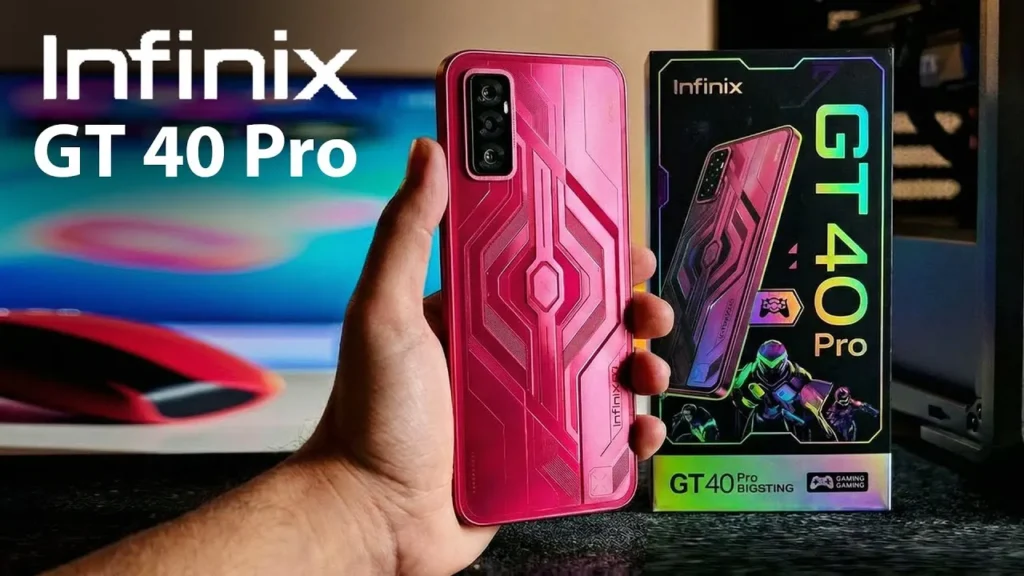
Introduction of Infinix GT 40 Pro
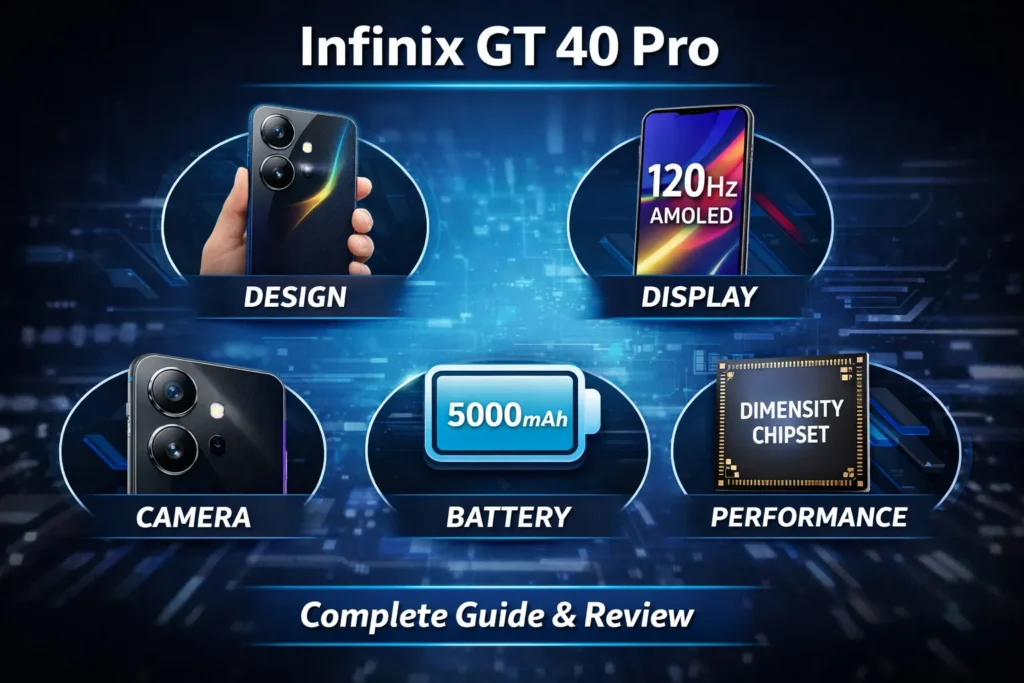
The Infinix GT 40 Pro is positioned as a performance-focused smartphone that blends gaming power, modern design, and long battery life at a competitive price. In this complete pillar guide, we break down every major feature—design, display quality, chipset performance, camera results, battery endurance, charging speed, software experience, and connectivity. This article is structured for easy reading and quick scanning, so you can find exactly what matters to you. Whether you are a casual user, student, gamer, or content consumer, this guide helps you understand the real-world strengths and limitations before making a buying decision.
Design & Build
Think of the phone’s design as the “input representation” for every interaction you will have: the chassis, finish, and ergonomics form the encoding layer that downstream experiences (touch, camera stability, pocketability) rely on.
Materials: Many entries in the GT 40 Pro family use polycarbonate or composite backs with reinforced frames; higher trims lean toward glass backs. In NLP terms, the material choice is a feature vector that influences downstream tasks (grip, scratch resistance, thermal dissipation).
Weight & size: Midweight range — comfortable for prolonged sessions (reading, streaming, web browsing). The size is a dimensionality constraint: larger screens give richer context windows for content, and smaller phones are more compressible and pocket-friendly.
Colors: Bright, gradient, and matte finishes. Matte reduces fingerprint tokens; glossy surfaces increase reflection but score higher for visual flair.
IP rating: Some variants include splash resistance; full IP68 immersion protection is rare in this class — treat water resistance as a binary flag that matters if you operate in wet environments.
Practical design notes
- Rounded corners reduce hand-strain and provide better ergonomics (think of smoothing functions in signal processing).
- Flat or slightly curved edges affect grip — a small change in geometry yields different user confidence (less slippage).
- Use a protective case that shields the camera bump — consider case thickness as a tradeoff: protection vs. bulk.
- Buttons: power + volume on the right side are standard. Fingerprint sensors can be side-mounted or under-display on higher trims; choose based on your unlock speed preference.
Display
The display is your primary output layer. It shapes perceived quality, readability, and media immersion. Treat refresh rate, color gamut, and peak brightness as important features in a perceptual scoring model.
Size: Typically 6.4″–6.8″ in this class — a wide context window for media and multitasking.
Type: IPS vs. AMOLED. AMOLED acts like a sparse representation for blacks (zero-level pixels), providing better contrast and energy efficiency on dark themes.
Resolution: FHD+ (1080p+). Consider resolution as an embedding dimension: higher resolution yields more detail but increases memory (power) usage.
Refresh rate: 60Hz baseline; 90Hz or 120Hz for smoother interactions. Higher Hz reduces motion blur and improves perceived responsiveness.
What affects your experience
- Brightness (peak nits): 500+ nits recommended for sunlight readability — it’s the signal-to-noise ratio for outdoor visibility.
- Color coverage (DCI-P3): Wider gamut yields vivid media; useful when using the phone as a content consumption endpoint.
- Touch sampling: A higher sampling rate (e.g., 180Hz) is better for fast-paced inputs in gaming, like increasing sampling frequency in a sensor to reduce aliasing.
Display a quick comparison
| Feature | Good value | Why it matters |
| Type | AMOLED | Deep blacks, contrast |
| Resolution | 1080 x 2400 | Sharpness for text/video |
| Refresh rate | 90–120Hz | Smooth scrolling & gaming |
| Peak brightness | 500+ nits | Outdoor readability |
| Protection | Gorilla Glass | Scratch/impact resistance |
Performance
In phones, you choose SoC (model), RAM (working memory), and storage type (I/O throughput). These determine throughput, latency, and sustained performance.
Chipset: A modern mid-range chipset (MediaTek Dimensity or Snapdragon mid-class) offers a balance of performance and power efficiency. Treat SoC choice as model architecture selection.
RAM: 6GB–12GB (LPDDR4X or LPDDR5). More RAM lets the system retain more context windows (open apps) without reloads.
Storage: UFS 2.2 or UFS 3.1 is preferred over eMMC. UFS is higher bandwidth storage (faster embedding load and fewer IO waits).
Real-life performance tips
- LPDDR5 is an efficiency and speed gain — analogous to optimized transformer layers.
- For gaming, GPU power and thermal dissipation determine sustained frame rates. Peak Benchmark numbers are like single-example accuracy; sustained throughput is the validation metric.
- If you multitask heavily, favor 8GB+ RAM. For casual users, 4–6GB may suffice.
Example: Gaming settings to try
- Game: popular battle royale
- Settings: Medium graphics, 60FPS (stable)
- Use game mode to suppress notifications and bias system resources toward the game, like setting a higher priority on a process scheduler.
Battery & Charging
What battery numbers mean
Battery capacity is a numerical feature; charging rate is the time-to-full metric. Both influence real-world uptime and how often you need to re-up the battery token.
Capacity: 4000–6000 mAh typical. Larger capacity usually correlates with longer time-on-task, but with increased mass.
Charging speed: 18W (entry) → 33W–120W (fast). Faster charging trades thermal stress and potential long-term wear for shorter downtime.
Real test steps
To generate reliable battery signals:
- Start at 100% with background sync on, brightness at 50%.
- Run an automated web-browsing loop for 1 hour; log battery delta.
- Loop video at 50% brightness for 2 hours; log delta.
- Run a 30-minute game, record temperature change, and frame stability.
- Charge from 0% to 100% and log timestamps for 0→30, 30→50, 50→80, 80→100.
Sample battery log
- Start: 100% — 0:00
- After web loop (1 hr): 90% — 1:00
- After video (2 hr): 70% — 3:00
- After gaming (30m): 62% — 3:30
- Charge 0→30: 10 min; 30→80: 25 min; 80→100: 20 min
Tip: Fast charging convenience is high, but long-term battery health benefits from moderated charging cycles. Avoid leaving at 100% plugged overnight whenever practical.
Camera
Camera hardware explained
The camera subsystem is the data acquisition front end. Sensor size, optics, and algorithms (ISP + computational photography) produce the final image.
Main sensor: The critical signal-capture element — larger sensors collect more photons (higher SNR), leading to better low-light outcomes.
Ultrawide: Wider field-of-view provides additional context tokens; useful for landscapes and group shots.
Tele / macro: Tele provides true optical magnification (preferred), macro is often a low-res close-up tool — treat it as a narrow, low-quality extractor.
Selfie: Front-facing sensor for portraits, video calls; quality depends on sensor and software denoising.
OIS vs. EIS: Optical Image Stabilization is hardware-level motion suppression (better for night shots), EIS is algorithmic compensation for shake (useful for video).
Photography tips
- Daylight: Auto mode works well; HDR for high dynamic range captures.
- Low-light: Use Night Mode or a tripod. Night mode merges frames to boost effective exposure (longer composite integration).
- Portraits: Maintain distance to allow background separation; good lighting improves segmentation masks.
- Video: 30/60fps are typical; stabilization modes or external gimbals help for smooth motion.
Camera sample checklist
- Daylight, wide, ultrawide, tele, portrait, night, macro, selfie, and video stills. Aim for 12–15 representative images.
Software & Support
What you get in software
Software is the model runtime: it governs features, privacy controls, and the update lifecycle. XOS (Infinix’s skin) sits over Android and adds customization and utilities.
Look for:
- Clean UI vs. heavy preinstalled apps (bloatware).
- Useful features: floating windows, gesture navigation, privacy toggles, and optimizations for background tasks.
- App permission control and privacy dashboards.
Update policy
Check the manufacturer’s update policy before buying:
- How many Android major releases are promised?
- How long are security patches issued?
If long-term maintenance matters, prefer vendors with explicit multi-year promises.
Tip: Important security fixes and major OS updates should be logged in your test notes with firmware/build numbers and release dates.
Connectivity, Sensors & Bands
What matters
Connectivity features are like extra attributes on the product record — the availability of 5G, Wi-Fi 6, and NFC matters depending on your country and use-case.
5G support: Region-specific bands — confirm the exact variant you buy supports your Carrier Bands. Treat band lists as a compatibility lookup table.
Wi-Fi 6 / Bluetooth 5.x: Provide better throughput and reliability for streaming and pairing.
GPS / NFC / IR blaster: NFC enables contactless payments; IR is a simple remote control utility for home electronics.
Sensors: Fingerprint (in-display/side), accelerometer, gyroscope, proximity, ambient light; these are input features enabling a variety of app behaviors.
Note: Band and feature sets vary by region and SKU — always validate with seller SKU and regional spec sheet.
Buying Guide
How to pick the right variant
Selecting the right SKU is like choosing the best model architecture for your dataset: balance memory, compute, and storage.
RAM & storage recommendations:
- 6/128GB is a good baseline for most users.
- 8/256GB for heavy multitaskers and gamers.
- If provided, UFS storage is strongly recommended over eMMC.
Colors & finish: Visual preference — matte for fingerprint resistance, glossy for show. Consider case compatibility.
Region variant: Ensure the variant supports local bands and a valid warranty.
Where to buy safely
- Buy from authorized retailers or the official store for warranty protection.
- Avoid grey-market imports if you value after-sales service and a valid warranty.
- Check the seller’s return policy and read user reviews for seller reliability.
Price tips: Compare multiple vendors, check for official launch offers, trade-in deals, and certified refurbished options if on a budget.
FAQs
A: Yes. The Infinix GT 40 Pro handles chats, video streaming, browsing, and light gaming smoothly. For extended heavy gaming, consider the higher-RAM variant.
A: With a 5000mAh cell, expect roughly 1–2 days of mixed use. Heavy gaming or constant streaming will reduce the runtime to under a day.
A: Some variants do. Confirm the regional SKU and band list with the seller before purchase.
A: Night mode helps, but low-light results depend on sensor size, OIS presence, and software processing. A tripod will improve long-exposure shots.
A: Update promises vary. Check the official support page for the GT 40 Pro’s update policy and release cadence.
Conclusion
The Infinix GT 40 Pro stands out as a strong value-focused smartphone that balances performance, battery life, and display quality in a competitive price segment. It delivers smooth everyday usage, dependable gaming at moderate settings, and a large immersive screen ideal for streaming and browsing. Battery endurance is one of its biggest strengths, while fast charging reduces downtime. The camera performs well in daylight, though low-light results are average for the class. It’s not a flagship killer, but for users wanting style, stamina, and solid overall capability without overspending, it remains a smart, practical choice.
