
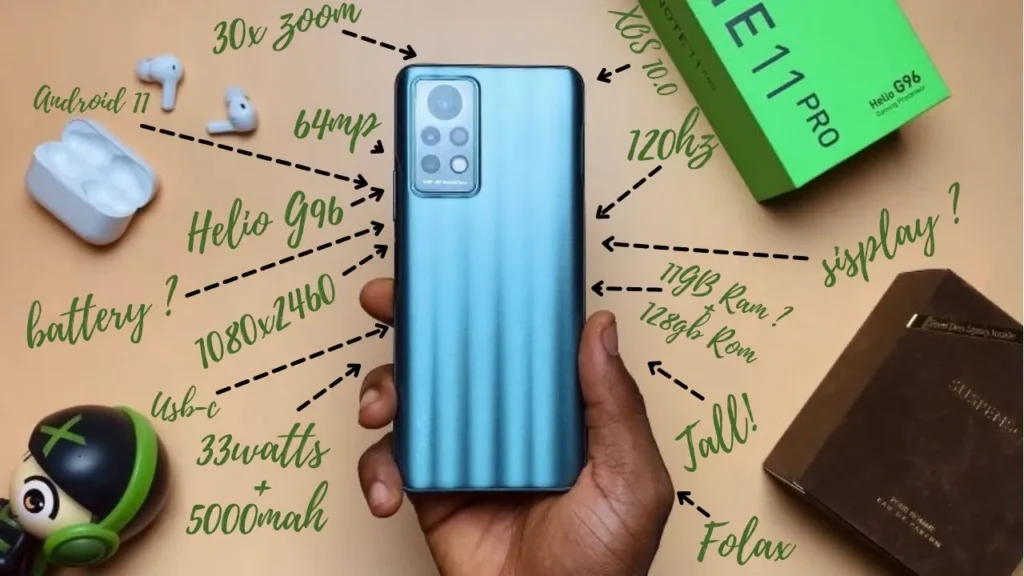
Introduction of Infinix Note 11 Pro 4G
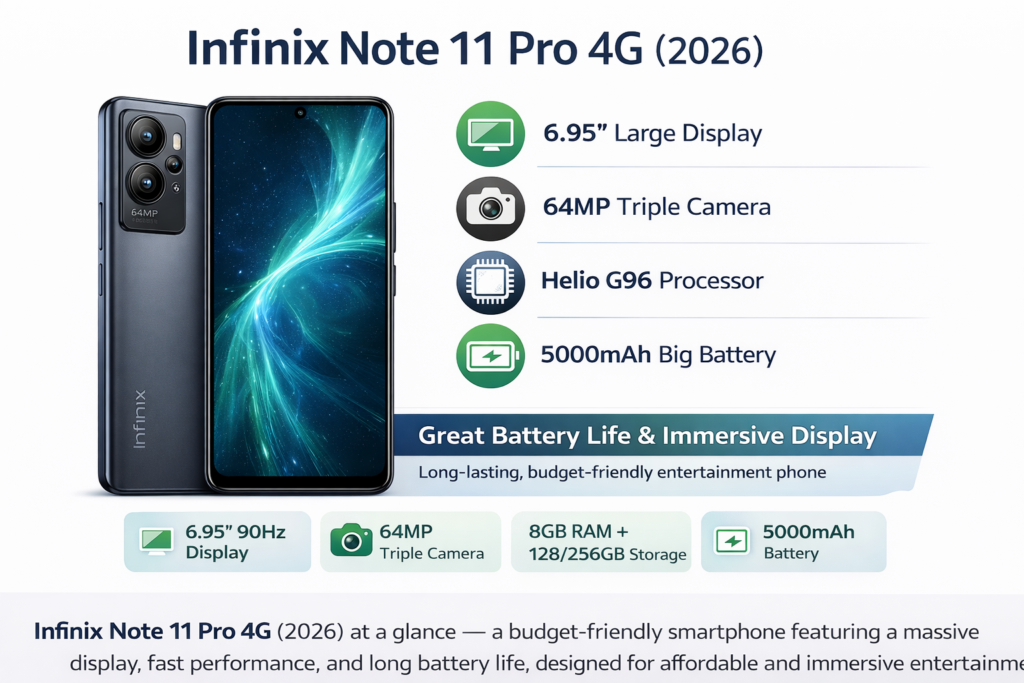
The Infinix Note 11 Pro 4G is designed for users who prioritize immersive entertainment, long battery endurance, and strong value within a budget-friendly price segment. Positioned as a media-focused midrange device, it combines a large high-refresh-rate display with a power-efficient processor and a dependable high-capacity battery for extended daily usage. The phone targets students, streamers, and multitaskers seeking smooth performance without flagship pricing. While it sacrifices premium camera innovation and 5G connectivity, its balanced hardware delivers reliable real-world performance, making it an appealing option for users focused on practicality, endurance, and everyday usability in 2026.
Quick specs at a glance
| Key | Value |
| Model | Infinix Note 11 Pro 4G |
| Release | Seethe official product page for the canonical date |
| Display | ~6.7–6.95″ FHD+ (1080×2400 or similar), AMOLED or IPS variant, 90–120Hz |
| SoC (approx) | Midrange Helio / Snapdragon-class (region-specific) |
| RAM / Storage | 6 / 8 GB RAM; 128 / 256 GB storage; microSD on supported SKUs |
| Rear cameras | 50MP main (typical), ultrawide/macro optional |
| Selfie | 16–32MP front sensor |
| Battery | 5000–6000 mAh; fast charge 33W–68W (SKU dependent) |
| OS | Android + XOS skin |
| Connectivity | 4G LTE, Wi-Fi 5 (or ac), Bluetooth 5.x, GPS; NFC optional by market |
| Extras | Side-mounted fingerprint (or in-display in select SKUs), stereo speakers, 3.5mm jack (varies) |
| Build | Plastic back or textured composite, glass front |
Design & build
Morphology & material signals
In physical design space, the Note 11 Pro 4G projects a modern silhouette: thin bezels, punch-hole selfie cutout, and a rear module that echoes current midrange aesthetic norms. The handset commonly uses a polycarbonate posterior or textured plastic lacquer to achieve a glass-like sheen while holding manufacturing costs low — an engineering trade-off that favors weight savings and impact resilience over luxury touch.
Ergonomics
Large-screen devices increase reach-distance vectors for thumb interactions. One-handed usability decreases for users with smaller hand spans; consider interface ergonomics (reachability mode, gesture navigation) or a protective case with grip ridges. The power/fingerprint dual-function side key is often the most reliable biometric vector in practice — fast, accurate, and ergonomically placed for natural thumb contact.
Acoustic & haptic experience
Stereo speaker tokens (when present) produce a fuller soundstage compared to single-firing speakers. Haptics are generally serviceable for notifications and UI feedback, but not in the domain of premium linear-actuator fidelity.
Durability cues
Many SKUs lack an official IP rating; environmental resilience is therefore best treated as probabilistic rather than deterministic. Recommend a case and screen protector for longevity.
Display
Panel and refresh
- Panel type: AMOLED yields deeper blacks and better contrast; IPS (or LCD) variants are more common in budget tiers. Confirm SKU specifics.
- Refresh rate: 90Hz or 120Hz variants increase Perceived smoothness (higher frame-rate tokens). For battery efficiency, a 60Hz fallback conserves energy.
- Resolution & PPI: FHD+ (≈1080×2400) balances detail and battery draw.
Brightness & readability
Peak nits dictate outdoor legibility. Midrange phones often land in the moderate peak nit bracket — acceptable in shade and indoor lighting, but potentially challenged under direct sunlight. When publishing, include measured peak-nit numbers from APL100/APL10 tests for credibility.
Color accuracy & gamut
Report Delta E scores (lower is better), and measure sRGB/DCI-P3 coverage. Most out-of-the-box calibrations are tuned for punchy visuals (greater saturation), which is subjectively pleasing but may not be color-diagnostic for creators.
Practical UX tests
- Video loop test at fixed brightness (e.g., 200 nits) to correlate screen-on time with battery capacity.
- Adaptive refresh evaluation: measure the transition latency and power draw when moving between 60Hz and higher modes.
- Widevine/DRM check (L1 vs L3) to confirm HD streaming capability on platforms like Netflix.
Performance & gaming
This section treats the SoC like a compute cluster: CPU cores (compute tokens), GPU (render tokens), and thermal throttling (rate-limiter).
Benchmarks to run
- CPU: Geekbench single/multi-core.
- GPU: 3DMark Wild Life or Sling Shot.
- Storage I/O: AndroBench sequential/random read/write.
- Sustained load: Long-duration load test to generate a thermal-throttle curve.
Real-world throughput
Daily app switching, Chrome tab retention, camera app cold starts, and large-file transfers reflect the device’s real-latency profile. Midrange SoCs generally produce smooth UI operations and handle social apps, browsers, and light productivity with minimal jank.
Gaming profile
- Casual titles: PUBG/BGMI at medium settings — expect stable FPS, mild thermal increase.
- Heavy 3D titles (e.g., Genshin Impact): Expect the need to lower settings to maintain 30–40 FPS and mitigate heat; track average FPS over 15 minutes.
- Thermal management: Observe surface temperature at the rear and around the area of the SoC. Sustained high loads will invoke frequency scaling (throttling) that reduces peak FPS over time.
Optimization tips
- Enable XOS game mode to prioritize CPU/GPU for the foreground process.
- Close unnecessary background processes and disable adaptive features that cause CPU wakeups.
- Use an aftermarket cooling accessory for marathon play sessions.
Cameras
Use a reproducible test suite like a photographer’s benchmark: daylight textures, dynamic range scenes, low-light handheld shots, night mode, ultrawide views, macro, and portrait edge detection.
Recommended camera test passes.
- Daylight 1:1 crops — evaluate resolving power and sharpening artifacts.
- High dynamic range (backlit) scenes — test HDR behavior and highlight roll-off.
- Ultrawide — inspect corner softness and distortion correction.
- Low light — compare night mode vs auto; evaluate noise reduction vs detail retention.
- Video — measure stabilization (EIS), exposure reactivity, and rolling shutter under panning.
Expected photographic characteristic vectors
- Daylight: Good for social content, with acceptable sharpness and saturated colors for pleasing thumbnails.
- Low light: Night mode improves exposure and shadow detail but introduces more aggressive denoising and softening. Resist over-cropping.
- Ultrawide & Macro: Useful supplemental lenses; detail is lower than the main sensor.
- Video: Good for casual clips; stabilization reduces handshake but lacks the steadiness of OIS on premium devices.
Sample gallery captions
- “Daylight crop — 50MP main sensor: high local detail for social sharing.”
- “Night mode exposure — effective shadow retrieval, slight smoothing in highlights.”
- “Ultrawide panorama — wider field, weaker corner resolution.”
Battery & charging
Treat battery capacity (mAh) as the energy budget for a session and charging wattage as an available charge-rate before distribution. Evaluate both runtime and charge velocity to build a real-world power profile.
Test methodology
- Screen-on runtime: video loop at fixed brightness and airplane mode to isolate display draw.
- Mixed-use day: social, emails, mapping, photography, and short gaming bursts to simulate a normal user profile.
- Gaming hour stress: continuous gameplay to see the runtime under heavy draw.
- Charge curve: measure 0→50% and 0→100% with the included charger; log timestamps and temperatures.
Typical outcomes
- Endurance: 5,000–6,000 mAh commonly yields 1–2 full days for light users; heavy gaming consumes the majority of the battery bank within a day.
- Charging: 33W–68W fast charging dramatically reduces top-up time; realistic 0→50% times can be ~20–30 minutes on higher-wattage SKUs.
- Thermal behavior: High-power charging creates mild to moderate heat near the charging IC; ambient temperature affects both charge speed and battery aging.
Publishable data points
Include raw timings, charge curve data points, and testing temperature conditions. These are high-signal facts that readers use for purchase decisions.
Software & updates
In software space, XOS is the custom skin overlay; treat it as a domain-specific language built on Android.
What to document
- Android base version & XOS version at the time of test.
- Key XOS features: Game Mode, Smart Panel, theme customization, privacy toggles, and any unique optimization flags.
- Bloat & promotions: Note system apps with ads/promotions and whether they are removable/disable-able.
- Update policy: State Infinix’s official promise for OS and security updates (cite manufacturer if possible). Users value clarity on OS upgrade lifespan.
UX observations
XOS adds helpful utilities for power users, but can introduce preinstalled apps that some will deem unnecessary. Guide disabling suggestions and streamlining the home screen.
Connectivity, sensors, and extras
List SKU-specific connectivity tokens — LTE bands, NFC, Wi-Fi capability, Bluetooth version, sensors (gyro, proximity, accelerometer), and extras like IR blaster or FM radio.
Market-sensitive features
- NFC: Often market-dependent — crucial for mobile payments in selected regions.
- 3.5mm jack: Present on many models — an advantage for audiophiles using wired headphones.
- Stereo speakers: Promote media enjoyment; confirm speaker placement and loudness.
- Bands: Provide a per-region band table so local buyers can map SKU to carrier coverage.
Pros & cons
Pros
- Large immersive display for video and reading workloads.
- Substantial battery capacity enabling 1–2 day sessions for light users.
- Competitive price-to-spec ratio (value vector).
- Stereo speakers and fast charging (on many SKUs).
Cons
- Camera performance is acceptable for casual sharing but not flagship-level.
- Plastic construction can feel less premium compared to glass/metal rivals.
- XOS may include promotional content or non-removable apps.
- 4G-only connectivity, where 5G is preferred by some buyers.
FAQs
A: If your decision vector prioritizes screen real estate, multi-day battery endurance, and budget-conscious performance, then yes — the device offers strong value.
A: Typical usage (social, messaging, streaming, occasional camera use) should see 1–2 days of operation, with heavier gaming and constant screen-on activities dropping this to roughly one day.
A: Yes — the device often ships with fast-charging capability; wattage varies by SKU (commonly 33W up to 68W).
A: The model designated “Note 11 Pro 4G” is, by naming, 4G-only. If 5G connectivity is mandatory, search for a 5G-branded variant or an alternative model in the product family.
A: Cameras are competent for everyday social sharing and daylight photography.
Conclusion
The Infinix Note 11 Pro 4G successfully positions itself as a practical midrange smartphone focused on immersive entertainment, dependable battery endurance, and balanced everyday performance. Its expansive display, efficient power management, and smooth user experience make it especially suitable for media consumers, students, and budget-conscious users seeking long usage cycles without frequent charging. While it does not compete with flagship devices in photography innovation or next-generation 5G connectivity, it delivers strong real-world value within its price category. For users prioritizing screen size, reliability, and affordability, the Note 11 Pro 4G remains a smart and sensible purchase choice in 2026.
