
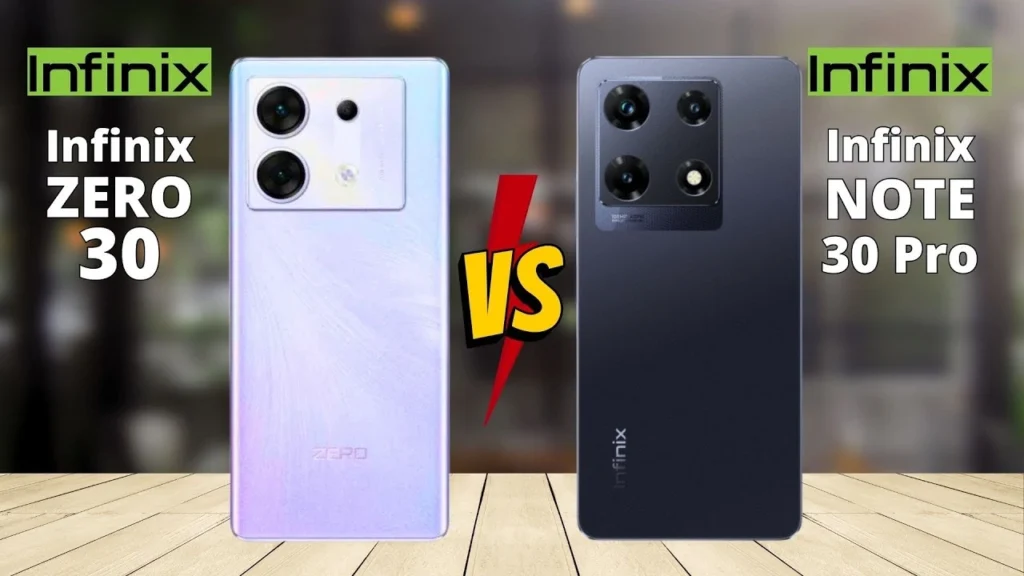
Introduction of Infinix Note 30 vs Note 30 Pro
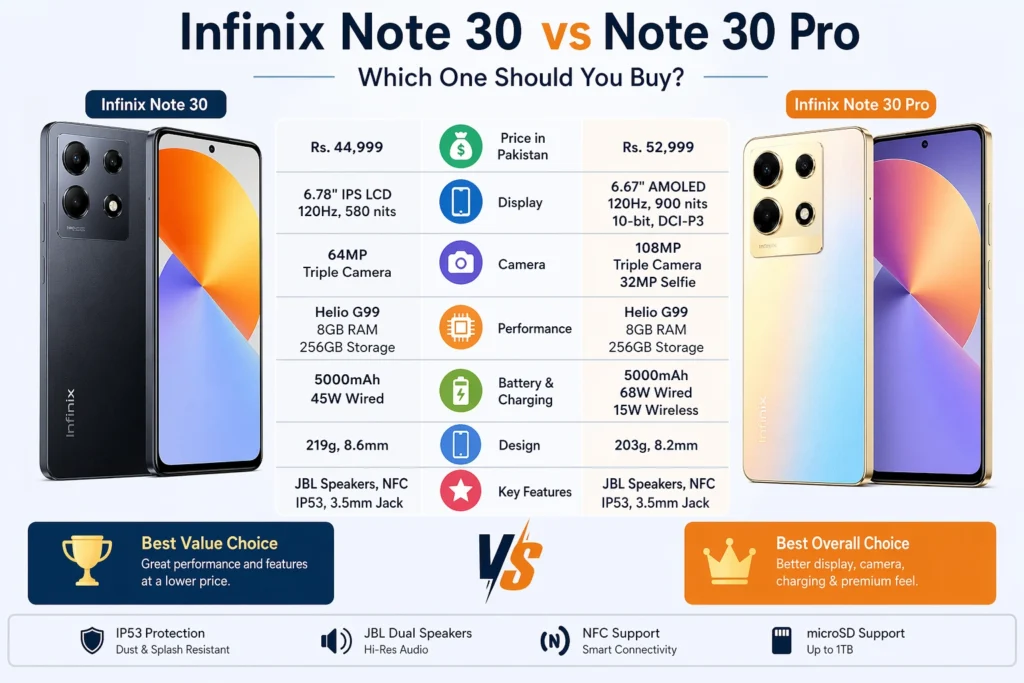
The Infinix Note 30 Pro is the better phone overall because it delivers an AMOLED display, a 108MP main camera, 68W wired charging, 15W wireless charging, and a lighter body, while still using the same Helio G99 chipset and 5000mAh battery as the Note 30. In simple buyer language, that means the Pro feels more premium every time you unlock it, watch content, take photos, or plug it in.
The Infinix Note 30 is the better value pick in Pakistan because it costs less but still gives you the same Helio G99 performance class, a large 120Hz display, a 5000mAh battery, JBL-tuned stereo speakers, NFC, and dependable everyday performance. For many users, that balance is enough, especially if the goal is to get the strongest possible spec sheet without paying for extra features that may not be used often.
Quick Verdict
If the buyer wants a phone that feels more premium in real life, the answer is the Infinix Note 30 Pro. It wins where the experience is most visible: display quality, camera hardware, charging speed, wireless charging, and physical comfort. These are not small cosmetic upgrades. They shape how the phone looks, how fast it powers up, how pleasant it feels to hold, and how enjoyable it is to use throughout the day.
If the buyer wants to spend less and still stay in the same performance bracket, the Infinix Note 30 is the smarter value buy. It uses the same Helio G99 chipset, offers a 120Hz screen, includes a 5000mAh battery, supports JBL-tuned speakers, NFC, and IP53 protection, and handles everyday tasks like social media, browsing, streaming, online classes, and light gaming without feeling underpowered.
At the prices you provided for Pakistan, the Note 30 sits around Rs. 44,999 and the Note 30 Pro around Rs. 52,999, which means the Pro costs roughly Rs. 8,000 more. That extra amount goes into the screen, camera system, charging tech, and overall refinement rather than into a faster processor.
At a Glance Comparison
| Feature | Infinix Note 30 | Infinix Note 30 Pro | What it means in real life |
| Price in Pakistan | Rs. 44,999 | Rs. 52,999 | The regular model is easier on the budget. |
| Chipset | Helio G99 | Helio G99 | Same baseline performance for apps and gaming. |
| Display | 6.78″ IPS LCD, 120Hz, 580 nits peak | 6.67″ AMOLED, 120Hz, 900 nits peak, 10-bit, DCI-P3 | Pro looks richer, brighter, and more premium. |
| Rear camera | 64MP triple camera | 108MP triple camera | Pro has stronger detail and broader photo appeal. |
| Selfie camera | 16MP | 32MP | Pro is better for selfies and video calls. |
| Battery | 5000mAh | 5000mAh | Endurance is similar; charging is the real difference. |
| Charging | 45W wired | 68W wired + 15W wireless | Pro charges faster and offers more convenience. |
| Body | 219g, 8.6mm | 203g, 8.2mm | The pro is easier to hold and carry. |
| Speakers | Dual speaker, JBL, Hi-Res | Dual speaker, JBL, Hi-Res | Audio experience is close on both. |
| Protection | IP53 | IP53 | Both handle light dust and splashes. |
Design and Build
The first noticeable difference in the Infinix Note 30 vs Note 30 Pro comparison is not the chipset or camera—it is the physical experience. The regular Note 30 is the larger and heavier device, measuring 168.6 x 76.6 x 8.6 mm and weighing 219 g. The Note 30 Pro is more compact, measuring 162.7 x 76 x 8.2 mm and weighing 203 g. In-hand, that makes the Pro easier to manage for longer periods, especially during extended calls, one-hand navigation, or endless scrolling on social apps.
Both phones are still practical and sturdy in everyday use. Infinix gives each model IP53 protection, which means they can tolerate light dust and minor water exposure, such as a splash, drizzle, or a sweaty commute. That is not full waterproofing, but it does add a useful layer of confidence for buyers in Pakistan who use their phones in real-world conditions rather than in sterile, controlled environments.
From a design perspective, the story is simple. The Note 30 is the bigger, budget-friendly all-rounder with a wide body and large screen. The Note 30 Pro is the more polished and comfortable version with a better balance of portability and premium feel. If size and weight are important to the buyer, the Pro has the advantage. If a large display matters more than comfort, the Note 30 still remains a sensible option.
Display
This is the most important area where the Note 30 Pro wins the comparison. The Infinix Note 30 comes with a 6.78-inch IPS LCD panel, a 120Hz refresh rate, and a 580 nits peak brightness rating. The Infinix Note 30 Pro uses a 6.67-inch AMOLED display with 120Hz, 10-bit colour, 100% DCI-P3 coverage, and a higher 900 nits peak brightness.
In real life, AMOLED is the more appealing technology. The Pro’s screen produces deeper blacks, stronger contrast, better colour saturation, and a more premium viewing experience when watching videos, browsing image-heavy apps, or using the phone at night. The display simply looks richer. Text seems sharper to the eye. Photos pop more. Dark scenes in movies look more dramatic. That visual difference is instantly noticeable even to users who are not technically inclined.
Brightness also matters. The Note 30 Pro’s higher peak brightness makes it easier to read outdoors, especially under the harsh sunlight that many Pakistani users deal with every day. The screen remains more visible and less washed out, which is one of those small usability advantages that becomes a daily benefit very quickly.
That said, the Note 30 is not weak. Its 6.78-inch screen is actually slightly larger, which can be useful for readers, social media users, and anyone who likes a broad display for long-form video or browsing. For pure size, it offers a bigger canvas. But size alone is not the whole story. The Pro’s AMOLED panel simply delivers a more vivid, more luxurious viewing experience.
So the practical answer is clear. If the buyer spends a lot of time on YouTube, Instagram, TikTok, movies, or mobile photography, the Note 30 Pro is the better display phone. If the buyer only wants a large and smooth screen for general use, the Note 30 remains perfectly usable and still strong for the price.
Performance
When it comes to speed and raw processing, the two phones are much closer than the price difference might suggest. Both the Note 30 and Note 30 Pro run on the MediaTek Helio G99 built on a 6nm process. They also share the same GPU family and, in the Pakistan listings you provided, both appear with 8GB RAM and 256GB storage. In practical terms, that means the core performance level is the same.
That is the central truth in this comparison: the Pro is not a massive performance leap. The Note 30 is not slow. Both devices can comfortably handle daily communication, web browsing, social media, banking apps, online classes, light content creation, and casual gaming. The experience is smooth enough for the target audience, and both belong to the same performance tier.
This is why the buyer should not look at the price gap and assume the Pro is faster in a dramatic way. The upgrade is not mainly about app opening speed or benchmark bragging rights. Instead, the Pro’s gains appear in more visible and tactile areas: screen quality, charging speed, camera quality, and overall comfort. Those changes affect the user experience more strongly than CPU numbers do.
The Note 30 Pro also has an extra advantage for heavier users: VC liquid cooling. Infinix highlights a large cooling structure with multiple layers, which helps keep thermals more controlled during longer gaming sessions or extended multitasking. A cooler phone can feel more stable and more comfortable during demanding use, especially in warm climates or during sustained play.
Camera
Camera hardware is where the Infinix Note 30 Pro begins to separate itself from the regular Note 30 in a meaningful way. The Note 30 uses a 64MP main camera supported by a 2MP depth sensor and a QVGA sensor. The Note 30 Pro upgrades to a 108MP main camera plus 2MP macro and 2MP depth sensors. On the front, the Note 30 has a 16MP selfie camera, while the Note 30 Pro carries a 32MP selfie camera.
What does this mean for the buyer in everyday language? The Pro is the better phone for people who care about sharper-looking photos, better social-media content, and stronger selfies. The 108MP main sensor gives the camera more room for detail capture and better flexibility for cropping. The 32MP front camera also gives the Pro an edge in video calls, vlogs, and selfie shots where clarity matters.
There is also a subtle video nuance worth noting. In some of the comparison pages you referenced, the Note 30 shows 1080p video at 30/60fps, while the Note 30 Pro is listed at 1080p at 30fps. That means the regular model may have a small edge in one specific video listing. Still, that does not change the overall conclusion: the Pro is the better camera phone because the combination of higher resolution on the back and a stronger selfie camera matters more in day-to-day use.
Battery and Charging
Battery capacity is not a major separation point because both phones include a 5000mAh battery. That means basic endurance should be broadly similar under comparable usage conditions. Whether the buyer scrolls, streams, chats, or browses, both phones are built to last a full day for many users, depending on brightness, network usage, and workload.
The meaningful difference is charging speed and charging flexibility. The Infinix Note 30 supports 45W wired charging. The Infinix Note 30 Pro upgrades to 68W wired charging and adds 15W wireless charging. That combination turns the Pro into a more modern and convenient device for people who hate long charging sessions.
In day-to-day life, this is a bigger deal than many buyers realise. A faster charge means less waiting before leaving for work or class. It means less stress when the battery is low before a commute. It means more convenience for people who frequently top up their phones rather than charging once overnight. Wireless charging, meanwhile, adds a premium touch that improves desk use, bedside use, and car-related convenience.
The Note 30 is still respectable in this department. Forty-five watts is not slow, and for users who usually charge overnight, the difference may not feel dramatic. But once someone becomes used to 68W charging, the faster recharge rate becomes very hard to give up. That is why the Pro wins the battery-and-charging category even though the battery size itself is identical.
So the practical conclusion is clear. Battery life is similar. Charging experience is not. The Note 30 Pro is the better choice for anyone who values quick top-ups, wireless convenience, and a more premium power setup.
Software, Sound, and Extra Features
Software is not a major deciding factor between these two models because both run Android 13 with XOS on top. That means the basic interface, menus, and everyday navigation will feel similar. The difference is not in software design; the difference is in what each phone does with its hardware.
Sound quality is also very close. Both models include dual speakers tuned by JBL and offer Hi-Res audio support. That is a strong inclusion for this segment because it makes video playback, gaming, and casual music listening more enjoyable without needing external speakers or headphones. For many buyers, that alone is a useful feature because it improves the media experience immediately.
The phones also share a useful set of everyday features such as NFC, USB Type-C, side-mounted fingerprint unlocking, a 3.5mm audio jack, and microSD expansion. These are not flashy specifications, but they matter a lot in actual use. NFC helps with supported contactless functions. The audio jack is still appreciated by users who use wired earphones. microSD expansion adds flexibility for storing photos, videos, and downloaded media. The side fingerprint scanner keeps unlocking fast and naturally.
Where the Pro gains an edge is not in software features but in how its hardware makes those features feel more complete. The AMOLED panel, faster charging, and improved camera system create a more premium package. The Note 30 gives the same practical basics at a lower price. That is why the comparison is less about software differences and more about how much comfort and refinement the buyer wants to pay for.
Which One Is Better for You?
Buy the Infinix Note 30 Pro if you want a better overall phone.
The Infinix Note 30 Pro is the right choice for buyers who want a more complete smartphone experience. It gives you the AMOLED display, the 108MP rear camera, the 32MP selfie camera, 68W fast charging, 15W wireless charging, and a lighter body. These are not cosmetic upgrades; they affect how the phone looks, feels, and performs in the scenarios people use most often.
This is also the better option for users who care about premium presentation. The display is richer, the body is more manageable, and the charging setup is more versatile. If the buyer plans to keep the phone for a few years and wants something that still feels modern and pleasant after the novelty wears off, the Pro is the more satisfying long-term decision.
Another reason to choose the Pro is emotional satisfaction. Many people do not buy phones only for benchmarks or processor names. They buy a phone because they want to enjoy using it. The Pro delivers that feeling more strongly. It looks better, charges faster, and takes better selfies. Those small daily moments add up.
Buy the Infinix Note 30 if budget matters most.
The Infinix Note 30 is the better value choice. It is cheaper, but it still keeps the same Helio G99, the same 5000mAh battery, the same 120Hz display refresh rate, the same JBL-tuned stereo speakers, and the same IP53 protection. That is a strong value proposition for anyone trying to maximise specs per rupee.
This is the model for students, first-time smartphone buyers, social media users, and practical shoppers who mainly want a dependable device without paying extra for features they may not fully use. It offers a modern daily-use experience and avoids the feeling of being cheap or outdated. In other words, it does not compromise on the essentials.
For many Pakistani buyers, that balance is exactly what matters. The regular Note 30 still gives a big screen, decent cameras, good battery life, and reliable performance. It is the smarter purchase when the priority is staying within budget while still getting a phone that feels current.
Buy the Pro if camera and charging matter to you.
If the buyer takes lots of selfies, posts on social media frequently, or wants a quicker and more flexible charging experience, the Pro makes more sense. The 108MP camera and 32MP selfie camera are meaningful upgrades, not marketing fillers. The 68W wired charging and wireless charging are similarly practical because they reduce friction in daily life.
Buy the Note 30 if you want the best budget-to-spec ratio
If the buyer says, “I want the strongest value, and I can live without AMOLED and wireless charging,” then the Note 30 is the model to choose. It stays close enough in performance to the Pro while costing less. That makes it the more economical option for users who care about value more than premium extras.
FAQs
Yes, both phones use the Helio G99 chipset, so their basic speed and gaming performance sit in the same class. The main difference is not raw processing power but display quality, camera hardware, charging speed, and the overall user experience.
The Note 30 Pro has a better display because it uses AMOLED, includes 10-bit colour, and is listed with a higher 900 nits peak brightness. The Note 30 uses IPS LCD and has a lower 580 nits peak brightness, which makes it less vibrant in comparison.
The Note 30 Pro is better for camera quality because it has a 108MP main camera and a 32MP selfie camera. The regular Note 30 has a 64MP main camera and a 16MP selfie camera, which are good for basic use but less impressive overall.
Yes. The Note 30 Pro supports 15W wireless charging in addition to 68W wired fast charging. The regular Note 30 does not list wireless charging.
The Note 30 Pro charges faster because it supports 68W wired charging. The Note 30 supports 45W wired charging, which is still decent but not as quick.
Final Verdict
The Infinix Note 30 Pro is the better phone overall because it improves the things users notice most in everyday use: the display, the cameras, the charging speed, and the comfort in hand. The Infinix Note 30 is the better value choice because it keeps the same Helio G99 performance platform, the same 5000mAh battery, and the same core daily-use strengths at a lower Pakistan price.
