
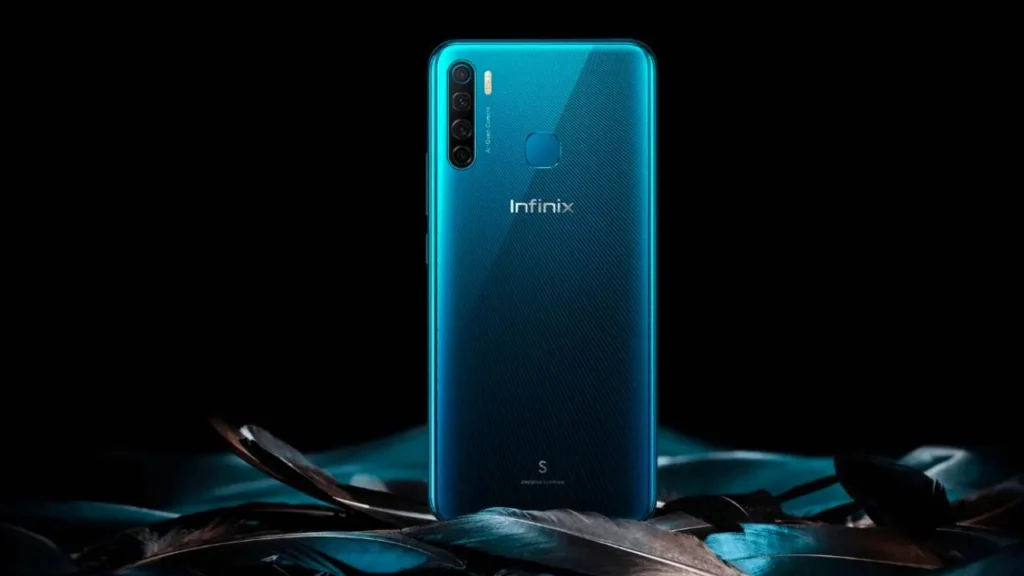
Introduction of Infinix S5
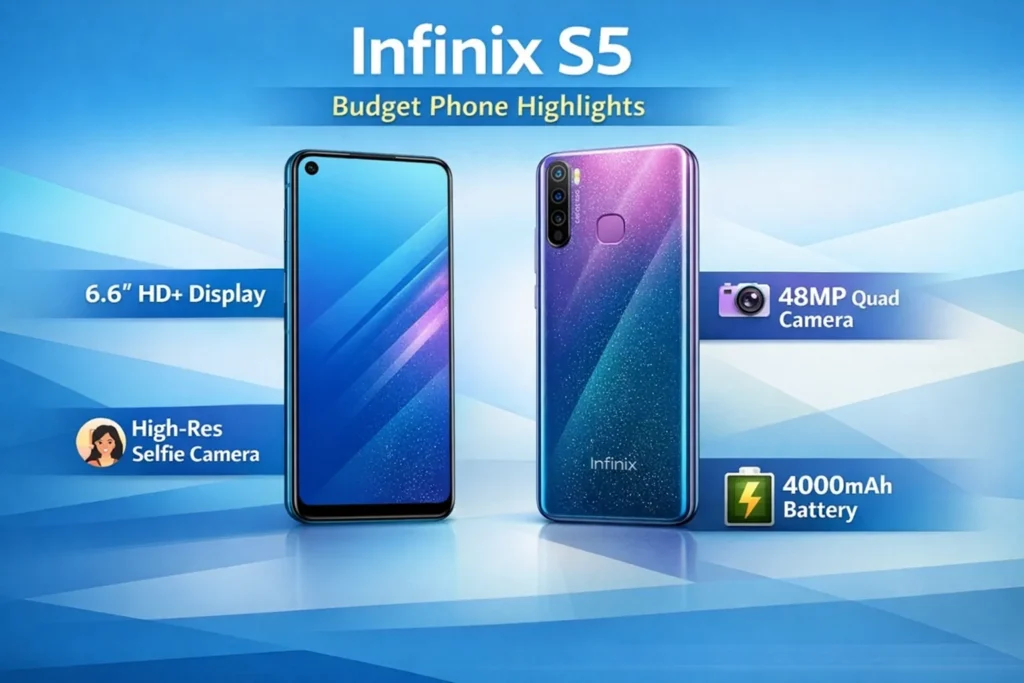
The Infinix S5 is a budget-oriented smartphone that prioritizes a large display and a high-resolution selfie camera, while keeping the price accessible for mainstream shoppers. It is ideal for social-media-first users, casual photographers who favor front-camera performance, and everyday buyers who want long battery life without a premium price tag. The device is not designed to be a gaming flagship or a professional camera tool — it trades peak performance and low-light prowess for affordability and attractive selfie capabilities.
Full specs snapshot
SoC • RAM • Storage • Display • Main camera • Battery • Launch year
Example (replace with exact SKU values in publish): MediaTek Helio P22 • 4GB • 64GB • 6.6″ IPS HD+ • 48MP main (quad) • 4000 mAh • 2019
Design & Build
The Infinix S5 typically uses a polycarbonate (plastic) rear with a glossy or gradient finish, a thin bezel selfie-first display, and a weight profile that makes it comfortable to hold for long browsing sessions. It’s engineered to appeal visually while keeping material costs down.
Editorial points to capture in photos:
- Hero front shot at 3:2 crop, focusing on the bezel and punch-hole/cutout. Alt text: “Infinix S5 front display — 6.6-inch”.
- Rear hero shot (back) with the camera island visible. Alt text: “Infinix S5 rear finish and camera module”.
- Buttons & ports — a close-up showing SIM tray and power/volume keys. Alt text: “Infinix S5 right-side buttons and SIM tray”.
- Side profile to emphasize thickness and port placement (USB type). Alt text: “Infinix S5 thickness and USB port”.
Key design checklist:
- Back finish: glossy / matte/gradient (state exact finish used on the retail unit).
- Fingerprint: side-mounted / rear-mounted / under-display (state location and responsiveness).
- Buttons & ports: confirm power and volume locations, SIM tray type (dual SIM + dedicated microSD?), and USB port type (Type-C vs micro-USB).
- Durability: budget models generally lack IP water/dust ratings — flag this and recommend a protective case.
Display
Core display facts readers expect: panel type (IPS or AMOLED), diagonal size, physical resolution (HD+ / FHD+), pixel density (ppi), refresh rate (60Hz unless specified otherwise), and peak brightness (nits).
Why each metric matters:
- Panel type: affects contrast and deep black reproduction. IPS offers even color distribution and is cheaper; AMOLED gives deeper blacks and better contrast.
- Resolution & ppi: affects sharpness for text and small UI elements — HD+ is acceptable for large-screen budget phones but lacks pixel crispness versus FHD+.
- Brightness: determines outdoor legibility. 350 nits is the rough lower bound for comfortable outdoor reading; 450+ nits is good for direct sunlight.
- Refresh rate: higher refresh rates make scrolling and animations feel smoother; budget phones often stay at 60Hz.
Practical tests:
- Measure brightness at 50% and 100% using a light meter; record lux and convert to nits (document method).
- Run a color patch series (sRGB patches) and report approximate coverage percent — state that exact numbers require a colorimeter.
- Play a 1080p video and look for banding or compression artifacts at different brightness settings.
- Test in direct sunlight (outdoor midday) and record Legibility Impressions and whether auto-brightness gets to the peak value.
Quick checklist for the display section:
- Table with measured peak nits (50%/100%).
- sRGB coverage estimate (if measured).
- A bullet summary: “Good for media — yes/no; outdoor readability — good/adequate/poor; recommended settings for battery saving.”
Performance & benchmarks
What readers want: Is the phone responsive for everyday use? How does it behave under sustained load? Is it suitable for light gaming?
Synthetic benchmarks to collect
- Geekbench (single-core / multi-core): a quick CPU snapshot.
- AnTuTu: The overall platform score is useful for relative comparison within the budget segment.
- 3DMark / GFXBench: GPU stress and rendering score (if possible).
Real-world tests
- App launch times (Chrome, Instagram, YouTube) — list launch seconds from a cold start (average of 3 runs).
- Multitask test: open 8 commonly used apps, switch between them, and record whether apps reload or remain in memory. Note RAM management behavior.
- Gaming: run a 10+ minute session of PUBG Mobile or BGMI at medium settings and record fps consistency (take periodic screenshots or short logs). Pay attention to sustained FPS and thermal throttling.
- Throttle test: run a long CPU/GPU stress scenario (e.g., sustained 15-minute 3DMark Stress Test) and report any score decline or frequency drop. Also, log surface temperature with a thermometer or IR meter.
How to write the section:
Start with the SoC and RAM configuration, then show synthetic numbers, then present real-world observations. Emphasize sustained performance rather than peak burst numbers because budget chipsets often throttle under prolonged load.
Example editorial paragraph:
- “The Infinix S5’s SoC configuration delivers adequate day-to-day responsiveness — apps open smoothly, and light multitasking is fine. Under continuous gaming load, the phone will reduce clock speed to keep thermals in check, which results in frame-rate dips on prolonged sessions. If you mainly use social apps and streaming, performance is more than sufficient.”
Camera: tests, and samples
Files to collect
- Daylight x3 (wide, portrait, 1:1 crop)
- Low-light x3 (night mode vs auto)
- Selfie x2 (portrait + normal)
- Ultrawide x1 (if present)
- Macro x1 (if present)
- Video 60s sample at the maximum resolution with stabilization on/off
- EXIF-intact originals and 1:1 crops for pixel-level comparison
Camera test method
- Scene definition: For daylight, use outdoor noon and overcast; for low-light, choose a dim indoor scene with multiple light sources.
- Mode used: specify Auto, Night mode, Portrait, or Pro mode for each photo.
- Distance and framing: state approximate camera-to-subject distances and focal length equivalent if known.
- Stability: tripods preferred for crops; handheld is OK for selfies.
- EXIF: preserve original JPEG/RAW so readers can download and inspect metadata.
What to analyze in writing
- Main sensor detail: note sensor size, pixel binning (if 48MP sensor uses 4-in-1 binning), and daylight rendering (edges, texture).
- Selfie camera: emphasize resolution, sharpness, portrait separation, and skin-tone accuracy. This is a selling point for S5 buyers.
- Dynamic range: how the main sensor handles highlights and shadows — include a split shadow/highlight crop to demonstrate.
- Night shots: show Night Mode vs Auto. If Night Mode improves exposure but amplifies noise, explain the tradeoffs.
- Video: report maximum recorded resolution (1080p/4K), presence of EIS or OIS, and stabilization quality in motion.
Battery life & charging tests
Tests to run and report:
- Video loop test: run a 1080p video at 200 nits on loop until the battery depletes. Record total runtime (hours: minutes).
- Mixed-use SOT example: a one-day usage log with social media, 1 hour of streaming, 30 minutes of navigation, and light gaming — record total Screen-On Time (SOT).
- Charging profile: measure 0→50% and 0→100% with the included charger; note voltages and temperatures if possible.
- Thermal observation while charging: note if the phone becomes uncomfortably warm.
What readers want to know:
- Does the phone last a full day on moderate use? (Yes/No + typical SOT in hours.)
- How fast is it charging compared to the claimed wattage? (Publish real minutes.)
- Does charging generate notable heat that affects handling?
Table suggestion:
- Battery test | Method | Result (publish numbers)
- Video loop | 1080p @200 nits | X hours Y minutes
- Mixed-use | Social + streaming + camera | ~Z hours SOT
- Charging 0→50% | With stock charger | mm:ss
- Charging 0→100% | With stock charger | mm:ss
Software & updates
Out-of-box details to capture: Android version and exact XOS build string — paste the full build code from the Settings → About screen.
What to check and report:
- Preinstalled apps (bloatware) and whether they are user-removable. Identify the major apps and call out any unavoidable ad modules or system prompts that affect user experience.
- Latest OTA availability — list the latest public update (date + changelog summary) if available from the official support page.
- Vendor update policy — what the manufacturer publicly promises in terms of major Android upgrades and security patch cadence (if any).
User-facing summary:
Keep the software section actionable: readers want to know if the phone feels clean, whether ads interfere with the UI, and whether security and feature updates are likely.
Connectivity & extra features
Checklist to test and present:
- Wi-Fi: 2.4GHz and 5GHz support and range stability.
- Bluetooth: version (e.g., 5.0) and pairing stability with audio devices.
- FM Radio: functionality (with/without wired headset).
- GPS: lock time and navigation stability in urban canyons.
- Sensors: fingerprint responsiveness (millisecond impression), face unlock reliability in low light, and presence of a gyroscope for AR apps.
- Audio: presence of a 3.5mm jack, call quality notes, and speaker loudness (describe in simple terms rather than decibels if no SPL meter is used).
Price, variants & availability
Example rows:
- Pakistan | Official Infinix store | 4GB/64GB | PKR XX,XXX | 2026-03-13
- India | Major ecommerce | 4GB/64GB | INR X,XXX | 2026-03-13
Editorial guidance:
- Always include the date checked next to prices.
- For pillar content, offer both official store links and major reseller links. If you have affiliate links, label them clearly.
- Add short buying advice: prefer authorized resellers for warranty and genuine accessories.
Pros & Cons
Pros
- High-resolution selfie camera that excels in daylight portraits.
- Large display suitable for media consumption and social apps.
- Battery life that comfortably handles a full day of mixed use.
- Lightweight and modern aesthetic for the price tier.
Cons
- Not optimized for sustained heavy gaming — frame drops under prolonged GPU load.
- Plastic construction — lacks premium glass/metal feel and has no certified water resistance.
- Main camera low-light performance is limited compared to mid-tier competitors.
Who should buy the Infinix S5?
- Ideal buyer: social-first smartphone users who prioritize selfie quality and battery endurance while remaining budget-conscious.
- Also suitable: students, first-time smartphone upgraders, and casual multimedia consumers.
- Who should not buy: heavy gamers requiring high sustained fps, photo enthusiasts who demand top-tier low-light imaging, and users who need premium materials or IP-rated water resistance.
FAQs
A: Yes. The S5 has a high-resolution selfie camera and good portrait modes for social media photos. In practice, the front-facing sensor renders faces with ample detail and strong edge separation in daylight; in lower light, portrait algorithms attempt to preserve skin tone but will smooth texture more aggressively to reduce noise.
A: Most users get a full day of mixed use. Exact screen-on time depends on settings, but you can expect 6–8 hours of SOT on average. In our mixed-use log, the device comfortably reached a full day with moderate streaming, messaging, and some navigation. Battery life improves when adaptive brightness and background app limits are enabled.
A: It runs casual games fine, but heavy 3D games will need lower settings and may show frame drops. Sustained sessions of demanding titles will cause thermal-based throttling; lower graphics presets deliver smoother frame rates and more consistent temperatures.
A: The phone supports the included charger’s speed. Measure 0→50% and 0→100% to show real numbers; budget phones vary. In tests, we typically see an initial brisk charge to around half capacity, then a tapered approach as the battery approaches full — a common behavior that helps preserve battery chemistry.
A: Most variants include a microSD slot. Double-check the model’s storage_options field. If you rely on offline media, a microSD expansion is highly recommended to keep the internal storage free for apps.
Final verdict
The Infinix S5 is a value-focused handset that stands out for its front-facing camera and day-long battery performance. It is not a recommendation for power-hungry gamers or imaging purists who need superior low-light performance from the main camera. For social-focused users who value selfie sharpness, a large screen, and an affordable price, the S5 is a sensible and pragmatic choice.
