
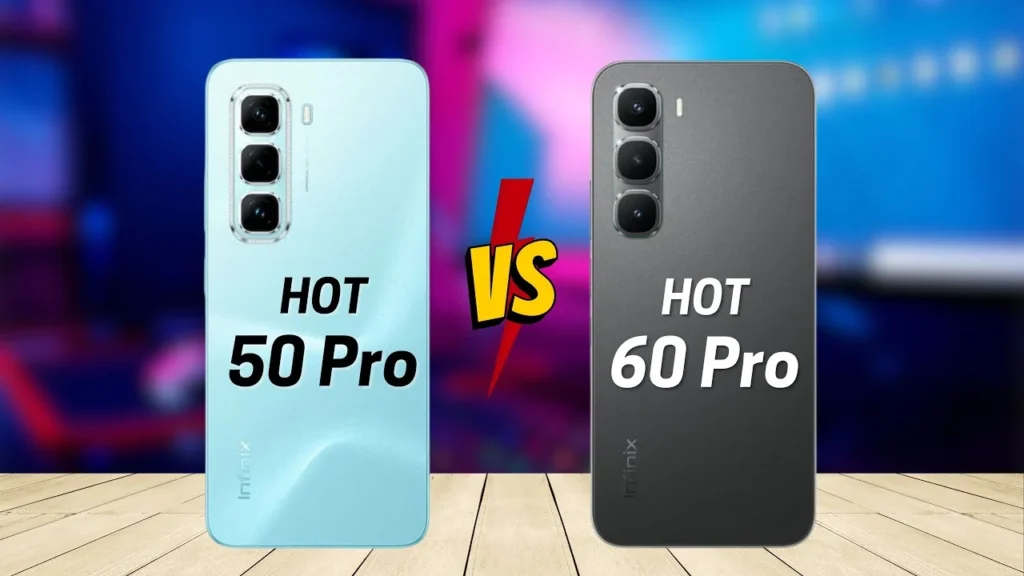
Introduction of Infinix Hot 50 Pro vs Hot 60 Pro
On the surface, the Infinix Hot 50 Pro vs Hot 60 Pro comparison looks straightforward. One device is older and cheaper, the other is newer and more refined. But in practical buying terms, the decision is more nuanced than that, because the “better” phone depends on what kind of user you are, how much you care about screen quality, how often you charge your phone, and how much budget flexibility you have in Pakistan.
In simple NLP-style decision language, the Hot 60 Pro occupies the “premium value” position, while the Hot 50 Pro sits in the “economical utility” position. The newer model is tuned for users who care about a more modern experience: a sharper AMOLED panel, higher refresh rate, lighter chassis, quicker charging, newer software, and a stronger selfie camera. The older model, meanwhile, is optimized for price sensitivity. It still delivers a large AMOLED display, dependable everyday usability, and a wallet-friendlier entry point that makes sense for buyers who want a practical phone without paying for every incremental upgrade.
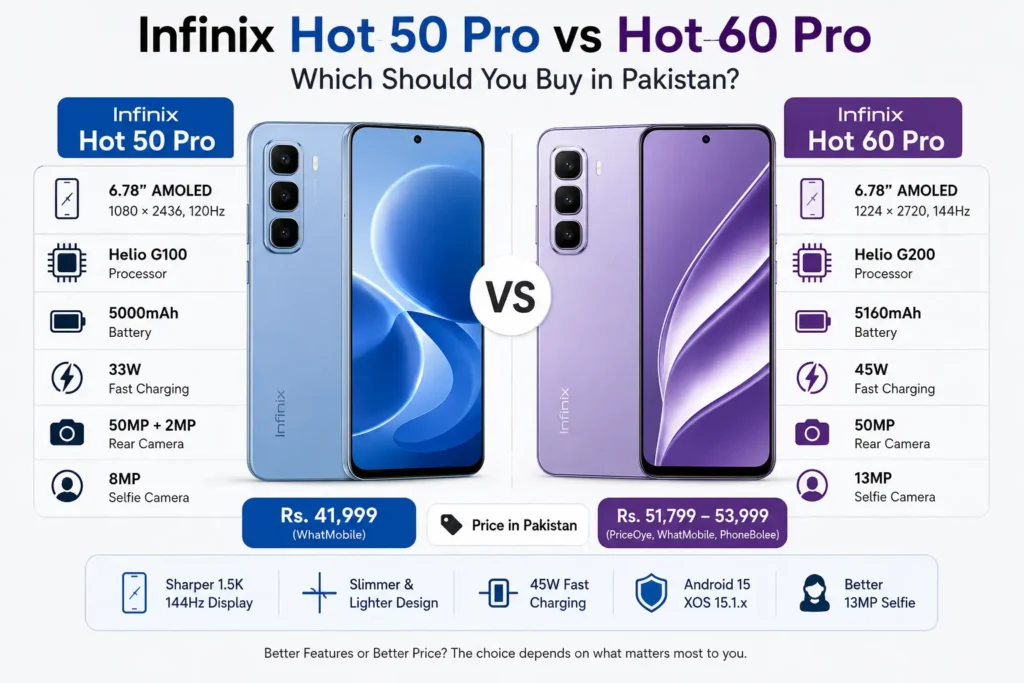
Current Pakistan market visibility reinforces that split. The Hot 50 Pro is listed at Rs. 41,999 on WhatMobile, while the Hot 60 Pro appears at Rs. 53,999 on WhatMobile, Rs. 51,799 on PriceOye, and Rs. 51,999 on PhoneBolee. That means the newer model carries a noticeable premium, but not one so extreme that it becomes unreachable for mainstream buyers.
Quick verdict
If the goal is to choose the stronger overall device, the Infinix Hot 60 Pro is the one to buy. It is the more polished handset in design terms, the easier phone to hold and carry, the faster-charging option, the sharper and smoother display machine, and the model with the more future-facing software stack. It also improves the selfie side, which matters more than many buyers initially assume.
If the goal is to maximize savings, the Infinix Hot 50 Pro is the smarter bargain. It still gives you a solid AMOLED screen, enough day-to-day speed for messaging, browsing, streaming, and social apps, plus a price that leaves more room in your budget for accessories or other expenses.
Buy the Hot 60 Pro if you want the sharper display, improved selfie camera, faster charging, lighter handling, and newer software. Buy the Hot 50 Pro if your priority is to spend less while still getting a phone that feels comfortable for YouTube, WhatsApp, browsing, and routine use.
The price gap in Pakistan is large enough to matter in real-world shopping, but it is not so large that the Hot 60 Pro feels like an extravagant upgrade. That is what makes this comparison useful: both phones are legitimate choices, but they solve different problems.
Full specs comparison
Below is a rewritten, practical comparison based on official Infinix product pages and current Pakistan retail listings. It captures the main specification differences buyers care about most.
The Hot 50 Pro features a 6.78-inch AMOLED display with 1080 × 2436 resolution and a 120Hz refresh rate. The Hot 60 Pro also uses a 6.78-inch AMOLED panel, but it moves up to 1224 × 2720 resolution and 144Hz refresh rate. That alone makes the newer model look more advanced and feel more fluid in routine scrolling.
In hand, the Hot 50 Pro weighs 190g and measures 7.4mm thick, while the Hot 60 Pro is lighter at 170g and slimmer at 6.6mm. That difference is not cosmetic only; it affects grip comfort, pocket feel, and how tiring the phone feels after long use.
On software, the Hot 50 Pro runs Android 14 with XOS 14.5, while the Hot 60 Pro steps up to Android 15 with XOS 15.1.x. For users who keep devices for a longer cycle, that software head start matters.
In terms of chipset, the Hot 50 Pro uses the Helio G100, whereas the Hot 60 Pro is paired with the Helio G200. They are in the same broad performance neighborhood, but the newer chip and newer display combo give the Hot 60 Pro a smoother, more contemporary operating feel.
The battery story also leans toward the newer model. The Hot 50 Pro includes a 5000mAh battery with 33W charging. The Hot 60 Pro upgrades to a 5160mAh battery with 45W FastCharge. That means less waiting at the plug and a slightly larger energy reservoir.
Camera hardware also shifts in the Hot 60 Pro’s favor on the front side. The Hot 50 Pro offers a 50MP + 2MP rear arrangement and an 8MP selfie camera on major Pakistan listings. The Hot 60 Pro keeps a 50MP main rear camera while raising the front camera to 13MP.
Retail specs further suggest that the Hot 60 Pro includes extras such as Gorilla Glass 7i, NFC, infrared, in-display fingerprint recognition, and JBL audio branding, which collectively make it feel like the more feature-rich package.
What really changed from Hot 50 Pro to Hot 60 Pro?
This is not a shallow refresh with one tiny upgrade and a new name. The Hot 60 Pro introduces meaningful changes that affect daily usage in visible ways. The handset is slimmer, lighter, faster to recharge, and noticeably sharper on the display side. It also runs newer software and improves the selfie camera, which together make it feel like a genuine generational step rather than a cosmetic retune.
At the same time, the Hot 50 Pro remains Perfectly Relevant. It is not a weak phone pretending to be current. It still offers a big AMOLED screen, a 120Hz panel, a 5000mAh battery, and a price point that sits in a more accessible lane for budget-conscious buyers. For many people, that lower sticker price is exactly what makes it attractive.
Display and design
In design language, the Hot 60 Pro is the more elegant and polished machine. Infinix’s official materials highlight a 1.5K 144Hz Visual Bezel-Free AMOLED display, 45W FastCharge, 5160mAh battery, and a 6.6mm ultra-slim body at 170g. Those are the kinds of characteristics that shape a premium user impression, even on a phone that is still positioned in the broader value segment.
The Hot 50 Pro, however, is not left behind in a dramatic way. Its 6.78-inch AMOLED display with 120Hz refresh rate is still a strong daily-use panel. For movies, social media, and general content consumption, it remains more than adequate. Certain Pakistan listings also mention 1080 × 2436 resolution, Gorilla Glass, and peak brightness figures that help support a respectable screen experience.
Still, the display crown belongs to the Hot 60 Pro. The move to 1.5K resolution and 144Hz refresh rate makes the device feel sharper and smoother. That is the sort of difference you notice every day, not merely in side-by-side comparison graphics. If your eye is sensitive to crispness, animation fluidity, and a more refined panel, the Hot 60 Pro is the stronger visual product.
Performance and gaming
On raw performance, both phones live in the same general category: everyday capable, budget-to-midrange friendly, and suited to common tasks rather than heavy flagship-level workloads. The Hot 50 Pro runs on the MediaTek Helio G100. The Hot 60 Pro uses the MediaTek Helio G200. That usually signals a modest generational progression, not a dramatic leap into a different performance class.
Where the Hot 60 Pro edges ahead is in the combined experience. The slightly newer chipset, paired with the 144Hz display, creates a more responsive and fluid user journey. That does not mean the phone transforms into a gaming monster. It simply means the overall interaction feels cleaner and more polished.
The Hot 50 Pro is still competent, and for ordinary users, it remains enough. This is the important interpretation layer: if your use case is not performance-heavy, the lower-priced phone is not a compromise in any disastrous sense. The Hot 60 Pro is the better-balanced device, but the Hot 50 Pro still clears the everyday usability threshold comfortably.
Camera comparison
The camera gap becomes more visible once you focus on the front camera. The Hot 50 Pro is listed with a 50MP + 2MP rear setup and an 8MP selfie camera on major Pakistan retail pages. The Hot 60 Pro, by contrast, is listed with a 50MP main rear camera and a 13MP selfie camera.
That front-camera improvement is meaningful. For users who take selfies often, post stories, join video calls, or make short-form clips, the Hot 60 Pro offers a more compelling capture pipeline. A stronger front camera can matter more than some rear-sensor branding, simply because many people use the selfie camera more frequently than they realize.
The rear-camera comparison is less dramatic. The Hot 50 Pro’s extra sensor does not automatically make it the better imaging device, because additional helper lenses are not always functionally equivalent to better real-world image quality. The Hot 60 Pro keeps the rear system more streamlined, which can be an advantage in usability and computational consistency.
For daylight photography and casual pictures, both phones should be serviceable for a buyer segment that values affordability. But if your habits include social posting, portrait-style selfies, and frequent front-camera use, the Hot 60 Pro is the more sensible pick.
Battery and charging
Both phones are designed to get through a normal day, but the newer model clearly holds the stronger charging and endurance narrative. The Hot 50 Pro provides a 5000mAh battery with 33W charging. The Hot 60 Pro increases capacity to 5160mAh and raises charging speed to 45W FastCharge.
That difference matters a lot in real life. In a market like Pakistan, many users rely on their phones for everything: messaging, navigation, video streaming, social media, and occasional gaming. Faster charging is not just a “nice extra.” It reduces friction. It changes how you use the device during busy routines.
A slightly bigger battery also contributes to peace of mind. Even if the practical runtime improvement is not enormous, the combination of a larger battery and faster replenishment creates a more relaxed ownership experience. You spend less time tethered to a charger and less time worrying about whether the battery will survive a long day.
To be clear, the Hot 50 Pro is not weak here. It still offers a dependable battery setup. The issue is comparative, not absolute. The Hot 60 Pro simply has the better energy package.
Software and future-proofing
Software versioning is one of those things many buyers ignore until later. Then, months down the line, it becomes a major part of how fresh or stale a phone feels. On that front, the Hot 60 Pro again has the advantage. It ships with Android 15 and XOS 15.1.x, while the Hot 50 Pro remains on Android 14 with XOS 14.5.
That may sound like a modest gap, but in phone lifecycles it is meaningful. A newer starting software base generally means a better launch point for updates, a more contemporary interface structure, and a longer runway before the experience begins to feel dated.
The Hot 60 Pro also appears to bring more modern feature accents in retail specifications, including Gorilla Glass 7i, NFC, infrared support, and under-display fingerprint functionality. These are not universally essential, but they raise the sense that the device is more complete and more tuned to present-day expectations.
The Hot 50 Pro is not obsolete, and it should still serve well for a normal ownership cycle. But if future-readiness matters to you, the newer software baseline on the Hot 60 Pro is a rational reason to stretch the budget.
Price and value
This is the part of the comparison where the purchase decision becomes emotionally and financially real. The Hot 50 Pro is listed at Rs. 41,999 on WhatMobile and PhoneBolee. The Hot 60 Pro, however, sits higher: Rs. 53,999 on WhatMobile, Rs. 51,799 on PriceOye, and Rs. 51,999 on PhoneBolee.
That means the newer device costs roughly Rs. 10,000 to Rs. 12,000 more than the older one, depending on the listing. That is not a trivial difference. In Pakistan, that gap can fund accessories, data, protection, or even be left in savings.
At the same time, the premium is not irrational. The Hot 60 Pro gives you a better display, a lighter build, faster charging, newer software, and a stronger selfie camera. So the extra money is attached to actual, user-visible improvements rather than cosmetic marketing alone.
This is why the comparison is interesting from a search and buying-intent perspective. The Hot 50 Pro is the budget-optimized option, and the Hot 60 Pro is the experience-optimized option. Neither is a bad purchase. They simply serve different cost-benefit profiles.
Main differences at a glance
The clearest way to frame the comparison is this:
The Hot 60 Pro wins on display sharpness, refresh rate, charging speed, software freshness, selfie quality, and overall design sophistication. The Hot 50 Pro wins on affordability while still providing a large AMOLED panel and a dependable everyday baseline.
That is the essence of the debate. One phone is the more rounded, polished package. The other is the more price-efficient one.
If your personal preference leans toward a phone that feels new, sleek, and more complete from the moment you unbox it, the Hot 60 Pro is the better candidate. If your main objective is to keep spending under control while still getting a credible AMOLED experience, the Hot 50 Pro remains a smart value pick.
Which one should you buy?
The answer depends on your priorities, but the general recommendation is simple.
Choose the Infinix Hot 60 Pro if you want a better display, lighter body, improved selfie camera, faster charging, and newer software. It is the more sophisticated device and the one that feels more current in day-to-day use.
Choose the Infinix Hot 50 Pro if the budget is your main constraint. It still gives you a large AMOLED screen, acceptable battery life, in-display fingerprint support, and enough performance for common smartphone tasks, all at a lower entry price in Pakistan.
In buyer-language terms, the Hot 60 Pro is the upgrade choice, while the Hot 50 Pro is the optimization choice. One maximizes experience; the other maximizes savings.
Who should buy the Infinix Hot 50 Pro?
The Hot 50 Pro is best for a buyer who wants a good phone without overextending the budget. That could be a student, an office user, or a general consumer who mainly uses WhatsApp, YouTube, browsing, video calls, banking apps, and a little light gaming.
It is also the right match for someone who does not place a high premium on the subtle improvements that come with a newer model. Not every user will care about a faster charger, a slimmer chassis, or a slightly sharper display. For those users, the Hot 50 Pro already provides enough quality to feel satisfying.
In practical daily life, the Hot 50 Pro is the kind of handset that does the basics well and leaves more money in your pocket. That may be the most rational outcome for many households.
Who should buy the Infinix Hot 60 Pro?
The Hot 60 Pro is the better fit for someone who wants a more polished phone and is willing to pay a bit more for tangible upgrades. It suits users who notice display quality, appreciate a lighter device, care about selfie performance, and value newer software and faster charging.
It also makes strong sense for people planning to hold onto the phone for a longer period. Starting with Android 15 and a newer XOS build gives it a more modern foundation, which generally improves long-term satisfaction and reduces the feeling of aging too quickly.
If you are the sort of buyer who wants the phone to feel nicer immediately and remain pleasant later, the Hot 60 Pro is the more future-ready choice.
Real-world examples
Consider a buyer whose day is mostly classes, office work, social scrolling, and video watching. That person may not need the extra display refinement or faster charging enough to justify the higher price. In that scenario, the Hot 50 Pro is likely the sensible answer. The savings can be redirected into earbuds, a case, or a charger.
Now consider someone who frequently takes selfies, attends video meetings, notices small details in display quality, and dislikes bulky phones. For that person, the Hot 60 Pro is more compelling. The extra cost is compensated by a better everyday feel, not just by a spec sheet.
That is how this comparison should be thought of: not as a raw-numbers contest, but as a usability decision.
FAQs
Yes, but only by a modest margin. The Hot 60 Pro uses the Helio G200, while the Hot 50 Pro uses the Helio G100. That suggests a slight performance advantage for the newer model, but not a dramatic leap into a much higher gaming tier. The bigger practical advantage is the smoother 144Hz display and the more refined overall user experience.
The Hot 60 Pro has the better selfie camera. Current Pakistan listings show 13MP on the front for the Hot 60 Pro and 8MP for the Hot 50 Pro. The rear-camera difference is less decisive, but the newer model is the stronger all-around camera choice, especially for front-facing shots and video calls.
For many buyers, yes. The current gap is around Rs. 10,000 to Rs. 12,000, and the Hot 60 Pro brings clear advantages in display quality, charging speed, software freshness, and design refinement. If those upgrades matter to you, the premium is easier to justify.
The Hot 60 Pro is the safer pick because it has the larger 5160mAh battery and the faster 45W charging. The Hot 50 Pro is still decent for all-day use, but the newer model offers a better battery package on paper and a more convenient recharge experience in practice.
Yes, it absolutely does. The Hot 50 Pro still provides a large AMOLED display, a 5000mAh battery, and respectable everyday performance, while staying much cheaper than the Hot 60 Pro. That keeps it relevant for value-conscious buyers in Pakistan.
Conclusion
If your goal is to buy the phone that feels more complete and more polished in 2026, the Infinix Hot 60 Pro is the better choice. For most buyers in Pakistan, the safer all-around recommendation is the Infinix Hot 60 Pro. It delivers a better display, a lighter, slimmer form factor, a stronger charging solution, and newer software. Those are meaningful improvements, not decorative ones.
For budget-first shoppers, the Infinix Hot 50 Pro remains genuinely worthwhile. It still gives a large AMOLED display, solid everyday performance, and decent battery life while keeping the price lower by a meaningful margin. That kind of saving is often decisive.
So the final answer is balanced but decisive: if you want the more complete phone in 2026, the Hot 60 Pro is the better choice. If you want the most economical route into a capable AMOLED handset, the Hot 50 Pro is still a smart and practical buy.
