
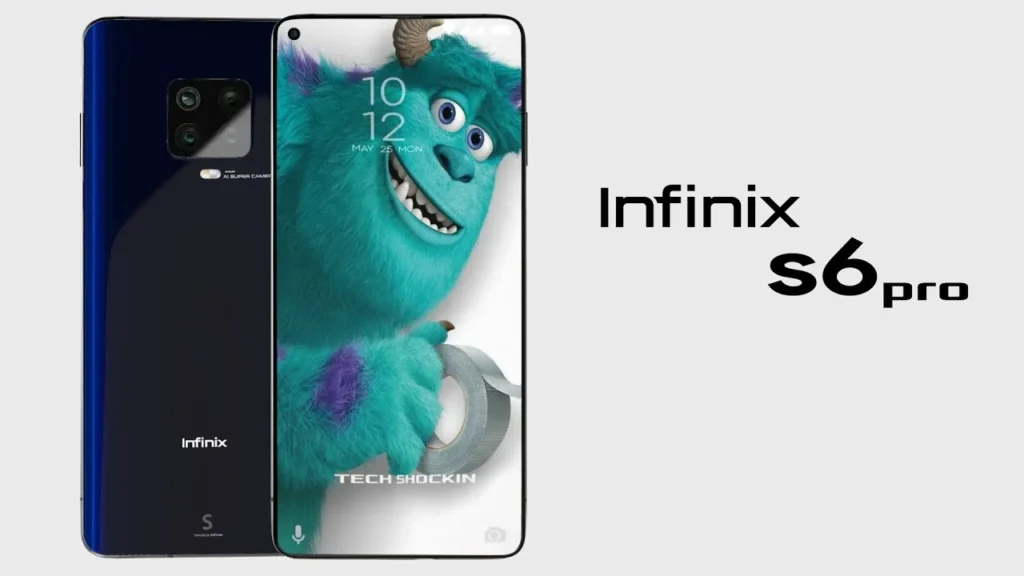
Introduction of Infinix S6
The Infinix S6 is a budget smartphone designed for users who love taking selfies and sharing content on social media. It stands out with its headline 32 MP front camera, a large immersive display, and a stylish design aimed at younger buyers. In this detailed review, we explore the phone’s full specifications, camera performance, battery life, and everyday usability. You’ll also learn how to test the selfie camera with simple 1:1 crop checks and real-world photography tips. If you’re thinking about buying the Infinix S6, this guide will help you understand its strengths, limitations, and whether it’s the right budget phone for you.
Quick verdict & who should buy
The Infinix S6 is a selfie-focused budget phone. If you post selfies a lot and want a high-resolution front camera (advertised as a 32 MP), it performs well for social-ready images in daylight. But if you need steady low-light rear photos or heavy performance, look elsewhere.
Who should buy the Infinix S6?
- Teens and social creators who post selfies and short videos daily.
- Buyers who want a large display for streaming and composing selfies.
- Budget shoppers who prioritize a strong front-camera spec and long screen time.
Who should NOT buy the Infinix S6?
- Mobile photographers who need the best-in-class low-light rear cameras.
- Gamers who want sustained high FPS in long sessions at high settings.
- Users who require long-term OS updates and flagship-level performance.
Full specs
- Model name — Infinix S6
- Display — ~6.4–6.6″ IPS/LCD; HD+ to low-FHD pixel range (budget-class panel)
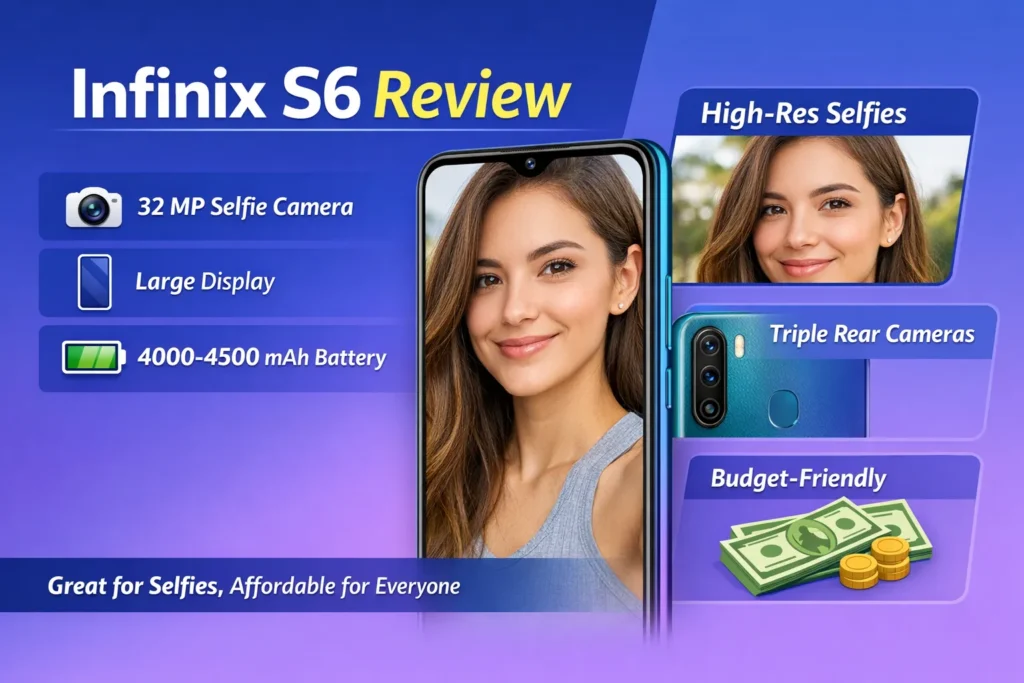
- Front camera — 32 MP main selfie (headline spec)
- Rear cameras — Triple-camera array; main ~16 MP (varies by listing) + depth/macro or similar auxiliary sensors
- Processor — MediaTek budget-tier (P-series family; model name varies by region)
- RAM / Storage — 3–6 GB RAM variants; 32/64/128 GB storage options; microSD slot available on most SKUs
- Battery — ~4000–4500 mAh (reports differ by market)
- OS — Android (wearing a manufacturer skin); reported builds vary from Android 9 to Android 11 across markets and time
- Connectivity — 4G LTE (no consistent 5G listing in sources)
- Weight & size — mid-range large-phone footprint; plastic frame and back likely
Design & Display
Design
The Infinix S6’s visual language targets younger buyers: glossy gradient backs, a pronounced camera island, and a tall display for social feeds. At this price, the body is typically plastic (polycarbonate) rather than metal or glass, which keeps the phone light while enabling flashy color finishes.
Practical notes:
- Expect a plastic frame and plastic back with a glossy or gradient finish. This looks premium but is more prone to fingerprints and micro-scratches. A clear case helps preserve the finish.
- Buttons are mostly positioned for easy one-hand reach on this size (6.4–6.6″). The phone is comfortable for browsing and selfies, but is still a two-handed device for full-screen typing.
Display
Large displays suit scrolling, video, and selfie-framing. The S6 fits the bill with a ~6.4–6.6″ panel, which helps you compose group selfies or preview cropped images.
What to expect in practice:
- Indoor brightness — Good for indoor use and social content creation.
- Outdoor brightness — Budget LCDs often max out lower than flagships; in direct sunlight, you’ll sometimes need higher brightness or shade the screen to see camera previews.
- Color & sharpness — Tuned for pleasing tones. Expect decent color for images and videos, but don’t compare it to an OLED flagship.
Practical tip: Before buying, check retailer photos and real-life showroom units for display readability in daylight. If you do a lot of outdoor content creation, test the preview visibility in bright sun.
Cameras
This is the core of the review. Below, I explain the hardware claims, how to test camera performance yourself, and what the Infinix S6 delivers across daylight, indoor, and low-light situations.
Camera hardware
- 32 MP front camera: This states the sensor outputs 32 million pixels. Higher megapixels allow more aggressive cropping and larger social-ready images, but they don’t guarantee per-pixel quality. Sensor size, pixel binning, lens quality, and software processing (denoising, sharpening, skin-tone tuning) shape the final picture.
- Rear triple array: Usually a main wide sensor (commonly listed as ~16 MP on many pages) plus auxiliary macro and depth or AI sensors. The extras add portrait and close-up flexibility but aren’t a substitute for a beefy main camera sensor.
How to test cameras
You can reproduce these tests in-store or at home to evaluate any phone’s camera:
- Daylight selfie (1:1 crop): Take a selfie outdoors in bright but indirect light. Export a 1:1 crop around the face center. Check hair detail, skin texture, and sharpness.
- Indoor selfie: Shoot under household lighting. Look for noise, color cast, and how much the phone smooths skin.
- Rear daylight landscape: Capture a detailed scene (brick wall, foliage). Crop 1:1 to inspect texture detail and dynamic range.
- Rear night mode vs auto: Shoot the same scene with default auto and with night mode. Compare exposure, noise, and color fidelity.
- Portrait mode: Shoot a subject at arm’s length. Inspect edge detection and naturalness of bokeh.
- Macro & close-ups: Photograph textures like fabric or leaves. Evaluate the sharpness and quickness of autofocus.
- Video & stability: Shoot a rolling 10–15 second clip while walking. See how stable electronic stabilization is and whether frames drop.
Selfie (daylight)
- The 32 MP front camera produces good detail in bright natural light. You can crop and still use the image for social posts.
- Colors and tones are tuned to be flattering — slightly warm skin tones, modest contrast, and pre-processing that tends to smooth skin, which many social users prefer.
Selfie (indoor / low-light)
- In dim conditions, the front camera uses software to brighten the scene. That helps visibility but adds noise and internal smoothing, which reduces fine detail.
- For better indoor selfies: face a window or lamp, use the screen flash if available, or enable any dedicated “night selfie” mode for improved exposure.
Rear main camera
- Daylight: The rear main sensor handles daytime shots reasonably well — Acceptable Texture and color for social sharing. Dynamic range is average; highlights can clip in very high-contrast scenes.
- Low-light: Expect grain and softness. Night mode can recover exposure and preserve color, but tends to smooth finer detail compared to flagships.
Portrait & bokeh performance
- Portraits look good in well-lit conditions. Edge detection is passable — hair and complex edges sometimes present occasional artifacts, especially in low contrast or backlit scenes.
Macro & detail work
- The macro sensor is fun for close shots like food and flowers. It provides a shallow depth-of-field look but not extreme optical detail. Use it for creative shots, not scientific detail.
Video & stabilization
- Video is fine for social clips and short vlogs. Electronic stabilization helps steady handheld footage but doesn’t match the smoothness of gimbals or flagship mechanical stabilization. Long recording sessions may warm the chassis slightly.
Battery & charging
Different regional spec pages list 4000 mAh or 4500 mAh batteries. In daily use, phones in this capacity range generally provide a whole day of moderate activity (social apps, messaging, streaming short videos). Your exact battery life depends on screen brightness, background sync, and how much camera/video you shoot.
Real-life tests you can run
- Screen-on time loop: Play a continuous 1080p video at medium brightness until the battery drains. Record total screen-on time; expect something between 8 and 12 hours, depending on exact battery and software optimization.
- Mixed usage day: Use social media, 30–60 minutes of video, some camera use, and light gaming. See if it lasts till bedtime. Most users report full-day endurance on similar hardware.
- Charging test: Use the supplied charger to time 0% → 50% and 0% → 100%. Budget phones often have modest fast charging (e.g., 10–25W); specifics vary by SKU.
Practical tip: Confirm the exact battery capacity on the seller page before buying (some pages differ). If long battery runtime matters, prefer the SKU that lists 4500 mAh.
Performance, storage & software
Performance
- Expect a budget MediaTek chipset from the P-series (P22/P35 family or similar). These chips are tuned for everyday apps, social media, and light games.
- Heavy 3D gaming will require lowering settings; thermal throttling may occur in prolonged sessions. If you game frequently, consider phones with mid-range gaming silicon.
Storage & RAM
- Typical variants include 3–6 GB RAM and 32–128 GB storage. Choose higher RAM/storage if you plan to retain many apps, offline media, or large camera libraries. A microSD card can be a cost-effective way to expand storage, but it may limit some Performance Benefits.
Software updates
- Budget phones often receive limited OS updates. Expect a manufacturer’s skin on top of Android with occasional security patches. If update longevity is critical, verify the brand’s published update policy for the specific S6 SKU in your region.
Comparison
If the Infinix S6 appeals because of its selfie strengths, here’s how to think about alternatives:
- If you want better rear photography, look for phones with larger main sensors (e.g., 48 MP or higher with larger pixel size) and proven night-mode processing.
- If you want better gaming, opt for devices with a stronger SoC (Qualcomm mid-range or higher-tier MediaTek Helio/G-series/Dimensity) and better thermal design.
- If you want longer battery life + faster charging, pick phones advertising 5000 mAh batteries and higher-watt fast charging (30W+), though they might cost a bit more.
How to choose: prioritize the single feature you use most (selfies vs gaming vs battery), then select the phone that wins that category in real-world sample images and benchmarks.
Buying advice
Before you buy
- Confirm the exact variant (S6 vs S6 Pro) — specs differ between variants.
- Verify the front camera claim — 32 MP appears consistent for the S6 across many listings.
- Confirm battery capacity on the seller page (4000 vs 4500 mAh).
- Buy from an authorized retailer with warranty coverage and a clear return policy.
- Inspect sample images or ask the seller for 1:1 selfie crops if possible.
- Check the included charger and cables; sometimes higher-watt chargers are not bundled.
- Compare local price trackers and promo deals before purchase.
Tips to save money
- Watch local e-commerce sale days for bundle discounts.
- Consider slightly older mid-range phones on sale if you want better rear cameras or a stronger chipset at a similar price.
- Use microSD for storage expansion instead of paying for a higher-storage SKU if you mostly store media.
FAQs
A: Yes. The 32 MP selfie camera is the phone’s main strength in daylight and indoor light. It’s great for social posts.
A: Low-light results are okay but not flagship-level. Night mode helps, but expect some noise.
A: Yes — most sources list 4000–4500 mAh, which gives a full day for normal use. Confirm the exact number from the seller.
A: It can run light games fine. For heavy gaming, look at phones with stronger chipsets.
A: The 32 MP number is real (sensor output), but real image quality depends on sensor size and software. It still gives high-res selfies useful for cropping.
Final verdict
The Infinix S6 out as a budget device designed mainly for selfie lovers and everyday users. Its 32 MP front camera, large display, and decent battery capacity make it a practical choice for social media, video watching, and casual photography. While the rear camera and processor are adequate for normal use, they may not satisfy heavy gamers or users who expect strong low-light photography. Overall, if your priority is high-resolution selfies and a large screen at an affordable price, the Infinix S6 remains a solid option in the entry-level smartphone category.
