
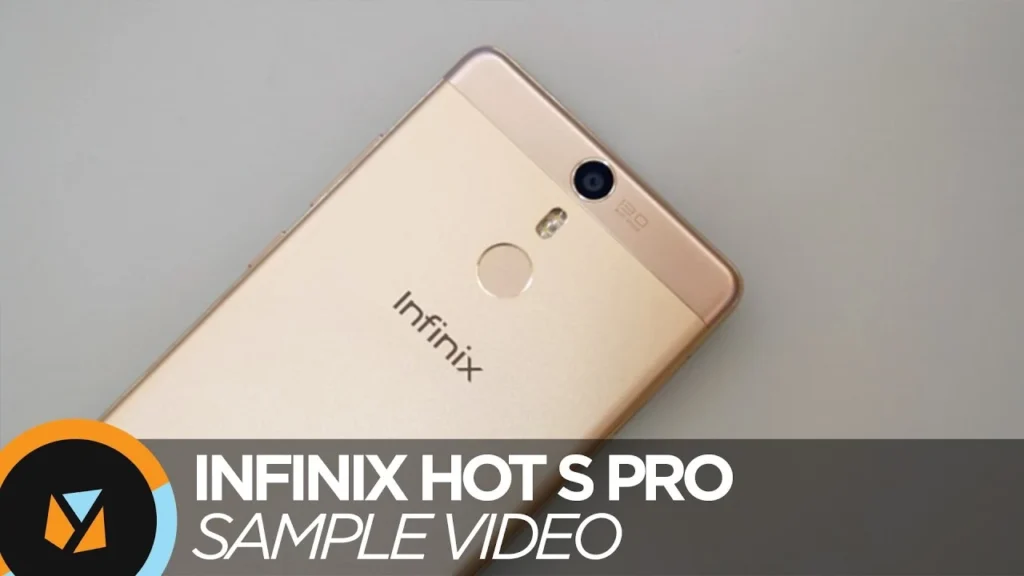
Introduction of Infinix Hot S Pro
The Infinix Hot S Pro review still matters in 2026 because this phone is no longer a launch-day product story. It is a used-phone decision guide, and that changes everything. In a market where buyers care more about condition, battery wear, network compatibility, and practical value than glossy marketing claims, the Hot S Pro deserves a fresh, reality-based evaluation.
At launch, the Infinix Hot S Pro positioned itself as a compact, stylish, value-focused smartphone for users who wanted a little more polish than the average entry-level device. Review and spec sources commonly describe it with a 5.2-inch display, MediaTek MT6753 octa-core chipset, 3GB RAM, 16GB storage, 13MP rear camera, 8MP front camera, rear fingerprint sensor, 4G LTE, Android 6.0 Marshmallow, and a 3000mAh battery. In its own time, that combination made sense. It gave buyers an affordable phone that still felt modern enough to stand out.
Pros and cons
Pros
- Compact size that is easier to hold than many newer budget phones.
- Rear fingerprint sensor for faster unlocking and basic security.
- 4G LTE support, which still matters for mobile data.
- 3GB RAM on the Pro variant gives it a better chance at light multitasking than weaker 2GB budget phones.
Cons
- Android 6.0 is very old now, so modern app compatibility and security are limited.
- Storage is small by today’s standards, and some Hot S family listings are inconsistent.
- Battery health on used units may be far below original capacity because the phone is many years old.
- Camera performance is acceptable for casual use, but not strong enough for demanding modern photography.
Specs table
| Category | Reported spec | Notes |
| Model | Infinix Hot S Pro / X521 | Review sources often use the X521 code. |
| Display | 5.2-inch IPS LCD | Most Pro pages describe HD 720 × 1280. |
| Processor | MediaTek MT6753 octa-core | Commonly reported across review pages. |
| RAM | 3GB | This is the key Pro spec. |
| Storage | 16GB | Commonly listed in review sources. |
| Rear camera | 13MP | Dual-LED flash appears on some sources. |
| Front camera | 8MP | Consistent across many listings. |
| Battery | 3000mAh | Non-removable battery. |
| OS | Android 6.0 Marshmallow with XOS | Repeatedly mentioned on review pages. |
| Connectivity | 4G LTE, dual SIM, Wi-Fi, Bluetooth, GPS, microUSB | Standard feature set for the class. |
| Security | Rear fingerprint sensor | One of the model’s standout features. |
This specification profile explains the phone’s identity very well. It was not a powerhouse, but it was a neat, compact, value-oriented smartphone with enough features to feel appealing in its category.
Design and build quality
The Infinix Hot S Pro was one of those budget phones that looked more expensive than many of its peers. At launch, its design language leaned toward slim lines, metallic styling, and a tidy rear layout. The compact body helped it stand out in a market where many affordable phones were chunky and visually plain.
The size also matters from a modern perspective. A 5.2-inch phone is much easier to carry and operate one-handed than many newer large-screen devices. That gives the Hot S Pro a small but real practical advantage for users who dislike oversized phones. Review sources commonly place the device around 148.8 × 73.2 × 8.1 mm and roughly 140 g, which helps explain why it still feels relatively light and pocket-friendly.
The rear fingerprint sensor is another design highlight. In 2016, that was a meaningful premium touch on a budget phone. It gave the device a more advanced identity and made unlocking more convenient. Even now, when it works properly, it still adds value.
But design is not only about appearance. On a used phone this old, physical wear is the real concern. You should expect to inspect:
- scratches on the glass,
- paint wear around the frame,
- dust around ports and buttons,
- loose charging connections,
- speaker degradation,
- and possible signs of previous repairs.
A polished product photo tells you almost nothing about the actual condition of a second-hand unit. For this model, the condition is the story. A well-kept Hot S Pro can still look respectable. A neglected one can feel tired very quickly.
Display
The display on the Hot S Pro is one of the most straightforward parts of the review, although source confusion exists across the broader Hot S family. For the Pro variant specifically, the most common references point to a 5.2-inch HD IPS panel with 720 × 1280 resolution.
That is not a cutting-edge screen by any modern measure, but it is still usable for a surprising number of everyday tasks. Because the panel is relatively small, the lower resolution is less painful than it would be on a much larger screen. Text remains readable, videos are watchable, and general navigation is still comfortable.
For a buyer in 2026, the display should be judged by use case:
- If you want crisp media consumption, a newer phone will clearly do better.
- If you want a compact screen for calls, messaging, browsing, and light video viewing, this panel is acceptable.
- If you are sensitive to brightness, color richness, or outdoor readability, you may find it basic rather than impressive.
This is an important distinction. The screen is not the reason to buy the phone. It is simply adequate for the phone’s role. That is not a criticism; it is a realistic interpretation of an older budget IPS panel.
Display takeaway
The Hot S Pro screen is best described as functional, compact, and serviceable. It is not the kind of display that competes with modern Full HD or AMOLED devices, but it still handles routine use without major trouble.
Performance
Under the hood, the Infinix Hot S Pro uses the MediaTek MT6753 chipset with an octa-core CPU and Mali-T720 graphics. In its original era, that hardware class was perfectly normal for a mid-budget smartphone. It could manage social apps, browsing, streaming, music, and basic multitasking with acceptable smoothness.
The Pro variant’s 3GB RAM matters more than it may seem at first glance. Memory is one of the main factors that influences how usable an older phone feels today. A phone with 3GB RAM has a better chance of holding a few apps in memory, reducing reloads, and feeling less cramped than a 2GB budget device.
That said, age is the limiting factor here. The phone’s hardware was fine for its time, but in 2026, it must compete with much newer software expectations. Modern apps are heavier. Websites are more demanding. Social feeds are more media-rich. Background processes are more aggressive. In that environment, the Hot S Pro becomes a light-duty device rather than a broadly capable daily driver.
Real-world performance verdict
For:
- calls,
- WhatsApp,
- light browsing,
- music,
- email,
- casual YouTube use,
The phone can still feel workable if the unit is in good condition.
For:
- heavy multitasking,
- newer games,
- large app libraries,
- long sessions of app switching,
- demanding media editing,
It will feel dated.
This is not simply a benchmark issue. It is a software-era mismatch issue. A phone from this generation can still function, but it is operating in a world that has moved on. That is the core performance reality.
Gaming reality check
It is tempting to ask whether an old phone can still “handle games.” The more useful question is whether that is the right expectation at all. On the Hot S Pro, gaming should be treated as a secondary possibility, not a selling point.
Light or older games may still run, but newer 3D games, large downloads, and long play sessions are not what this phone was designed for. The MT6753 + Mali-T720 combination is too dated for modern gaming comfort, especially if the device also has battery wear or storage pressure.
If your use case includes gaming, you should look elsewhere. The Hot S Pro belongs in the category of a basic utility device, not a performance bargain.
Camera
The camera system is one of the reasons the Hot S line got attention in the first place. The Hot S Pro is commonly described with a 13MP rear camera and an 8MP front camera, and some sources also mention dual LED flash. On a budget phone from 2016, that was a respectable package, especially for users who cared about selfies and simple social sharing.
In practical terms, the camera can still be useful in the right conditions:
- daylight shots,
- indoor shots with good lighting,
- document scanning,
- product photos,
- casual social uploads,
- video calls.
The limitations appear quickly when the lighting drops. Old sensor hardware, older image processing, and the natural wear that comes with time can make low-light photography look soft, noisy, or uneven. Autofocus may be slower than modern users expect. Color consistency can vary. In some units, image quality may depend heavily on condition and app behavior rather than just the spec sheet.
What to expect from the camera in 2026
The camera is not bad in an absolute sense. It is simply age-limited. In good light, it should still capture functional pictures. In poor light, it is likely to struggle. That means you should treat it as a phone that can still document life, not one that is built for photography enthusiasm.
Infinix Hot S Pro camera test notes
A strong review page should ideally include sample categories such as:
- daylight sample,
- indoor sample,
- low-light sample,
- selfie sample,
- text/document sample,
- close-up sample.
That kind of sample structure gives readers far more value than vague praise. It shows how the camera behaves in real scenes, not just how the camera sounded in a launch brochure.
Battery life and charging
The Hot S Pro uses a 3000mAh non-removable battery. At launch, that capacity was respectable for a 5.2-inch device with modest hardware. It could deliver comfortable usage for a phone of its class, especially when paired with a compact display and an efficient enough chipset.
The major issue in 2026 is not original capacity. It is battery degradation. A phone this old has almost certainly experienced years of charge cycles, heat exposure, and storage aging. Even a battery that once felt decent can become weak, inconsistent, or frustrating over time.
Battery life in practice
A healthy used unit may still manage a day of light use, such as:
- calls,
- messages,
- occasional browsing,
- and short video sessions.
A tired battery, however, can turn the experience into a constant recharge routine. That is why battery condition is often the deciding factor in whether an old phone feels usable or annoying.
Charging is also old-school here, because the device uses microUSB rather than USB-C. That means:
- The port may be more worn,
- cable convenience is lower,
- Replacement cables are common, but not as modern or tidy as newer standards.
Battery verdict
If you find a Hot S Pro with a healthy battery or a recently replaced cell, the phone becomes much more sensible. If the battery is weak, the device loses much of its practical value very quickly.
Software and user experience
The phone ships with Android 6.0 Marshmallow and Infinix’s XOS skin. At launch, that combination helped the device feel current and recognizable. XOS added its own visual flavor and helped the phone stand apart from plain stock Android devices.
Today, though, Android 6.0 is a major limitation. Modern app ecosystems have moved well beyond Marshmallow. Security expectations are higher. Feature support is more demanding. Some apps may still run, but the experience is not the same as on a newer phone. That means the Hot S Pro should not be approached as a primary long-term smartphone for modern digital life.
What does old software mean in real life
An older operating system can lead to:
- weaker app compatibility,
- slower app loading in some situations,
- limited security confidence,
- fewer update expectations,
- and more caution around sensitive tasks.
That does not mean the phone is unusable. It means the phone belongs in a narrower role. It is best for light, low-risk usage rather than banking-heavy, work-heavy, or Security-Sensitive activity.
Storage pressure matters too.
The Hot S Pro is commonly associated with 16GB internal storage, which is very small by current standards. On a phone with old Android software, small storage can quickly become a problem. Photos, cached data, app updates, and downloads can make the phone feel cramped. That is one of the reasons many used units perform worse in reality than their spec sheet suggests.
User experience conclusion
The software story is simple: this is a phone for basic, cautious use. It is not the kind of device you should buy if you need strong support, modern security, or extensive app flexibility.
Infinix Hot S Pro vs Infinix Hot S
This comparison matters because many buyers see the names and assume the models are very different. In practice, the Pro is much closer to a tuned variant than a complete redesign.
Review sources often describe the Hot S Pro as having almost similar features to the standard Infinix Hot S. That makes the differences modest rather than dramatic. The Pro model generally gets attention because it is the slightly more capable option in memory, even if many other parts of the experience are comparable.
Simple comparison table
| Feature | Infinix Hot S | Infinix Hot S Pro | Meaning |
| Display | Source pages vary across the Hot S family | 5.2-inch HD IPS in Pro reviews | The viewing experience is very similar. |
| Processor | MT6753 family | MT6753 family | The performance difference is small. |
| RAM | 2GB or 3GB appears in some source pages | 3GB is the common Pro claim | Pro is the safer choice for multitasking. |
| Storage | Conflicting listings exist | 16GB in Pro reviews | Verify the exact unit before paying. |
| Rear camera | 13MP | 13MP | No major camera leap. |
| Front camera | 8MP | 8MP | Selfie experience remains similar. |
| Fingerprint sensor | Yes, in the family | Yes, rear sensor | Both offer basic biometric security. |
| Battery | 3000mAh | 3000mAh | Condition matters more than model name. |
What this comparison really means
The Pro version is not a giant transformation. It is simply a slightly more attractive variant for buyers who want the same basic platform but with a little more memory headroom. If both phones are in equal condition, the Pro is generally the better buy because of the commonly reported 3GB RAM configuration. But if the standard Hot S is in much better physical condition, condition can matter more than the badge on the back.
What buyers need to know
This is one of the most important sections of the entire article because old phones often suffer from inconsistent source data. The Hot S family is a good example. Some pages disagree on RAM, storage, display details, and even video recording claims. That does not automatically mean the phone is mysterious; it usually means the online record is messy.
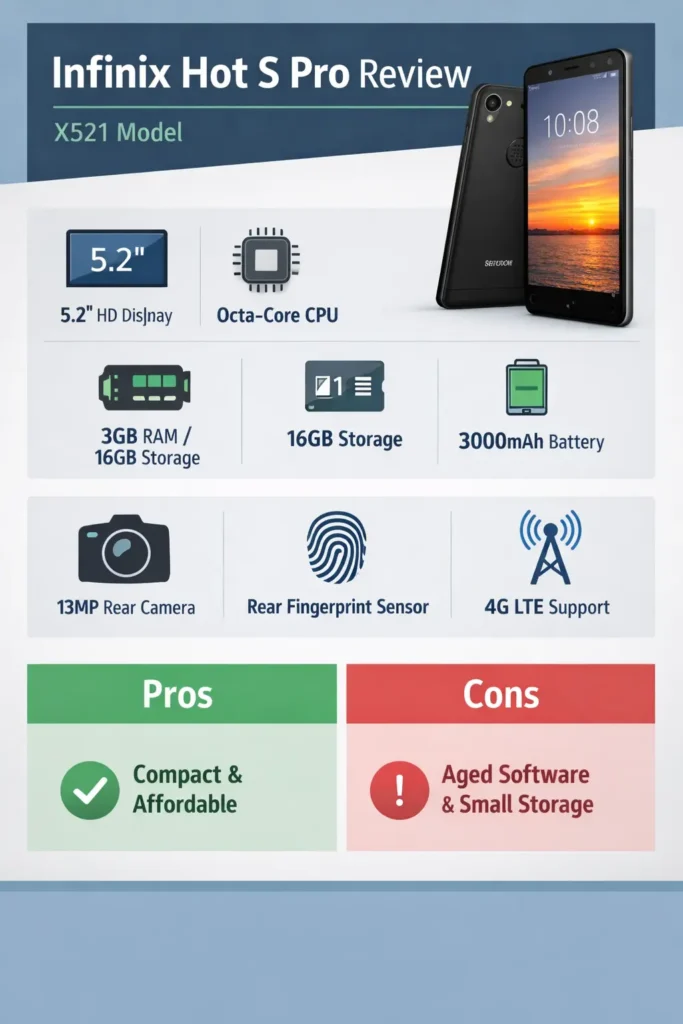
For an honest evergreen article, the safest approach is to separate stable facts from uncertain details.
Safe to state
- Android 6.0 Marshmallow
- MT6753-class octa-core processor
- 13MP rear camera
- 8MP front camera
- 4G LTE
- rear fingerprint sensor
- 3000mAh battery
Use caution / varies by source
- exact RAM and storage bundle in some listings
- display specifics across broader Hot S family pages
- video recording details
Who should buy the Infinix Hot S Pro today?
The Hot S Pro still has a narrow but real audience. It may suit you if you want:
- a cheap backup phone,
- a compact one-handed device,
- a calling and messaging handset,
- a light-use WhatsApp phone,
- or a low-risk secondary smartphone.
Its 4G LTE, rear fingerprint sensor, and 3GB RAM claim make the Pro variant more appealing than many weaker budget phones from the same era. But that only matters if the specific unit is healthy.
You should skip it if you want:
- a modern gaming device,
- a strong camera phone,
- up-to-date security support,
- large storage,
- or long battery life without replacement.
That is the essential buyer filter. The Hot S Pro is a practical, used utility device, not a future-proof smartphone.
FAQs
Yes, but only as a used phone for basic tasks. It is best for buyers who need a cheap backup device and are okay with old Android software and old battery risks.
X521 is the model name used in many reviews and spec pages for the Infinix Hot S Pro. It is the code readers should look for when checking listings or comparing sources.
Yes. Review the sources list 4G LTE support for the Hot S Pro.
The Pro review sources commonly list 3GB RAM and 16GB storage, but some Hot S family pages show conflicting configurations for related variants. For used buyers, verify the exact unit before payment.
It runs Android 6.0 Marshmallow with XOS.
Final verdict
The Infinix Hot S Pro is not interesting in 2026 because it is new, fast, or fashionable. It is interesting because it may still offer reasonable value in the second-hand market if the unit is in solid condition. Its compact size, fingerprint sensor, 4G LTE support, and decent-at-the-time hardware make it a usable little phone for basic needs. But there are limits. The Android 6.0 software is old. The battery may be tired. Storage is small. Camera quality is only fine in ideal lighting. Performance is acceptable for light tasks, not demanding ones.
