
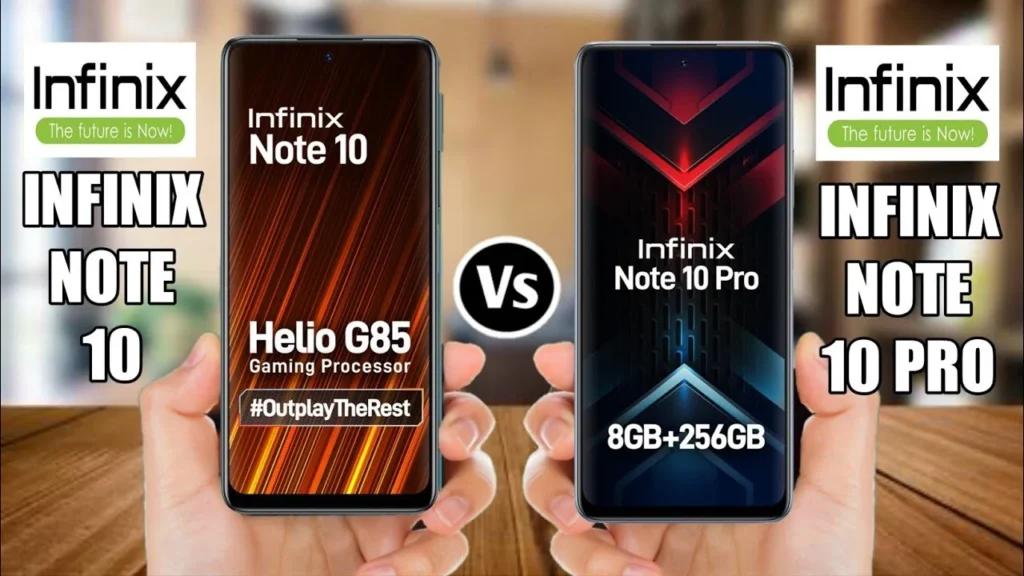
Introduction of Infinix Note 10 vs Note 10 Pro
The Infinix Note 10 vs Note 10 Pro comparison is one of those budget-phone matchups where the differences matter in real life, not just on a spec sheet. Both devices are built for buyers who want a large screen, a big battery, and a phone that can handle everyday social media, video playback, messaging, browsing, and light gaming without costing too much. But once you look beyond the shared family name, the Note 10 Pro clearly steps forward with better performance, a smoother display, faster charging, and more flexible storage and RAM options.
The Infinix Note 10 is the more affordable gateway model. It gets the job done for users who mainly want a large screen and dependable battery life at the lowest possible price. The Infinix Note 10 Pro, on the other hand, feels like the more complete package. It offers a more responsive experience, a stronger chipset, a better camera arrangement, and a charging speed that feels more practical in daily use.
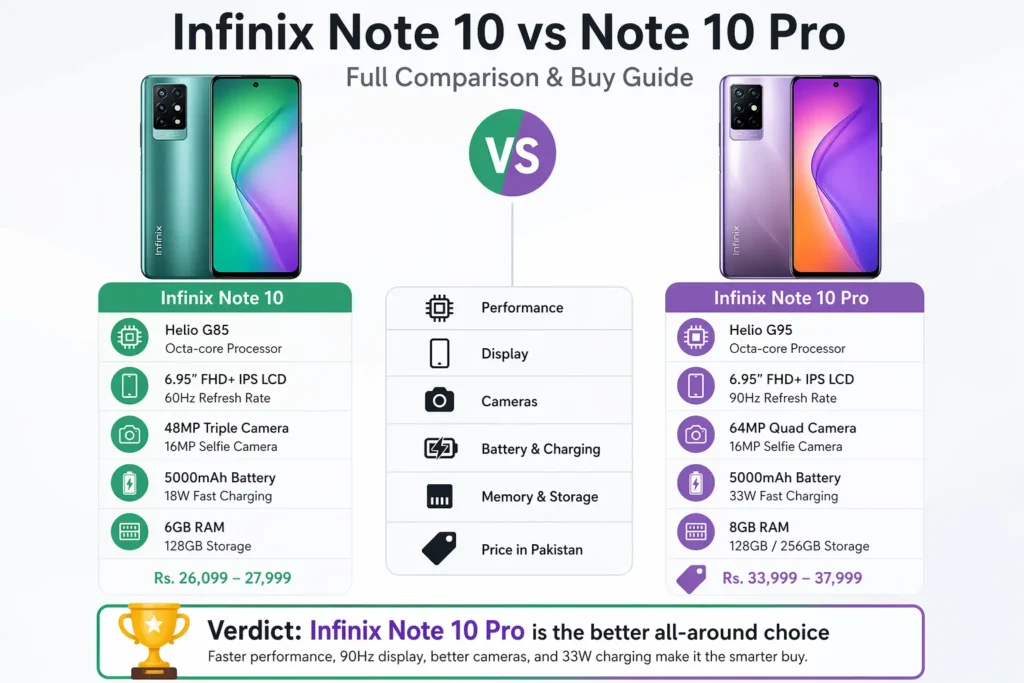
Public Pakistani listings currently place the Note 10 in the Rs. 26,099–27,999 range, while the Note 10 Pro is usually listed around Rs. 33,999–37,999. PriceOye marks both devices as discontinued, so real availability depends on remaining local stock, import channels, and the specific shop you check. That means the buying decision is not only about features; it is also about what is actually available in your market right now.
Both phones launched with Android 11 and XOS 7.6, and the support pages still direct users toward Infinix’s system update area and downloads section. I did not find a newer public operating system listing for either model in the reviewed sources, so these should be treated as older devices with limited software expectations rather than long-term update champions.
Important variant warning
This part matters because the naming can be confusing. The Note 10 and Note 10 Pro were sold in different RAM and storage combinations, and those combinations do not always match across markets. Some Pakistan listings show the Note 10 as 128GB/6GB, while the Note 10 Pro appears as 128GB/8GB or 256GB/8GB. Since many of these listings are now tied to limited stock or discontinued inventory, you should not assume every shop is selling the same configuration.
Full specs table
The specs below reflect public Pakistan listings and general product information. They may vary slightly by region, seller, or market batch.
| Spec | Infinix Note 10 | Infinix Note 10 Pro |
| Release date | 2021 (Pakistan availability in July 2021) | 2021 (global launch in 2021; Pakistan availability followed later) |
| OS | Android 11, XOS 7.6 | Android 11, XOS 7.6 |
| Chipset | MediaTek Helio G85 (12nm) | MediaTek Helio G95 |
| CPU | Octa-core, 2x 2.0GHz Cortex-A75 + 6x 1.8GHz Cortex-A55 | Octa-core, 2x 2.05GHz Cortex-A76 + 6x 2.0GHz Cortex-A55 |
| GPU | Mali-G76 MC4 | Mali-G76 MC4 |
| RAM options | 6GB listed in the current Pakistan listings | 128GB / 256GB are listed in the current Pakistan listings |
| Storage options | 128GB is listed in the current Pakistan listings | 6GB is listed in the current Pakistan listings |
| Display | 6.95-inch IPS LCD, 1080 x 2460 | 6.95-inch IPS LCD, 1080 x 2460, 90Hz |
| Cameras | Rear: 48MP + 2MP + 2MP; Front: 16MP | Rear: 64MP + 8MP + 2MP + 2MP; Front: 16MP |
| Battery | 5000mAh | 5000mAh |
| Charging | 18W | 33W |
| Connectivity | 4G, Wi-Fi ac, Bluetooth 5.1, USB-C, FM radio, 3.5mm jack, NFC no | 4G, Wi-Fi ac, Bluetooth 5.0, USB-C, FM radio, 3.5mm jack, NFC no |
| Sensors | Fingerprint, side-mounted, accelerometer, compass, gyro, proximity | Fingerprin,t side-mounted, accelerometer, compass, gyro, proximity |
| Colors | Black, Purple, Emerald Green | Black, Purple, Nordic Secret |
| Dimensions | 173.2 x 78.7 x 8.8 mm | 172.76 x 78.32 x 8.7 mm |
| Weight | Not listed | Not listed |
Design and display
Big screen, big comfort
The first thing both phones have in common is size. Each one uses a 6.95-inch Full HD+ IPS LCD, which makes them easy to enjoy for videos, reading, social feeds, and general media consumption. This is not a small or pocket-friendly device family. Instead, it is aimed at buyers who actively want a large viewing area. If your daily routine includes YouTube, WhatsApp, scrolling through Facebook, or watching downloaded shows, the big display is one of the main reasons these phones remain attractive.
In everyday use, the screen size is the feature you notice immediately. Text looks large and easy to read. Video playback feels spacious. Typing with two thumbs is comfortable. Even if the panel is not AMOLED, the full-HD resolution helps the picture stay crisp enough for daily use. For a budget phone from this generation, the display still holds up reasonably well for people who prioritize size over premium panel technology.
Why the Pro feels better
The Infinix Note 10 Pro pulls ahead because its public spec sheet includes a 90Hz refresh rate. That does not make it a different-size screen, but it does make motion feel smoother. Scrolling through webpages, social feeds, and app menus looks more fluid, and the interface feels a little more polished. When switching between apps or moving around inside the UI, the Pro tends to feel more responsive and more modern.
The Note 10 does not show that refresh-rate advantage in the public listing reviewed, so it lacks that extra smoothness layer. That does not mean the screen is bad. It simply means the Note 10 Pro has a more pleasant interaction experience for people who are sensitive to scrolling fluidity and animation smoothness.
What this means in real life
Neither phone is compact. Neither is built for one-handed convenience above all else. Both are best thought of as entertainment-first, content-friendly phones with a very large front display. If you spend a lot of time watching videos, reading text-heavy content, or using apps that benefit from a wide visual canvas, both models are comfortable. But if you want the version that feels more refined during long screen sessions, the Pro is the better match.
Plain-English takeaway: both phones are made for big-screen comfort, but the Note 10 Pro wins because the 90Hz display feels smoother in daily use.
Performance and gaming
Helio G85 vs Helio G95
The most important technical gap between the two phones is the chipset. The Note 10 relies on the MediaTek Helio G85, while the Note 10 Pro uses the MediaTek Helio G95. That difference is not just marketing language. It changes how the phone behaves when you move through the interface, launch apps, switch between tasks, or play heavier games.
The Helio G95 is the more capable processor. It gives the Pro more breathing room in multitasking and stronger handling of demanding apps. The Note 10 can still cover everyday needs, but it is the more modest performer. That matters if your phone usage includes a lot of app switching, camera use, heavy browser tabs, or extended gaming sessions.
Everyday speed
For basic usage, both phones are functional. You can message, browse, stream, scroll social apps, make calls, and handle video playback without major trouble. But the Pro feels faster when you go beyond simple use. It opens heavy apps more confidently, maintains better responsiveness under pressure, and generally behaves like a more balanced device.
The Note 10 is acceptable for lighter buyers. It is fine for WhatsApp, YouTube, calls, and casual browsing. But once you start doing more at the same time, the slower chip becomes easier to notice. If you are the kind of user who keeps many apps open and expects a smoother transition between them, the Pro is the more satisfying option.
Gaming experience
For casual titles like Subway Surfers, Stumble Guys, or Candy Crush, both phones can cope without drama. The real difference appears when the games become heavier. For games such as PUBG Mobile, Call of Duty Mobile, or Genshin Impact, the Note 10 Pro has a safer and more comfortable profile because it combines a stronger chipset with more RAM in most listings.
That does not turn the Pro into a gaming monster. It is still a budget device, so expectations should stay realistic. You will not get flagship-level graphics or flawless long-session thermals. But if you want one of these two phones specifically for occasional to moderate gaming, the Pro is the clear choice. It is better equipped to handle stress, and it is less likely to feel strained when the game load gets heavier.
Who should care most about this difference?
Students, social users, and light phone users may find the Note 10 acceptable if they are mainly concerned with price. But if you value faster app switching, better multitasking, and a more confident performance profile overall, the Note 10 Pro is the one to buy. The difference becomes more obvious over time because the Pro feels less limited when the device gets busy.
Plain-English takeaway: the Note 10 Pro is the better pick for gaming, multitasking, and overall speed.
Cameras
Main camera difference
On paper, the camera gap is clear. The Note 10 uses a 48MP triple-camera setup, while the Note 10 Pro moves up to a 64MP quad-camera setup. The larger main sensor number does not automatically mean perfect photos, but it does indicate a more versatile rear camera package. The Pro gives you more flexibility and a stronger overall imaging specification.
What to expect in real-world use
These are not flagship camera phones, and they should not be treated as such. At this price level, camera quality depends heavily on lighting, user steadiness, and processing. In bright daylight, both phones can look respectable. As the light drops, image quality naturally becomes more limited. The Note 10 Pro still has the better chance of producing a more pleasing photo because the overall hardware package is stronger.
The Note 10 remains fine for quick point-and-shoot use. If your camera habits are basic and you mainly want to document moments rather than create polished photography, it will satisfy that need. But if you care more about the best output from this specific comparison, the Pro wins again.
Selfie camera
Both phones are listed with a 16MP front camera, so selfie performance is not a major deciding factor between them. Video calls, selfies, Instagram stories, and casual front-facing photos should be serviceable on either device. In this matchup, the selfie camera is not where the meaningful difference lies. The rear setup and the overall hardware package are what separate the two models.
Plain-English takeaway: the Note 10 Pro has the better rear camera package, but neither phone is meant for serious photography enthusiasts.
Battery and charging
Same battery size, different charging speed
The battery situation is interesting because both phones come with a 5000mAh battery. That is still a useful capacity for a large-screen phone. In normal life, it can comfortably cover a full day for many users, especially if the device is used mostly for messaging, browsing, social media, and media playback rather than constant gaming.
Where the phones diverge is in charging. The Note 10 uses 18W charging, while the Note 10 Pro supports 33W charging. That difference is substantial. Faster charging changes how the phone feels to live with because it reduces the waiting time between a low battery and a usable battery.
Why charging speed matters more than many buyers think
A phone with a good battery but slow charging can still feel inconvenient. If you are someone who regularly tops up during the day, fast charging becomes a quality-of-life feature. The Note 10 Pro handles this much better. It is simply easier to keep it ready because a short charging session restores more power in less time.
The Note 10 is still usable if you charge overnight and follow a predictable routine. But if your lifestyle is busy, or you often forget to charge until you are in a hurry, the 18W limit can feel behind the times. For a big device with a big display, faster charging is not just a luxury. It is part of what makes the phone more comfortable to own.
Battery life in practical terms
Because both phones are built around a similar battery size, their endurance should be broadly decent. Neither one is designed to be a lightweight compact battery champion, but both can still deliver sensible runtime for regular daily use. The Pro’s advantage is not extra battery capacity; it is the faster refill process and the more modern overall feel.
Plain-English takeaway: battery life is fine on both, but the Note 10 Pro is easier to live with because 33W charging is much faster.
Software and updates
Both phones ship with Android 11 and XOS 7.6. That matters because software age influences long-term satisfaction. Even when a phone still performs its basic jobs well, the software platform can make it feel older, less future-proof, and less attractive for people who care about continued update support.
The public support pages reviewed still guide users toward Infinix’s system update section and downloads area, but I did not find a newer official Android version listing for these models in the sources reviewed. That means neither phone should be bought with the expectation of long-term software leadership. They are older phones, and their software profile should be treated that way.
In practical terms, older software does not automatically make the phone unusable. Apps may still run, messaging still works, browsing still works, and media playback still works. But for buyers who want newer features, stronger security, or a longer support runway, both phones are limited by age. The Note 10 Pro has better hardware, but it is not a solution to outdated software by itself.
Plain-English takeaway: both phones are running old software, so they are value buys rather than update-focused purchases.
Price and availability
Current Pakistan price snapshot
| Region | Note 10 | Note 10 Pro | Availability note |
| Pakistan | Rs. 26,099–27,999 | Rs. 33,999–37,999 | PriceOye marks both discontinued; local stock may still exist |
These figures reflect public Pakistan listings checked on April 24, 2026. WhatMobile lists the Note 10 at Rs. 27,999 and the Note 10 Pro at Rs. 37,999. PriceOye lists the Note 10 at Rs. 26,099 and the Note 10 Pro at Rs. 33,999, with both marked discontinued.
Which phone is the better value?
The Note 10 is cheaper, but the value question is not only about the lowest price. The Note 10 Pro gives you more practical benefits in almost every important category: faster performance, smoother display interaction, better charging speed, and more comfortable headroom for multitasking. Unless the price gap is unusually wide, the Pro is the more sensible buy.
If you are shopping on a tight budget and every rupee matters, the Note 10 may still appeal because it gets you into the family at a lower entry point. But from a pure value perspective, the Note 10 Pro is the more complete and future-resistant purchase within the limits of this lineup.
Plain-English takeaway: the Note 10 costs less, but the Note 10 Pro gives better real-world value for most buyers.
Pros and cons
Infinix Note 10
Pros
- Large Full HD+ display
- Good 5000mAh battery size
- Lower price
- Fine for basic daily tasks
Cons
- Slower Helio G85 performance
- 18W charging feels dated
- Older Android 11 / XOS 7.6 software
- Less future-proof overall
Infinix Note 10 Pro
Pros
- Faster Helio G95 chipset
- 90Hz display for smoother scrolling
- Better rear camera setup
- 33W charging
- Better RAM/storage options
Cons
- Still old software
- Still LCD, not AMOLED
- Large and bulky body
- Limited to 4G
Who should buy the Note 10?
Choose the Note 10 if you:
- want the lowest possible price
- mostly use WhatsApp, YouTube, Facebook, and calls
- do not care much about fast charging or gaming
- are okay with older software and a basic camera setup
Who should skip the Note 10?
Skip it if you:
- play heavier games
- want smoother scrolling
- Need more storage flexibility? Charge your phone often during the day
- care about better long-term value
Who should buy the Note 10 Pro
Choose the Note 10 Pro if you:
- want noticeably better performance
- care about 90Hz smoothness
- Need faster 33W charging
- want the stronger camera package
- want the better all-around budget phone
Who should skip the Note 10 Pro
Skip it if you:
- want newer Android support
- need 5G
- want AMOLED
- are not comfortable buying an older, discontinued model
FAQs
No. The Note 10 Pro is better in performance, display smoothness, charging speed, and storage options.
Yes. The public spec listing shows a 6.95-inch FHD+ IPS LCD with 90Hz.
The Note 10 Pro is better because it uses the stronger Helio G95 chipset and usually comes with more RAM.
The Note 10 Pro charges faster with 33W, while the Note 10 uses 18W charging.
Yes, both are listed with a 3.5mm audio jack.
Verdict
If you want the simplest and most practical answer, buy the Infinix Note 10 Pro. It is the better phone for almost every kind of everyday use that people actually care about: performance, display smoothness, camera flexibility, and charging speed. The Infinix Note 10 Pro is the stronger pick because it delivers a faster Helio G95 chipset, a 90Hz display, more RAM and storage options, and 33W charging. The Infinix Note 10 only makes sense if it is much cheaper and your usage is light.
The Infinix Note 10 only makes sense when price is the main factor and your usage is light. It can still serve as a budget large-screen phone for calls, messaging, social media, and YouTube, but it does not offer the same comfort level or performance margin as the Pro. If you can stretch to the higher model without hurting your budget too much, the Pro is the better long-term choice.
