
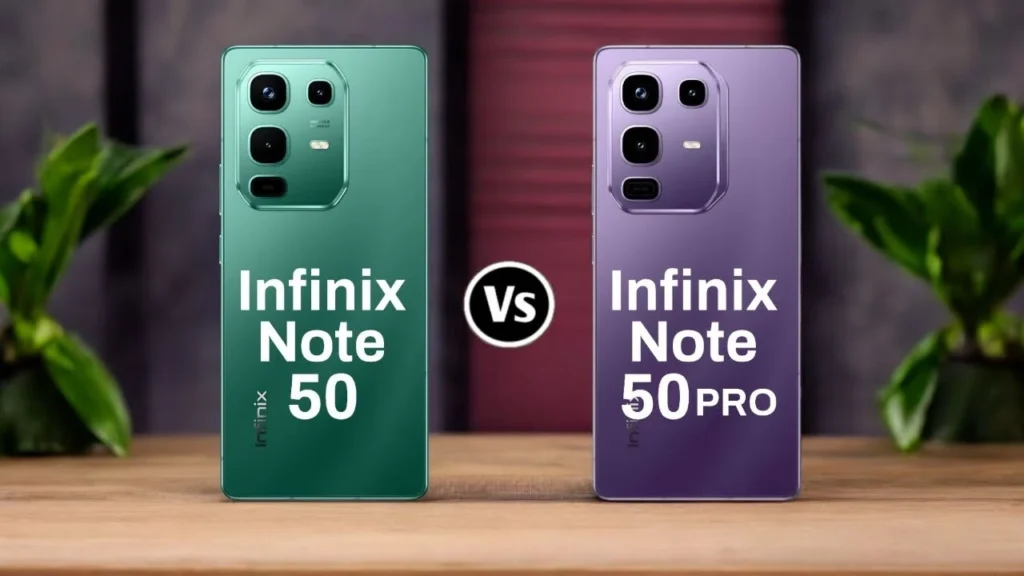
Infinix Note 50 vs Note 50 Pro
The Infinix Note 50 vs Note 50 Pro comparison is not a classic “bigger number wins” battle. It is a practical, user-focused decision where both smartphones share the same core platform, the same large AMOLED display, and the same battery class. That means the heart of the buying decision is not raw performance. Instead, it comes down to camera tuning, selfie quality, charging style, hand feel, and how much extra money you are actually paying for the Pro model.
In simple terms, the base model is the value-first option, while the Pro is the camera-first and slightly more polished option. That is the real framework you should use before making a purchase. If you look at this comparison through a spec-sheet lens only, the difference may look small. But if you think like a real buyer, the distinction becomes much clearer: one phone is built to save you money while keeping the essentials intact, and the other is built to give you a noticeably better imaging experience and a more refined physical profile.
Quick Verdict
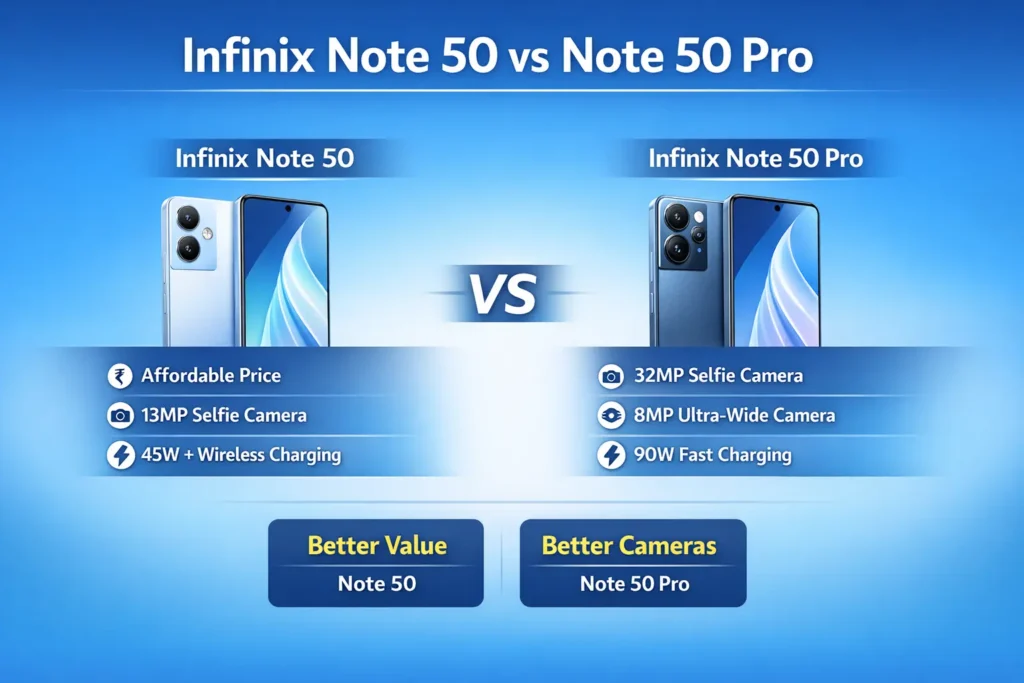
If you want the strongest value proposition, the Infinix Note 50 is the smarter buy. It delivers the same big AMOLED panel, the same Helio G100 Ultimate chipset, and the same battery class for less money. That is excellent cost efficiency.
If you care more about selfies, broader camera versatility, and a slightly more premium in-hand experience, the Infinix Note 50 Pro is the better choice. The Pro is not a huge leap in every area, but it does make enough meaningful upgrades to justify the higher asking price for the right user.
Key Differences at a Glance
The following summary highlights the most important differences based on live Pakistan comparison pages and official Infinix product information.
| Feature | Infinix Note 50 | Infinix Note 50 Pro |
| Price in Pakistan | Rs 68,999 | Rs 79,999 |
| Display | 6.78-inch AMOLED, 1080 × 2436, 144Hz | 6.78-inch AMOLED, 1080 × 2436, 144Hz |
| Chipset | Helio G100 Ultimate | Helio G100 Ultimate |
| Battery | 5200mAh class | 5200mAh class |
| Main rear camera | 50MP OIS + 2MP | 50MP OIS + 8MP |
| Selfie camera | 13MP | 32MP |
| Body | 163.26 × 74.43 × 7.55mm, 199g | 163.26 × 74.43 × 7.32mm, 198g |
| Charging | 45W + 30W wireless MagCharge | Up to 90W |
| Storage highlight | 256GB + 8GB RAM | 256GB + 12GB RAM |
These numbers matter because they reveal the real structure of the comparison. The panel and processor are nearly identical, so the user experience is largely shared. The upgrade premium is concentrated in photography, charging, memory configuration, and physical refinement.
Design and Build
At a glance, the two phones belong to the same visual family. They are both large-screen midrange smartphones with a modern, flat aesthetic and a design language that looks current rather than old-fashioned. This is not one of those comparisons where the Pro instantly appears like a completely different product. The shape, footprint, and overall styling remain very close.
Still, the Pro does have a mild edge in the engineering and ergonomics department. The Note 50 is listed at 7.55mm thick and 199g, while the Note 50 Pro measures 7.32mm thick and 198g. On paper, that difference may seem tiny. In everyday handling, however, small reductions in thickness and weight can slightly improve comfort, especially during extended browsing, reading, social media use, or long photo sessions.
This is the kind of distinction that matters more to someone who uses a phone constantly throughout the day than to someone who just wants a decent handset and a fair price. The Pro does not reinvent the design; it simply feels a little more trimmed, a little more streamlined, and a bit more premium subtly.
The important takeaway is this: the base model already looks and feels modern. You are not buying an outdated or compromised device if you choose the standard Note 50. The Pro just adds a light layer of polish.
Who will notice the design difference most?
Users who keep their phone in hand for long periods, shoot many images, or value a softer, lighter grip will appreciate the Pro more. Buyers who are primarily focused on budget savings will likely find the standard Note 50 perfectly satisfying, because the base model still offers a sleek, contemporary package without feeling cheap.
Design verdict
The Pro wins on refinement, but the gap is modest. Do not overvalue this category. The real purchasing decision lies elsewhere.
Display Comparison
This is one of the least complicated sections of the matchup. There is no meaningful display winner because both phones essentially share the same visual foundation. According to live comparison listings, both models come with a 6.78-inch AMOLED display, 1080 × 2436 resolution, and 144Hz refresh rate.
That is a strong combination for a phone in this segment. AMOLED usually brings richer contrast, deeper blacks, and a more vibrant look than basic LCD panels. The 144Hz refresh rate also makes the interface feel smoother, whether you are scrolling through feeds, switching apps, reading websites, or moving through menus.
Since the display setup is so similar, you should not buy the Pro only for the screen. The regular Note 50 already gives you the same visual experience in practical terms. This is important because some shoppers assume the Pro will automatically have a much better screen. In this case, that is not true.
Real-world display experience
For watching videos, browsing social content, checking documents, and handling day-to-day multitasking, both phones should feel very comfortable. The panel size is generous, the AMOLED tech should make content look lively, and the high refresh rate helps the whole interface feel responsive.
Display verdict
There is no compelling reason to pay extra just for the screen. The display is one of the strongest shared characteristics in this comparison, which means the decision naturally moves to other areas.
Performance Comparison
This is where many comparison pages can overcomplicate the discussion. They frame the Note 50 and Note 50 Pro as if they are in a serious speed duel. They are not. Both phones use the MediaTek Helio G100 Ultimate platform, which means day-to-day performance should be extremely close.
The performance story is therefore very simple: both devices are built for balanced everyday use, not for chasing flagship-level benchmarks. App loading, web browsing, messaging, video streaming, and normal productivity should feel similar on both phones. Neither model is positioned as an extreme gaming machine or a synthetic benchmark champion.
That is why the smarter question is not “Which phone is faster?” The smarter question is “Which phone gives you the better overall package for the money you are spending?”
Gaming and practical use
For light gaming and moderate gaming, both phones should be suitable enough for mainstream users. They are not trying to fight with dedicated gaming devices, and they should not be judged by that standard. If you are someone who primarily wants stable everyday performance, smooth general navigation, and a large display, both models can meet that expectation.
Heavy gamers should understand that this comparison is not designed around top-tier performance escalation. These are broad-appeal phones, not performance monsters.
RAM and storage
The memory situation gives the Pro another modest advantage. The comparison page indicates 256GB storage + 8GB RAM for the Note 50 and 256GB storage + 12GB RAM for the Note 50 Pro. That means the Pro may offer a more comfortable multitasking experience, especially if you tend to switch between several apps or keep many background tasks open.
Still, this is a convenience gain rather than a complete performance overhaul. The core chipset remains the same, so the base experience is closely matched.
Performance verdict
If speed is your primary concern, the cheaper Note 50 already covers the essentials. The Pro is not a dramatic leap forward in power; it is mainly a memory and experience enhancement.
Camera Comparison
This is the most important section of the entire article because the camera system is where the real separation begins.
The key difference between the Infinix Note 50 and the Infinix Note 50 Pro is not the display or processor. It is imaging. The standard model is listed with a 13MP selfie camera and a rear arrangement of 50MP OIS + 2MP, while the Pro comes with a 32MP selfie camera and a rear setup of 50MP OIS + 8MP.
That is a meaningful difference, especially for people who care about social media, video calls, portraits, travel photography, or content creation.
Rear camera difference
Both phones share the same 50MP main camera with OIS, so the primary rear shooter is not where the major split happens. The difference lies in the secondary lens. The Note 50 uses a 2MP helper sensor, whereas the Pro has an 8MP secondary lens.
In practical terms, an 8MP secondary camera is far more useful than a 2MP utility sensor. It gives you more flexibility for wide scenes, group photos, buildings, interiors, landscapes, and any situation where you want a broader perspective. The 2MP sensor on the base model is more limited and generally less versatile.
So if you often shoot with the rear camera, the Pro is the stronger and more adaptable option.
Selfie camera difference
This is the clearest and most noticeable upgrade of all. The Note 50 uses a 13MP front camera, while the Note 50 Pro jumps to a 32MP front camera. That is not a tiny enhancement. It is a substantial front-facing camera improvement.
If you take selfies regularly, make video calls frequently, create short-form content, or upload to social platforms often, the Pro makes a much stronger case. A sharper front sensor can improve detail, clarity, and overall presentation in a way that everyday users can actually notice.
This is the kind of upgrade that feels tangible rather than theoretical. It is not just a spec increase on paper. It changes the phone’s identity from a general-purpose device into something more appealing for camera-conscious buyers.
Who should care most about the camera gap?
Casual users who rarely take photos can live comfortably with the Note 50. However, users who care about selfie sharpness, daily photography flexibility, or a more capable camera package should lean toward the Pro. For those buyers, the extra money goes toward a feature they will truly use.
Camera verdict
The camera system is the strongest reason to choose the Pro. If photography does not matter much to you, the standard Note 50 becomes very compelling on value alone.
Battery and Charging
Battery life is another area where the two devices are closer than many people expect. According to the available information, both phones sit in the 5200mAh battery class. That is a healthy capacity for a phone in this segment and should support solid day-long usage for routine tasks such as messaging, calls, browsing, video, and social apps.
The more interesting difference is charging.
The Infinix Note 50 is listed with 45W charging plus 30W wireless MagCharge, which makes it unusual in a good way. Wireless charging-style convenience is not something every phone in this segment offers, and for some buyers, that feature alone adds real appeal.
The Infinix Note 50 Pro, on the other hand, is listed with up to 90W charging. That is a much more aggressive wired charging spec and should translate into faster top-ups, which can be very useful if you charge in short bursts during the day.
What does this mean in practice?
If you like the idea of fast wired charging, the Pro is the more impressive device. If you prefer the convenience angle and find wireless-style charging more interesting, the Note 50 offers a different kind of advantage.
This is why the base model should not be dismissed as underpowered. It may not win on wired charging numbers, but it does bring its own practical benefit.
Battery verdict
Both phones should provide dependable everyday endurance. The real difference is charging philosophy: the Pro is faster on wired charging, while the Note 50 offers a more convenience-focused approach.
Price and Value
This is the section where the overall verdict becomes easiest to understand.
According to the comparison page, the Infinix Note 50 is priced at Rs 68,999, while the Infinix Note 50 Pro is priced at Rs 79,999. That creates a difference of Rs 11,000.
The question is not simply whether the Pro is more expensive. The real question is what extra value you receive for that premium.
For that additional amount, you get:
- a better selfie camera,
- a stronger secondary rear camera,
- a slightly thinner and lighter body,
- and faster charging.
What you do not get is a new display class, a different chipset, or a completely transformed battery setup. The phone’s core identity remains very similar.
That means the Pro should be seen as a camera-and-finish upgrade, not as a full generational leap in overall capability.
Value breakdown
Best budget choice: Note 50
Best camera choice: Note 50 Pro
Best savings: Note 50
Best premium feel: Note 50 Pro.
Price verdict
If you are purchasing with cost efficiency in mind, the Note 50 is the stronger deal. If you are prioritizing photography and a more refined experience, the Pro can justify its price more convincingly.
Which One Should You Buy?
This is the practical buying guide section. The correct answer depends on what kind of user you are and what matters most in your day-to-day phone usage.
Buy the Infinix Note 50 if:
You want the lower price, the same display, the same chipset, and the same battery class. You are okay with a simpler selfie camera and a more modest rear setup because your priority is maximizing value rather than paying extra for camera gains.
Buy the Infinix Note 50 Pro if:
You take selfies often, care about front camera clarity, want a more useful secondary rear camera, and like the idea of a thinner, lighter device with faster charging. The price increase makes sense only if those upgrades matter to you in real usage.
Best choice for students
The Note 50 is usually the smarter student pick. Students often want a large screen, stable everyday performance, good battery life, and a reasonable price. Since both phones share the same display and chipset, the cheaper model usually provides the better overall student-friendly balance.
Best choice for creators
The Note 50 Pro is the stronger option for creators, selfie users, and people who post regularly on social media. The 32MP front camera and improved rear versatility make it a more attractive phone for content-oriented buyers.
FAQs
Not overall. The Note 50 is better for value, while the Note 50 Pro is better for camera quality and selfies. The better phone depends on which feature set matters more to you.
The main difference is the camera setup. The Note 50 Pro has a 32MP selfie camera and an 8MP secondary rear camera, while the Note 50 has a 13MP selfie camera and a 2MP secondary rear camera.
Yes. Both phones use a 6.78-inch AMOLED display with 1080 × 2436 resolution and 144Hz refresh rate.
Yes. Both phones use the MediaTek Helio G100 Ultimate chipset. That is why their daily performance should feel very similar.
Both phones have a 5200mAh battery class, so battery life should be similar in normal use. The main difference is charging speed and charging style.
Final Verdict
The Infinix Note 50 vs Infinix Note 50 Pro matchup is not a performance war. It is a value-versus-camera decision.
Both phones share the same 6.78-inch AMOLED display, the same Helio G100 Ultimate chipset, and the same 5200mAh battery class. That means the core user experience is closely aligned. The major upgrades in the Pro are the camera system, selfie quality, charging speed, and a slightly more refined body feel.
The standard Note 50 remains the stronger value buy because it keeps the essential experience intact while costing less. The Note 50 Pro becomes worth the higher price only when camera quality, especially selfies, is a priority.
