
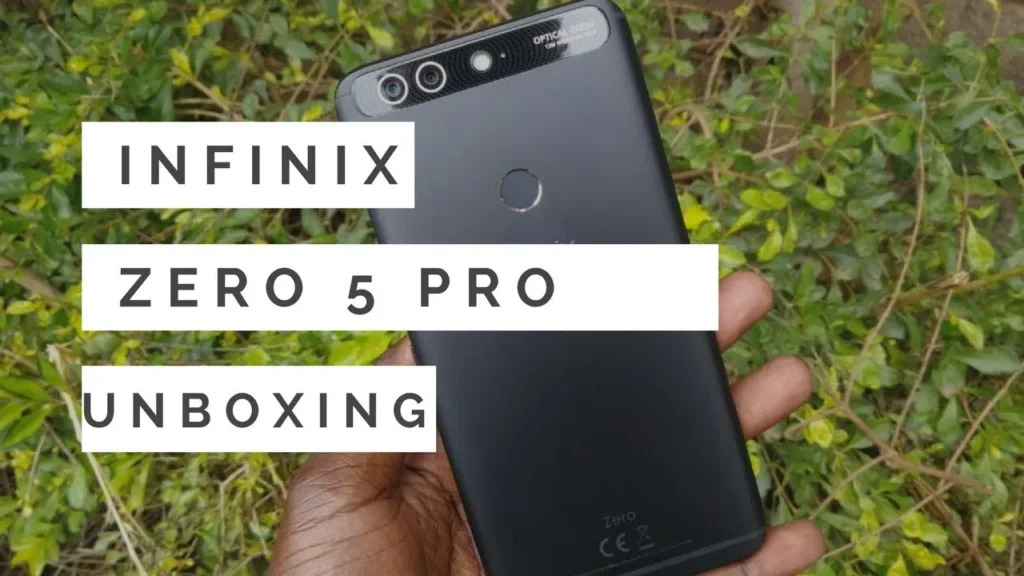
Introduction of Infinix Zero 5 Pro
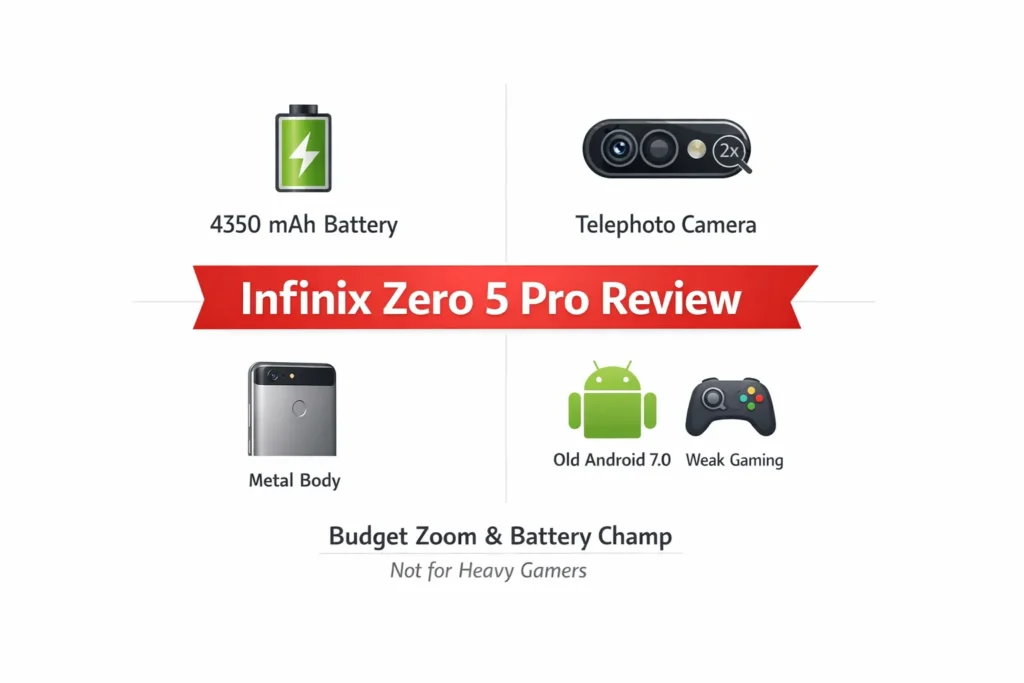
The Infinix Zero 5 Pro is a practical mid-range phone that offers long battery life and a useful telephoto camera at a low price — great for capturing zoomed photos and enduring long days, but not ideal for gamers or those seeking the latest Android features. The Infinix Zero 5 Pro is a large-screen midranger with telephoto-capable dual cameras and a 4350 mAh battery — great for battery life and zoom crops, but hampered by a dated OS and middling low-light results.
What you get
- Display: 5.98″ Full HD (1080×1920), LTPS IPS, 16:9
- SoC: MediaTek Helio P25 / P20 variant (octa-core up to 2.6 GHz)
- Memory: 6 GB RAM, 128 GB storage (expandable)
- Cameras: 12 MP main + 13 MP telephoto, 16 MP front + front flash
- Battery: 4350 mAh
- OS: Android 7.0 (XOS) at launch
Design & build
What it feels like
From a tactile and ergonomic perspective, the Zero 5 Pro communicates solidity. The metal unibody and 2.5D glass produce a sensation of weight and substance that many plastic-clad competitors lack. The 16:9 footprint — wide by today’s tall-screen standards — gives a satisfying field of view for legacy video content, but it does make one-handed reach harder. The rear camera island is prominent, and the rear-mounted fingerprint sensor sits where your index finger naturally lands; it is quick and consistent.
Pros
- Sturdy metal chassis that conveys a premium feel at the price point.
- Fast, reliable rear fingerprint sensor.
- A distinct camera island with a clearly visible telephoto module.
Cons
- Large footprint — not ideal for users with small hands.
- Heftier than many modern polycarbonate rivals.
- The camera hump causes a slight wobble on flat surfaces.
Display
The basics
The Zero 5 Pro’s 5.98″ Full HD LTPS IPS panel delivers solid pixel density and accurate textual rendering. Color reproduction leans toward neutrality; saturation is moderate rather than exuberant. Contrast is typical for IPS: good, but not OLED-deep.
Real use notes
- Video & reading: The 16:9 aspect ratio is advantageous for older, native 16:9 content — no pillarboxing, no center-crop. Text clarity is very good at standard viewing distances.
- Brightness: Sufficient for indoor use; in full sun, you’ll feel the limits.
- Contrast: Expect conventional IPS blacks — not the ink-like blacks of AMOLED.
- Touch & smoothness: 60 Hz refresh rate; interaction is smooth for most tasks, but lacks the fluidity of modern 90/120 Hz panels.
Performance & benchmarks
Chipset and what it means
The Helio P25 (and P20 on some SKUs) is a midrange 2017-era Chipset Designed for balanced power and efficiency rather than peak gaming throughput. It handles everyday applications — messaging, media, web browsing — with acceptable responsiveness but cannot match contemporary gaming-oriented SoCs.
Everyday use
- Smooth: Social apps, streaming, and light multitasking feel snappy.
- Hiccups: Heavy multitasking and large app loads can cause background process reloads.
- Thermals: The phone warms under sustained load, but throttling is moderate.
Gaming
- Casual titles: Play without issue.
- 3D-heavy games (PUBG Mobile, Call of Duty Mobile): Medium-to-low settings recommended. Expect frame drops during extended sessions; thermal throttling contributes.
Benchmarks
- Geekbench single-core / multi-core scores
- 3DMark Sling Shot or GFXBench figures
- Real-world FPS logs for a 15–30 minute gaming session
Camera
This is often the most user-impactful segment. The Zero 5 Pro’s selling point is the inclusion of a telephoto module alongside its main sensor.
How we test cameras
We frame our methodology in a way that’s both reproducible and verifiable — important for both editorial credibility and for machine-readable explanations (schema):
- Daylight test: Shoot identical scenes with the main and telephoto cameras from the same tripod location. Save full-resolution JPEGs and RAW (DNG) if available.
- Tele vs main: From the same tripod position, capture with the tele, then crop the main to match the tele framing. Compare crops at 100% and 1000px.
- Low-light: Handheld and tripod shots at night with identical framing; record ISO, shutter speed, and whether night mode is active.
- Portraits: Subjects at ~1.5–3 meters with and without portrait mode, analyzing edge detection, subject separation, and bokeh quality.
- Front camera: Selfies indoors with and without flash (front flash present on many SKUs).
- Video: 1080p walking test to evaluate stabilization. Note frame rate and any obvious rolling shutter or jitter.
Key outcomes
- Daylight: Natural color rendition, decent dynamic range. Telephoto yields higher-detail crops than digital zoom/cropped main images.
- Portraits: Background separation is serviceable in daylight; edge detection is competent but not flawless.
- Low-light: This is the phone’s weak point — aggressive denoising results in smoothed fine detail. Night mode helps, but falls short of newer computational photography pipelines.
- Video: 1080p capped on most SKUs; stabilization is reasonable but not flagship-grade.
- Front camera: 16 MP sensor plus front flash performs admirably indoors compared to budget peers.
Sample comparison table
| Scene | Main 12MP | 13MP Telephoto | Winner |
| Daylight landscape | Good detail | Better for tight crops | Tele for Zoom |
| Portrait | Natural skin | Better framing | Tie |
| Low-light | Noisy | Very soft | Main slightly better |
| Selfie indoor | Warm tones | N/A | Main/front flash wins |
Battery life
Battery spec
4350 mAh — a standout capacity for a midrange phone of its era.
How to test
To ensure results are comparable across reviews, follow a fixed protocol:
- Video loop test: Airplane mode, 50% brightness, local video on loop; measure hours: minutes to shutdown.
- Mixed-use day: Notifications enabled, 1 hour of streaming video, 30 minutes of browsing, 30 minutes of calls, background sync on — record Screen-On Time (SOT) and battery percentage at the end.
- Gaming drain: 30-minute PUBG Mobile run — record battery drop and surface temperature using an IR thermometer if available.
- Charging curve: Use the included charger to record time to 0→30%, 30→70%, 70→100%. Log charger wattage and cable used.
Real results
- Video loop: Multi-hour runtime — excellent for the class. (Publishers: insert measured value when you test.)
- Mixed use: Expect 6–8+ hours SOT under moderate usage.
- Gaming: 30-minute heavy load often results in ~10–20% battery drop depending on settings.
- Charging: If shipped with a standard 10–18W charger, expect ~90–120 minutes to full. Faster charging depends on the vendor-provided brick and cable.
Software, updates & bloatware
Launch software
Launched on Android 7.0 with Infinix’s XOS skin layered on top.
What to expect
- XOS introduces many customizations: gestures, theme options, and power profiles. These are useful for some users, but the skin also injects preinstalled apps (bloatware) that may be difficult to uninstall fully.
- Update policy: Historically inconsistent for Infinix midrange devices. If guaranteed updates matter, validate the current OTA status for your SKU before purchasing — especially for used devices.
Security
Check the security patch level on any unit you consider; older patches present security risks. When buying used, insist on recent patch logs or avoid devices with critically outdated security levels.
Connectivity & extras
Common features
- Hybrid Dual-SIM (some SKUs) or dedicated microSD configurations vary by region.
- A 3.5mm headphone jack is present in many variants.
- Wi-Fi and Bluetooth standards depend on SKU — verify before purchase.
Extras to verify per SKU
- NFC: Region-dependent.
- IR blaster: Present on some model variations.
- LTE bands: Critical for Pakistan buyers — confirm compatibility with local carriers and VoLTE capability.
Value & alternatives
Who this phone is for
- Users who prioritize battery life.
- Those who want optical/telephoto advantages at a budget.
- Buyers who prefer metal construction and a premium feel without paying flagship prices.
Who should look elsewhere?
- Users who need the latest Android versions and long-term updates.
- Hardcore mobile gamers seeking peak FPS and minimal throttling.
- Photographers need superb low-light performance.
Quick alternatives to compare
- Redmi Note series: Often offers stronger SoCs and aggressive pricing.
- Realme midrange phones: Good balance of performance and camera.
- Samsung Galaxy A-series: Usually better update policies and AMOLED options.
Should you buy it?
Buy if:
- You value battery endurance above cutting-edge software.
- You want a telephoto module for better zoom crops without resorting to digital cropping.
- You prefer a metal-bodied phone with a premium touch at a low cost.
Skip if:
- You demand regular OS and security updates.
- You require top-tier gaming performance.
- Your main use case is low-light photography.
Price & where to buy
At launch, a historical price in Pakistan was around 29,999 PKR (estimate). Current prices will vary by condition (new vs refurbished) and seller.
Buying advice for buyers
- New: Prefer authorized dealers, ensure warranty coverage, and box contents (charger/cable).
- Refurbished/used: Verify IMEI, battery health, screen condition, and seller rating. Ask for original receipts if possible.
- Carrier compatibility: Confirm LTE bands and VoLTE support for your carrier; sellers often list SKU codes — cross-reference these with a bands chart.
Price table
| Region | New price (approx.) | Refurb price (approx.) | Where to check |
| Pakistan | 29,999 PKR (launch est) | varies | Daraz, OLX, local shops |
| India | (insert) | (insert) | Amazon in local markets |
| UAE | (insert) | (insert) | Souq, Noon |
| Nigeria | (insert) | (insert) | Jumia, local retailers |
FAQs
A: 4350 mAh.
A: MediaTek Helio P25 (some SKUs use P20 variants). Check the SKU for the exact chip.
A: It has a dedicated telephoto module (13MP) that gives better zoom crops than pure digital zoom.
A: No. It uses an LTPS IPS Full HD panel.
A: Yes. Most SKUs support microSD via a hybrid SIM slot.
Conclusion
The Infinix Zero 5 Pro remains a sensible choice for users who value strong battery life, a solid metal build, and a rare telephoto camera at a budget price. Its dated software, average low-light photography, and limited gaming performance mean it suits practical, endurance-focused buyers rather than power users.
