
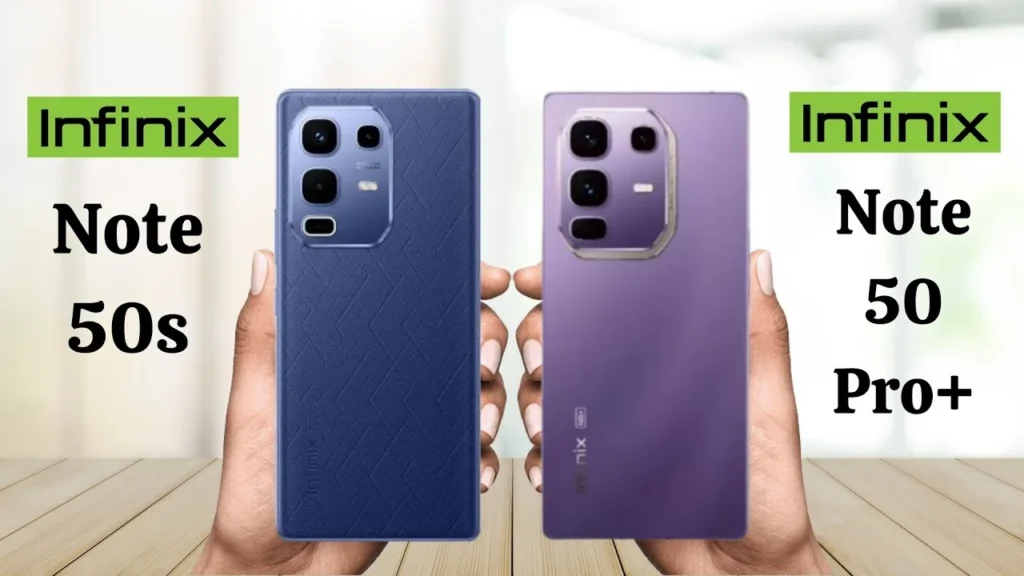
Infinix Note 50S vs Note 50 5G
The Infinix Note 50S 5G+ and the Infinix Note 50 live in the same broad smartphone segment, but they are built for different kinds of buyers. At first glance, they look close enough to confuse many shoppers. Both phones offer a large 6.78-inch AMOLED display, a 144Hz refresh rate, and Android 15-based software, which make them feel modern, fast, and competitive in the budget-to-midrange space. But once you look past the surface, the real difference becomes much clearer.
This is not a simple spec-sheet fight. It is a performance-first vs feature-first comparison.
The Note 50S 5G+ is the more athletic choice. It is tuned for quicker response, better gaming behavior, a lighter body, and a more aggressive camera pitch. It is the kind of phone that tries to impress people who care about speed, frame stability, and a more future-facing hardware package.
The Note 50, on the other hand, takes a more balanced route. It focuses on day-to-day comfort, premium practical extras, and a friendlier price tag in live listings. Features like OIS, wireless MagCharge, and a lower current comparison price make it look more appealing for users who want convenience and value rather than the fastest possible performance.
So the real buying question is simple: Do you want the faster, lighter, gaming-oriented phone, or do you want the more complete, practical, value-led phone?
That is why this comparison works best as a decision guide, not just a technical breakdown. Both phones belong to the same family, but they target different buyer mindsets. One model leans toward speed and endurance. The other leans toward convenience and real-world usefulness. Once you understand that split, the decision becomes much easier.
Verdict
If you want the short answer first, here it is:
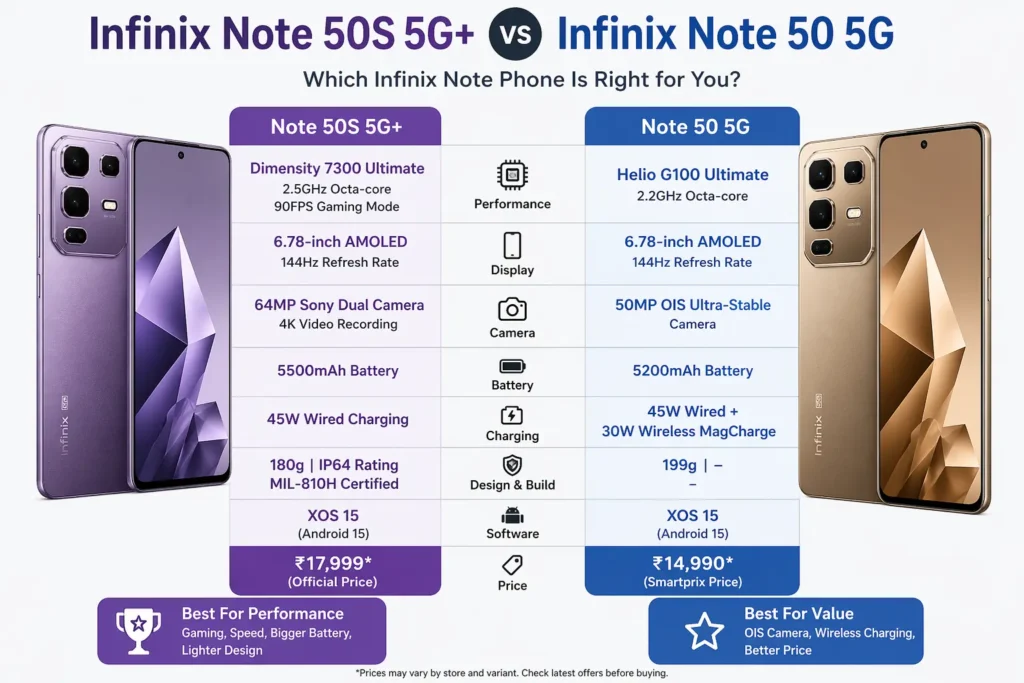
Buy the Infinix Note 50S 5G+ if your priority stack includes gaming, stronger sustained performance, a lighter chassis, a larger battery, and a camera setup that looks more future-ready on paper. Infinix highlights the Dimensity 7300 Ultimate, 90FPS gaming mode, 64MP Sony dual camera, 4K video recording, 5500mAh battery, IP64 protection, and MIL-810H certification on the official page. It is also listed at ₹17,999 on Infinix’s India store, while Smartprix currently shows ₹18,999 for the comparison entry.
Buy the Infinix Note 50 if you want a better value equation, along with everyday features that genuinely improve the user experience: 50MP OIS Ultra-Stable Camera, 45W wired charging, 30W wireless MagCharge, 5200mAh battery, and a lower live comparison price of ₹14,990 on Smartprix. Infinix’s official product snippet also presents the Note 50 as a 6.78-inch 144Hz AMOLED phone powered by the Helio G100 Ultimate platform.
In plain English, the Note 50 is the cleaner recommendation for most buyers who want more convenience per rupee. The Note 50S 5G+ is the better pick for users who want more speed and a more performance-heavy identity.
Differences at a Glance
The easiest way to understand these two phones is to map them to their core purpose.
The Note 50S 5G+ is the more performance-led model. It feels lighter, faster, and more gaming-friendly. It also carries a larger battery and a more aggressive camera setup on paper.
The Note 50 is the more feature-complete model. It places more emphasis on comfort, charging flexibility, OIS, and value for money.
Smartprix also shows the Note 50S 5G at 180g, while the Note 50 weighs 199g. That difference may not look dramatic on a spec sheet, but in real use, it changes the handling experience. The same listing shows a 5500mAh battery on the Note 50S 5G and a 5200mAh battery on the Note 50. It also shows a 2.5GHz octa-core CPU for the Note 50S 5G and a 2.2GHz CPU for the Note 50.
On the camera side, Smartprix lists the Note 50S 5G with 64MP + 2MP dual rear cameras, while the Note 50 uses 50MP + 2MP with OIS on the main lens.
The official Infinix product pages make the split even more obvious. The Note 50S 5G+ is presented with the Dimensity 7300 Ultimate, 90FPS gaming mode, 64MP Sony dual camera, 4K video, MIL-810H certification, IP64 rating, and 5500mAh battery. The Note 50 page highlights 5200mAh battery life, 45W wired charging, 30W wireless MagCharge, 144Hz AMOLED, in-display fingerprint, and 50MP OIS Ultra-Stable Camera.
That is not a small variation. That is a completely different product strategy.
Design and Display
At first glance, the two phones appear closely related because both use the same broad display philosophy: a 6.78-inch AMOLED panel with a 144Hz refresh rate class. For most users, that means the viewing experience will feel familiar in the best possible way. Scrolling should feel fluid, animations should look smooth, and video playback gets the benefit of a large, vivid canvas. In the display department, there is no massive gulf between them.
The Note 50S 5G+ is the lightest phone at 180g. That matters more than many people think. A lighter phone is easier to hold for long reading sessions, more comfortable during one-handed use, and less tiring when you are gaming or watching content for a long stretch. In everyday use, this creates a more agile impression. The phone feels quicker, not just in performance, but also in physical behavior.
The Note 50, at 199g, is still manageable and not overly heavy. But it has a more grounded presence. It feels a little fuller, a little denser, and a little more substantial in the hand. Some users will like that because it gives the device a more solid feel. Others will prefer the lighter Note 50S 5G+ because it is easier to carry and easier to live with over time.
The design story also extends into the way the hardware is packaged around the screen. The Note 50S 5G+ combines the AMOLED panel with the Dimensity 7300 Ultimate, 90FPS gaming mode, military-grade durability, and Active Halo Lighting around the camera module. These details are not random decorative extras. They create a stronger performance-first personality.
Performance and Gaming
This is the part of the comparison where the difference becomes the most obvious.
The Note 50S 5G+ uses the MediaTek Dimensity 7300 Ultimate, while the Note 50 uses the MediaTek Helio G100 Ultimate. That one change shapes the whole conversation. The Note 50S 5G+ is the more powerful device, the more responsive multitasker, and the better long-term option for users who care about smoothness under pressure.
Infinix makes that priority clear by marketing the Note 50S 5G+ with 90FPS gaming support and a dedicated gaming story. That is a strong signal about the intended audience. This is not just a phone that can game. It is a phone that wants to be seen as a gaming-capable machine.
Smartprix’s side-by-side comparison supports that hierarchy as well. It shows the Note 50S 5G with a 2.5GHz octa-core CPU, while the Note 50 sits at 2.2GHz. On paper, that looks like a modest difference. In real use, it means the faster phone should open apps more quickly, stay smoother when switching between multiple tasks, and offer more breathing room when you combine social media, streaming, photography, and gaming.
For gaming, the Note 50S 5G+ is the clear winner. The lighter body helps with comfort during long sessions, the stronger chipset provides better headroom, and Infinix’s own 90FPS positioning tells you exactly which audience it wants to attract. If your mobile routine includes racing games, battle games, esports-style titles, or long sessions where frame stability matters, this is the phone built for that job.
Camera Comparison
The camera comparison is more nuanced than a simple megapixel contest. On paper, the Note 50S 5G+ appears stronger because it carries a 64MP Sony dual camera and supports 4K video recording on the official India page. That gives it a more exciting camera story, especially for buyers who care about social content, short-form videos, editing flexibility, and a camera setup that looks stronger in marketing terms.
The Note 50 takes a different route. It uses a 50MP OIS Ultra-Stable Camera, and the official Note 50 snippet also highlights the phone’s 30W wireless MagCharge and 45W wired charging. Smartprix’s comparison line reinforces the OIS angle by showing a 50MP + 2MP rear setup and listing OIS on the main lens.
So which one is actually better? That depends on how you shoot.
For raw headline value, the Note 50S 5G+ looks stronger. The 64MP Sony Camera and 4K video support make it feel like a more ambitious imaging package.
Battery and Charging
Battery life is another section where the split becomes very clear.
The Note 50S 5G+ carries a 5500mAh battery, and Smartprix confirms the same number. The Note 50 is listed at 5200mAh. That gives the Note 50S 5G+ a small but meaningful capacity advantage. If your usage includes gaming, streaming, multitasking, and 5G activity, the larger battery can help the phone last a little longer through a heavy day.
But charging is where the Note 50 becomes especially interesting.
Infinix’s official Note 50 snippet highlights 45W wired charging and 30W wireless MagCharge. That is a genuinely attractive convenience package in this segment. Wireless charging is still not common enough in budget and midrange phones, so having it here creates a noticeable premium feel. It makes the phone easier to live with on a desk, on a bedside table, or during quick top-ups throughout the day.
The Note 50S 5G+ page, by contrast, focuses more on battery size and the performance story than on charging luxury. That difference matters because it shows where the product team wants your attention. The Note 50S 5G+ is being framed as the endurance-plus-speed device, while the Note 50 is being framed as the comfort-plus-convenience device.
This leads to the practical question that matters most: do you want more battery headroom or more charging flexibility?
If you charge once at night and then want the phone to last as long as possible through heavy use, the Note 50S 5G+ is the stronger fit.
If you like the idea of wireless charging, desk docking, or a more premium charging routine, the Note 50 is the more appealing option.
Battery winner: Note 50S 5G+ for capacity.
Charging winner: Note 50 for convenience and premium flexibility.
Software and Feature Set
Both phones are current enough on software to feel relevant in 2026-style comparisons.
The Note 50S 5G+ runs XOS 15 powered by Android 15 on the official page. Smartprix also lists Android v15 for both devices. That means neither phone feels behind in the software age, which is a strong point for both models. From a freshness perspective, they are both modern enough to remain meaningful choices for buyers looking at current-generation phones.
Where they diverge is in the broader feature package.
The Note 50S 5G+ offers wider durability and multimedia identity. Infinix highlights IP64 rating, MIL-810H certification, in-display fingerprint, and a product story that includes gaming and AI-oriented touches. These extras make the phone feel more complete, especially for users who want something that looks modern, feels resilient, and behaves like more than just an affordable speed machine.
The Note 50 has a narrower but more immediately useful feature identity. Its official presentation focuses on 50MP OIS, 45W wired charging, 30W wireless MagCharge, and the same broad 144Hz AMOLED display experience. That combination is attractive because it solves actual everyday problems. Better camera stability. Better charging convenience.
This is why the feature comparison cannot be reduced to one winner without context.
If you define “features” as durability extras, gaming mode, and creator-friendly video support, the Note 50S 5G+ is stronger.
If you define “features” as charging convenience, OIS stability, and practical lifestyle improvements, the Note 50 has a stronger real-world appeal.
That tension is exactly what makes this comparison interesting. These two phones are not trying to be the same thing.
Price and Value for Money
Price changes the whole equation, and this is where the Note 50 becomes especially persuasive.
Smartprix currently lists the Infinix Note 50s 5G at ₹18,999 and the Infinix Note 50 at ₹14,990, with the comparison updated on Apr 21, 2026. That is a significant gap, and it is large enough to affect most buyers’ decisions. When the difference is that wide, value becomes a bigger part of the conversation than raw hardware.
At the same time, the official Infinix India store lists the Note 50S 5G+ at ₹17,999 for the base variant. So pricing does vary across stores and configurations, which is normal in this segment. Even so, the overall pattern remains stable: the Note 50S 5G+ costs more because it delivers a stronger chipset, a lighter body, a bigger battery, and a more performance-driven identity. The Note 50 costs less while still offering premium touches like OIS and wireless charging.
That changes the buying logic.
For a power user, the extra spend on the Note 50S 5G+ can make sense. If you care about gaming headroom, lighter handling, a more modern camera story, and a stronger speed feel, the premium is easier to justify.
For the average buyer, the Note 50 is the smarter financial choice. It keeps the cost lower while still giving you practical premium features that many people will actually use every day.
This is why the value crown goes to the Note 50. It is not the fastest phone in the pair, but it delivers more practical convenience per rupee at the current comparison price.
The Note 50S 5G+ is the better speed buy.
The Note 50 is the better value buy.
That is the most useful summary of the price discussion.
Which One Is Better for You?
The best way to decide is not by staring at specs. It is by looking at how you actually use a phone.
Choose the Infinix Note 50S 5G+ if your daily routine includes gaming, app switching, multitasking, and you want a lighter phone with a bigger battery. It is the more performance-forward model, and the entire official presentation supports that identity. It is a good fit for buyers who want speed, smoothness, battery headroom, and durability-focused extras such as IP64 and MIL-810H.
Choose the Infinix Note 50 if you want a lower price, stronger charging convenience, OIS, and a daily-use package that feels more rounded. This is the better option for buyers who care about comfort, not just benchmark speed. It gives you premium-feeling practical features without pushing the price too high.
The simplest decision rule is this:
Pick Note 50S 5G+ for performance, gaming, a lighter feel, and a bigger battery.
Pick Note 50 for value, OIS, wireless charging, and a lower price.
That rule works for most buyers, and it cuts through the noise very quickly.
FAQs
Buy the Note 50S 5G+ if you want performance, gaming, a lighter phone, and a bigger battery. Buy the Note 50 if you want a lower price, OIS, and wireless MagCharge.
Yes. The Note 50S 5G+ uses the Dimensity 7300 Ultimate and is officially promoted with 90FPS gaming support and a dedicated game mode, so it is the stronger gaming choice.
It depends on what you mean by better. The Note 50S 5G+ has a stronger camera spec sheet with a 64MP Sony main camera and 4K video. The Note 50 may be better for steadier everyday shots because it uses 50MP OIS.
The Note 50S 5G+ has the larger battery at 5500mAh, while the Note 50 is listed at 5200mAh.
Yes. The official Note 50 snippet shows 30W wireless MagCharge along with 45W wired charging.
Final Verdict
The Infinix Note 50S vs Note 50 5G comparison is not really a battle between identical twins. It is a comparison between two different purchase philosophies. The Note 50S 5G+ is the stronger performance-first phone. It combines the Dimensity 7300 Ultimate, 5500mAh battery, 64MP Sony dual camera, 4K video recording, lighter 180g build, 90FPS gaming mode, and durability extras like IP64 and MIL-810H certification. It feels more energetic, more modern, and more tuned for users who demand more from their phone.
The Note 50 is the stronger feature-first and value-first phone. It undercuts the Note 50S 5G+ in live pricing while adding everyday advantages that many users will appreciate much more often: 50MP OIS, 45W wired charging, 30W wireless MagCharge, and the same large 144Hz AMOLED experience. If your decision process is centered on value, comfort, and day-to-day usability, the Note 50 is the smarter buy.
