
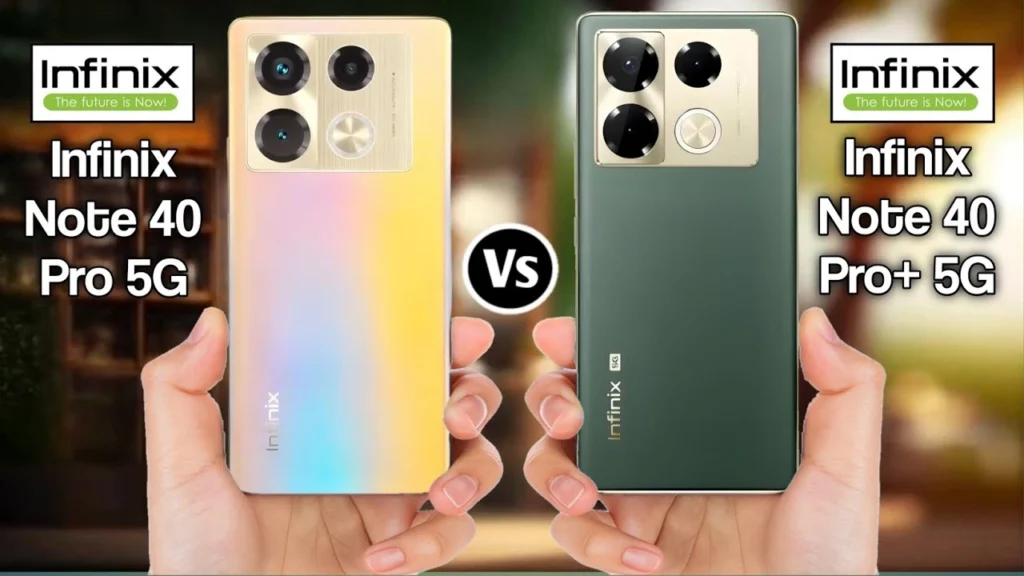
Introduction of Infinix Note 40 Pro+ 5G vs Note 40 Pro
If you are weighing the Infinix Note 40 Pro+ 5G against the Infinix Note 40 Pro, this guide is meant to make the decision easier, clearer, and much less confusing. At first glance, the two phones appear closely related: both look polished, both offer a premium-style design language, both come with a vivid AMOLED display, and both aim to deliver a lot of phone for the money. Yet they are not identical, and the differences matter more than they first seem.
The simplest way to frame the choice is this: pick the Note 40 Pro+ 5G if you care most about faster charging and stronger processing power, and pick the Note 40 Pro if you prefer a larger battery, slightly better protection, and a more balanced everyday package. That is the heart of the comparison.
Quick Verdict
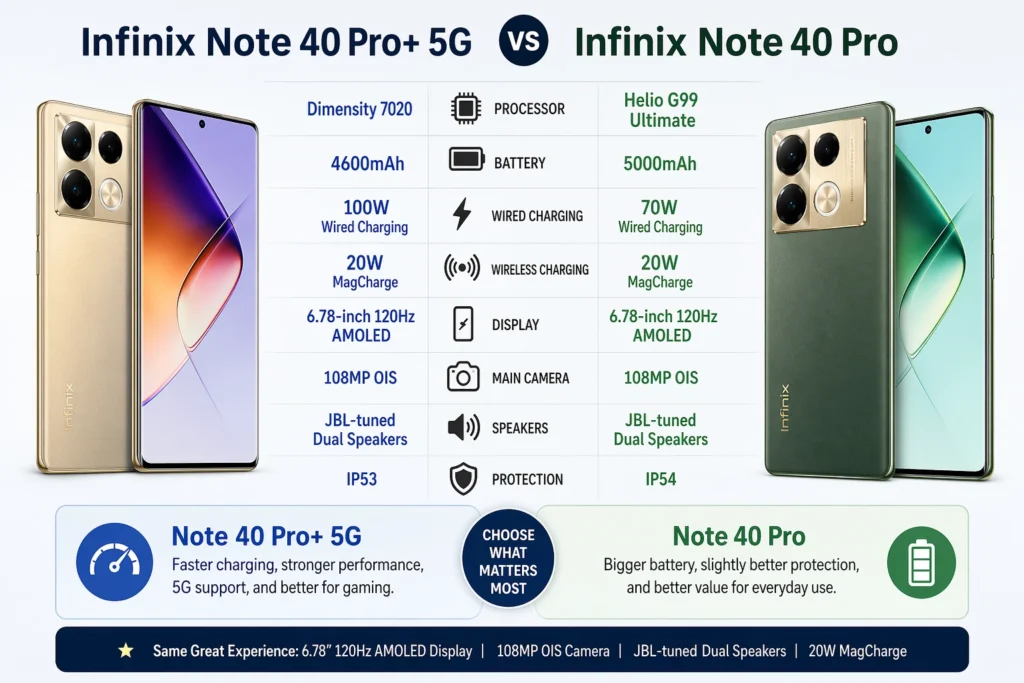
If your priority list starts with charging speed and overall performance, the Infinix Note 40 Pro+ 5G is the more exciting device. It brings the Dimensity 7020, a 4600mAh battery, 100W wired charging, 20W wireless MagCharge, and IP53 protection. In practical terms, that means it is built for speed, convenience, and a more future-facing specification sheet.
If, however, you want a phone that feels a little more conservative, a little more endurance-focused, and a touch more reassuring in daily use, the Infinix Note 40 Pro is easier to recommend. It runs on the Helio G99 Ultimate, carries a 5000mAh battery, supports 70W wired charging, also includes 20W wireless MagCharge, and offers IP54 protection. That gives it the edge in capacity and a small advantage in protection.
The important part is that both phones share the same foundation. Each one gives you a 6.78-inch 120Hz AMOLED display, a 108MP OIS main camera, and JBL-tuned dual speakers. So you are not choosing between a good phone and a bad one. You are choosing between two good phones with different strengths.
Comparison Table at a Glance
| Feature | Infinix Note 40 Pro+ 5G | Infinix Note 40 Pro |
| Processor | Dimensity 7020 | Helio G99 Ultimate |
| Battery | 4600mAh | 5000mAh |
| Wired Charging | 100W | 70W |
| Wireless Charging | 20W MagCharge | 20W MagCharge |
| Display | 6.78-inch 120Hz AMOLED | 6.78-inch 120Hz AMOLED |
| Main Camera | 108MP OIS | 108MP OIS |
| Speakers | JBL-tuned dual speakers | JBL-tuned dual speakers |
| Ingress Protection | IP53 | IP54 |
| Best For | Faster charging, stronger chipset, gaming | Bigger battery, value, slightly better protection |
This snapshot shows the split very neatly. The Pro+ pushes toward performance and rapid top-ups. The Pro leans toward stamina and practical balance. Everything else is largely shared.
Why This Comparison Matters
A lot of comparison articles simply recite specifications. That approach is informative, but it is not always helpful. Most buyers do not wake up thinking, “I need this exact chipset architecture and this exact charging wattage.” They think in terms of real-world needs: how long the phone lasts, how fast it refuels, how smooth it feels, whether games run well, whether the camera is dependable, and whether the phone feels worth its price.
That is why this comparison matters.
A faster processor matters if you switch between apps often, play demanding games, or want a device that keeps feeling responsive after months of use. A larger battery matters if you travel, stream a lot, study on the move, or simply dislike charging too often. Faster charging matters if your schedule is hectic and your phone rarely gets to sit on a charger for long. A slightly better ingress protection rating matters if you want a bit more confidence against splashes, dust, and everyday mishaps.
So rather than treating the two phones as nearly identical twins, it is more accurate to see them as cousins with different strengths. That distinction helps you buy more intelligently.
Infinix Note 40 Pro+ 5G vs Note 40 Pro
The core difference between these two phones is not the design, display, or camera package. It is the performance-and-charging formula.
The Note 40 Pro+ 5G is equipped with the Dimensity 7020, which gives it a stronger performance profile and 5G support. It also has 100W wired charging, which is substantially faster than what the Note 40 Pro offers. Those two things together give the Pro+ a more ambitious identity.
The Note 40 Pro, on the other hand, answers with a 5000mAh battery and IP54 protection. That means it emphasizes endurance and a slightly stronger practical shield against everyday exposure. Even though it is slower to charge than the Pro+, it still offers very respectable charging at 70W.
So the short version is easy to remember:
- Pro+ = faster charging + stronger chipset
- Pro = bigger battery + slightly better protection
That is the cleanest way to think about them.
Design and Build Quality
Visually, both models belong to the same design family. They share the same overall styling cues, and both are clearly intended to feel more premium than the average budget phone. Infinix has done a good job of making the Note 40 series look sharp, modern, and polished without pushing the price into a higher bracket.
These are phones that try to look refined rather than flashy. The rear panel has a stylish finish, the camera arrangement is neat, and the hand feel is designed to be comfortable for long periods of use. The frame and body language suggest a device that wants to impress without shouting.
What they have in common
Both models deliver:
- a premium-looking aesthetic,
- a sleek and slim profile,
- a comfortable in-hand feel,
- and a tidy rear camera layout.
What sets them apart
The key difference is not appearance, but protection level.
- Note 40 Pro+ 5G: IP53
- Note 40 Pro: IP54
On paper, that gives the Note 40 Pro a slight edge in resistance to dust and splashes. It is not a dramatic gap, but it is still a meaningful one for users who want a little extra peace of mind in ordinary life.
Design takeaway
If you are judging by looks alone, both phones are attractive. If you are judging by the little practical details that matter over time, the Note 40 Pro has a small advantage because of its IP54 rating. The Pro+ still looks excellent, but its headline appeal lies elsewhere.
Display Experience
This category is one of the easiest to compare because the two phones are effectively equal in their most important display traits. Both ship with a 6.78-inch 120Hz AMOLED display, and that is a very appealing setup for this segment.
A screen like this matters a lot in everyday use. It affects everything from scrolling speed to media enjoyment to perceived smoothness when you move through the interface. AMOLED technology generally delivers richer colors, stronger contrast, and deeper blacks, while the 120Hz refresh rate adds a visibly fluid feel.
What you get in daily use
With a panel like this, both phones should provide:
- smooth scrolling,
- rich, vibrant colors,
- strong contrast,
- pleasing video playback,
- and a more premium interaction experience.
Why it matters
If you spend time on social media, watch YouTube, read articles, browse the web, or play casual games, the display will be one of the strongest parts of the experience. The large screen size also makes both phones comfortable for content consumption, multitasking, and general navigation.
Real-world impression
On a practical level, the display is a major shared strength. Whether you are using the Note 40 Pro or the Note 40 Pro+ 5G, the visual experience should feel lively and modern. It is one of the reasons these phones can look and feel more expensive than they are.
Display takeaway
There is no meaningful display winner here. Both phones are well matched, and the screen quality should not be the deciding factor.
Performance
This is one of the most important sections in the entire comparison, because the chipset determines how the phone actually behaves beyond the spec sheet.
The Infinix Note 40 Pro+ 5G uses the Dimensity 7020.
The Infinix Note 40 Pro uses the Helio G99 Ultimate.
These two chips target different priorities. One is more forward-looking and performance-oriented; the other is more conservative, efficient, and sufficient for everyday use.
Why chipset choice matters
The processor influences:
- app launch speed,
- gaming fluidity,
- multitasking capability,
- thermal stability,
- responsiveness over time,
- and, in the case of the Pro+ model, 5G connectivity.
Why the Pro+ 5G is the stronger performer
The Dimensity 7020 gives the Note 40 Pro+ 5G a more capable and more versatile foundation. It should feel more confident when juggling demanding apps, handling games, and keeping things snappy when you move between tasks. For users who value speed and responsiveness, that matters a lot.
It is the better choice if you want:
- faster everyday reactions,
- more headroom for gaming,
- a stronger long-term performance profile,
- and 5G support for future-ready connectivity.
Where the Pro still makes sense
The Helio G99 Ultimate in the Note 40 Pro is not weak. It is a proven and practical chip for routine smartphone tasks. For browsing, chatting, social apps, streaming, productivity, and light to medium gaming, it is perfectly serviceable.
It is a sensible fit if you mainly do:
- messaging,
- video watching,
- social media,
- normal multitasking,
- and casual gaming.
Gaming comparison
For games, the Note 40 Pro+ 5G is the clearer winner. It has a stronger chipset and a more performance-oriented makeup. That does not mean the Note 40 Pro is bad at gaming. It simply means the Pro+ is the better option if gaming is important to you or if you want a device that feels more capable when titles become more demanding.
Performance takeaway
- Best for gaming: Note 40 Pro+ 5G
- Best for basic everyday use: Note 40 Pro
If the chipset is a major deciding factor, the Pro+ earns the point.
Battery Life
Battery capacity is another major difference, and here the balance shifts in favor of the Note 40 Pro.
The Infinix Note 40 Pro comes with a 5000mAh battery, while the Note 40 Pro+ 5G has a 4600mAh battery. On paper, the Pro has the larger endurance reserve.
What does the bigger battery mean
A 5000mAh battery typically offers:
- longer use between charges,
- more comfort throughout the day,
- less battery anxiety,
- and more freedom when you are away from a charging point.
This can be especially valuable if you are on campus, commuting, traveling, or simply using your phone very heavily.
Why the Pro+ remains attractive
The Pro+ has a smaller battery, but that is not the whole story. It supports 100W charging, which dramatically reduces the time you spend waiting for the battery to refill. In other words, it trades some capacity for significantly more speed.
That means the battery conversation is not only about how much power is stored. It is also about how quickly the device can recover power when you need it.
Who benefits most from the Note 40 Pro battery
The Note 40 Pro is especially appealing for:
- students who stay active on the phone all day,
- people who travel often,
- users who watch a lot of video,
- and anyone who prefers fewer charging interruptions.
Who benefits most from the Pro+ battery setup
The Note 40 Pro+ 5G suits:
- users who are comfortable doing quick top-ups,
- people who value charging speed over battery size,
- and buyers who prioritize performance as much as endurance.
Battery takeaway
- Best for battery size: Note 40 Pro
- Best for charging convenience: Note 40 Pro+ 5G
This is one of the clearest trade-offs in the entire comparison.
Charging
Charging is where the Note 40 Pro+ 5G really makes a statement.
The Pro+ supports 100W wired charging, while the Note 40 Pro supports 70W wired charging. Both phones also support 20W wireless MagCharge, which is a nice premium touch at this level.
What does 100W wired charging mean?
With 100W charging, the phone can recover power extremely quickly. That is useful for people who are constantly moving, who forget to charge overnight, or who need a fast boost before heading out.
It is ideal for users who:
- are busy throughout the day,
- rely heavily on their phone,
- dislike long charging sessions,
- and want a phone that can be ready again in a short span.
What does 70W wired charging mean
70W is still fast. It is by no means slow. For most people, it is already more than adequate for daily life. It can charge the phone quickly enough to be convenient without becoming a nuisance.
If you usually charge during short breaks or while getting ready, 70W is already a very good experience.
The value of wireless MagCharge
Both devices include 20W wireless MagCharge, which adds convenience and a sense of premium usability. Wireless charging is handy at a desk, beside the bed, or anywhere you want a simple place-and-charge routine.
Charging takeaway
- Fastest wired charging: Note 40 Pro+ 5G
- Still fast wired charging: Note 40 Pro
- Wireless charging: Equal on both
If raw charging speed is a top priority, the Pro+ is the obvious winner.
Camera Comparison
The camera hardware is another area where these phones are closely aligned. Both models feature a 108MP OIS main camera.
That is a very strong headline specification for this class. Infinix has chosen to keep the core imaging experience consistent between the two devices, which is good news for buyers.
What 108MP OIS suggests
In simpler language:
- 108MP points to high-resolution image capture,
- OIS helps stabilize shots and reduce blur.
Together, those features can improve:
- daylight clarity,
- shot stability,
- low-light usability,
- and video smoothness.
Everyday camera use
Both phones should be capable companions for:
- social media photos,
- portraits,
- casual travel images,
- document scanning,
- and everyday snapshots.
Video and movement
Optical image stabilization is useful when recording while walking or making handheld videos. It helps steady footage and can make the camera feel more dependable in motion.
Camera takeaway
There is no major camera advantage for either side on paper. Since the main imaging setup is shared, the deciding factors are more likely to be charging, battery, chipset, and protection.
Speaker and Audio Experience
Both phones come with JBL-tuned dual speakers, and that is a notable strength.
This kind of audio setup can improve the phone’s appeal for people who consume a lot of media on-device without always reaching for headphones.
Why it matters
Dual speakers can enhance:
- video playback,
- music listening,
- gaming immersion,
- voice note clarity,
- and overall media enjoyment.
JBL tuning also gives the system a more premium character, which is a welcome bonus in this price range.
Everyday audio feel
For casual streaming and entertainment, both phones should feel lively and enjoyable. The sound experience is one of the shared strengths that helps the Note 40 series feel richer than many competitors.
Audio takeaway
This is another category where there is no major winner. Both devices offer the same speaker experience, and both should be satisfying for everyday listening.
Software and Everyday Feel
When two phones share much of the same hardware and design philosophy, the daily experience often comes down to subtle differences in power, battery behavior, and how comfortable the phone feels over time.
Both models are designed to deliver a modern, responsive smartphone experience. The expectation is that they handle the usual routine without drama: apps should open promptly, scrolling should feel smooth, and calls, messages, video playback, and browsing should all work without friction.
What most users want
Most people simply want a phone that:
- launches apps quickly,
- keeps up with multitasking,
- feels smooth to scroll,
- plays video reliably,
- and remains stable through the day.
Both phones are built for that.
Which model feels more future-ready?
The Note 40 Pro+ 5G feels more future-proof because of the stronger chipset and 5G support. It is the model that seems more prepared for heavier use and more demanding expectations.
The Note 40 Pro feels more grounded and practical. It suits users who are not chasing the latest connectivity or peak performance but want something dependable and balanced.
Software takeaway
For light to moderate users, both phones should feel capable. For buyers who want more growth room over time, the Pro+ has the stronger case.
Best for Gaming
If gaming is important to you, the choice becomes quite straightforward.
Winner: Infinix Note 40 Pro+ 5G
The Dimensity 7020 gives the Note 40 Pro+ 5G the edge in game performance and general processing power.
Why it wins
It offers:
- stronger chipset performance,
- better graphics headroom,
- more confidence in demanding games,
- and a more performance-focused identity overall.
When the Note 40 Pro is enough
The Helio G99 Ultimate in the Note 40 Pro is still good for casual and moderate gaming. It will suit users who play lighter titles or do not spend a lot of time in graphically intense games.
Gaming conclusion
If gaming sits high on your priority list, the Note 40 Pro+ 5G is the better pick without much debate.
Best for Battery
Winner: Infinix Note 40 Pro
The 5000mAh battery gives the Note 40 Pro the advantage in endurance and on-paper battery capacity.
Why it wins
It offers:
- a larger battery reserve,
- better all-day comfort,
- less frequent charging,
- and more peace of mind during busy routines.
The important nuance
The Pro+ has much faster charging, so it can still feel incredibly convenient. But if the question is strictly about battery size and battery-first ownership, the Note 40 Pro is the stronger answer.
Best for Value
“Value” is not a fixed concept. It depends on what matters most to you.
The Note 40 Pro makes more sense if you want:
- a larger battery,
- slightly better protection,
- a practical all-round package,
- and strong everyday endurance.
The Note 40 Pro+ 5G makes more sense if you want:
- faster charging,
- stronger performance,
- 5G support,
- and a more premium-feeling specification mix.
Value conclusion
For battery-focused buyers, the Note 40 Pro is the better value proposition. For performance-focused buyers, the Note 40 Pro+ 5G offers a stronger return.
Spec-by-Spec Comparison
Processor
- Note 40 Pro+ 5G: Dimensity 7020
- Note 40 Pro: Helio G99 Ultimate
The Pro+ wins because it offers stronger performance and 5G support.
Battery
- Note 40 Pro+ 5G: 4600mAh
- Note 40 Pro: 5000mAh
The Pro wins because it has the larger battery.
Wired charging
- Note 40 Pro+ 5G: 100W
- Note 40 Pro: 70W
The Pro+ wins because it charges faster.
Wireless charging
- Both: 20W MagCharge
This is a tie.
Display
- Both: 6.78-inch 120Hz AMOLED
This is a tie.
Camera
- Both: 108MP OIS
This is a tie.
Speakers
- Both: JBL-tuned dual speakers
This is a tie.
Protection
- Note 40 Pro+ 5G: IP53
- Note 40 Pro: IP54
The Pro wins slightly because of better ingress protection.
Buyer Profiles
Best for gaming
Choose the Infinix Note 40 Pro+ 5G if you want the stronger chipset and more gaming headroom.
Best for battery life
Choose the Infinix Note 40 Pro if battery capacity matters most to you.
Best for fast charging
Choose the Infinix Note 40 Pro+ 5G if you want the 100W wired charging advantage.
Best for value seekers
Choose the Infinix Note 40 Pro if you want a balanced package with a bigger battery and slightly better protection.
Best for camera and media use
Both phones are strong here because they share the 108MP OIS camera, 6.78-inch 120Hz AMOLED display, and JBL-tuned dual speakers.
Best for future-ready use
Choose the Infinix Note 40 Pro+ 5G if you want stronger performance and 5G support.
Real-World Examples
A student with a long day
A student attending classes, chatting, streaming videos, and moving around campus may prefer the Note 40 Pro because the 5000mAh battery gives more breathing room between charges.
A gamer or heavy user
Someone who values app speed, gaming smoothness, and a more capable chipset should lean toward the Note 40 Pro+ 5G.
A busy professional
A user who often needs quick power boosts between meetings or errands will probably appreciate the Note 40 Pro+ 5G more because 100W charging is such a time saver.
A practical, everyday buyer
A person who wants a great screen, a dependable camera, good speakers, and longer battery life may find the Note 40 Pro to be the more sensible and comfortable choice.
Strengths and Weaknesses
Infinix Note 40 Pro+ 5G
Strengths
- stronger chipset,
- 5G support,
- 100W wired charging,
- 20W wireless MagCharge,
- and the same premium display and camera experience as the Pro.
Weaknesses
- smaller battery than the Pro,
- slightly lower ingress protection rating.
Infinix Note 40 Pro
Strengths
- bigger 5000mAh battery,
- slightly better IP54 protection,
- 20W wireless MagCharge,
- same display, camera, and speakers as the Pro+,
- and a more obvious battery-first value proposition.
Weaknesses
- slower wired charging,
- weaker chipset than the Pro+,
- No 5G advantage.
Which One Should You Buy?
Now for the final answer.
Choose the Infinix Note 40 Pro+ 5G if you want:
- faster charging,
- stronger processing power,
- 5G support,
- a more premium specification sheet,
- and better gaming potential.
Choose the Infinix Note 40 Pro if you want:
- a bigger battery,
- slightly better ingress protection,
- a more balanced everyday phone,
- better battery-first value,
- and a simpler, more practical buy.
FAQs
The better phone depends on your needs. The Note 40 Pro+ 5G is better for performance and faster charging, while the Note 40 Pro is better for battery size and slightly better protection.
Yes. The Dimensity 7020 in the Note 40 Pro+ 5G is the stronger chipset compared to the Helio G99 Ultimate in the Note 40 Pro.
The Infinix Note 40 Pro has a bigger 5000mAh battery.
The Infinix Note 40 Pro+ 5G charges faster because it supports 100W wired charging.
Yes. Both phones support 20W wireless MagCharge.
Final Thoughts
The Infinix Note 40 Pro+ 5G and the Infinix Note 40 Pro are both very capable phones in their category. They are built on the same attractive foundation: a 6.78-inch 120Hz AMOLED display, a 108MP OIS main camera, and JBL-tuned dual speakers. That shared base means both devices already start from a strong position.
The Pro+ is the better choice if you value faster charging, stronger chipset performance, and 5G. The Pro is the better choice if you value larger battery capacity, slightly better protection, and more balanced everyday ownership.
