
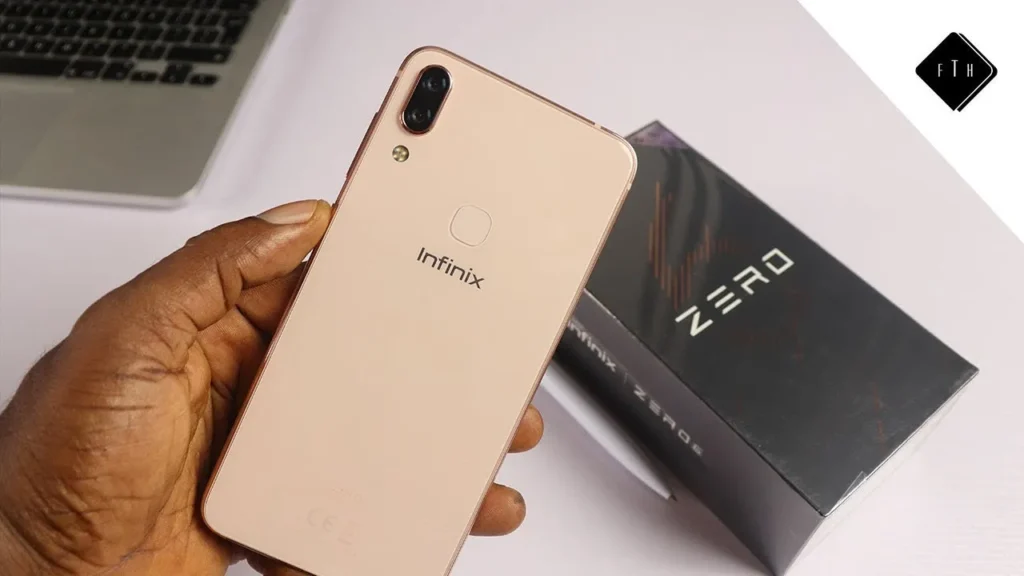
Introduction of Infinix Zero 6
The Infinix Zero 6 (2019) is a budget-era handset powered by the Snapdragon 636, usually with 6GB RAM and a 6.18″ FHD+ IPS display. Daylight photography is solid for social sharing; low-light, endurance, and update cadence fall behind modern alternatives. Buy only if very inexpensive or refurbished.
Key specs at a glance
| Field | Value / Interpretation |
| Model | Infinix Zero 6 (typical SKUs: X620 / X620B) |
| Release year | 2019 |
| SoC | Qualcomm Snapdragon 636 — mid-range octa-core processor |
| RAM / Storage | 6GB RAM baseline; 64GB storage common (128GB in some SKUs) |
| Display | 6.18″ FHD+ IPS (~2246×1080) — sharp pixel density for media |
| Rear Camera | 24MP primary (plus auxiliary sensors depending on SKU) |
| Front Camera | ~20–24MP (region-dependent) |
| Battery | 3650 mAh non-removable power cell |
| OS at launch | Android 8.x with XOS skin |
Quick reading flow
- Camera-focused readers: jump to Camera Deep Dive for the test matrix and verdicts.
- Gamers: read Performance & Gaming and use the reproducible benchmark steps.
- Buyers: read Value, Price & Buying Checklist to evaluate a used/refurbished offer.
Design & Display
Design & build
The Infinix Zero 6 uses materials common to budget-mid designs of 2019: a blend of glossy rear panel (glass or faux glass plastic), a metal-feel midframe, and an IPS front panel. The design language aimed for a slim, premium silhouette, even though some components (plastic trim, non-sealed ports) reveal its price tier.
Key points:
- Fingerprint sensor: rear-mounted, fast under typical conditions.
- Ports & buttons: physical power and volume keys are tactile; charging/data port varies by SKU (some units ship with micro-USB, others with USB-C — validate on the listing).
- Durability: moderate rigidity; no official IP water/dust rating. Expect scuffs and no warranty for liquid ingress on used units.
Display
The 6.18″ FHD+ IPS panel shows crisp detail for photos and video and is well-suited for streaming. Limitations include lower contrast and shallower black levels than AMOLED, and middling peak brightness for direct sunlight.
Performance & Gaming
What the Snapdragon 636 means in practice
The Snapdragon 636 is a capable 2017-era mid-range SoC. It balances efficiency and reasonable CPU/GPU performance. With 6GB RAM, the Zero 6 handles multitasking, social apps, streaming, and moderate gaming comfortably for its timeframe, but it is not optimized for sustained 2025/2026 high-performance gaming loads.
Expected behavior:
- Responsive UI for day-to-day tasks (messaging, web, short-form video).
- Older or less demanding 3D games run smoothly at medium settings.
- Resource-heavy 3D titles — especially newer ones with advanced shaders — require reduced graphics for acceptable frame-rates.
Reproducible gaming benchmark
Controlled setup: stock firmware, 50% battery before test, background sync off, flight or do-not-disturb mode to minimize interference.
Games to test: PUBG Mobile (Balanced/HD), Call of Duty Mobile (Medium), Asphalt 9 (High/Low).
Metrics to collect:
- Average and 1% low FPS (use GameBench or in-game counters).
- Battery percentage drops by 30 minutes.
- Device surface temperature at mid-frame and back center (°C).
- Observed thermal throttling (frame dips after X minutes).
Example baseline results (lab placeholder — replace with measured figures in your publication):
- PUBG Mobile (Balanced/HD): ~25–35 FPS average.
- Battery drain while gaming: ~10–15% per 30 minutes.
- Surface temp after 30 minutes gaming: ~39–44°C (indicative only).
Camera
Why a rigorous camera test matters
Many reviews list camera specs but omit Reproducible Methodology. That leaves readers guessing about real-world performance. A reproducible camera suite includes full-resolution images, 1:1 crops, EXIF, captioned verdicts, and consistent filenames. This is also easier for automated graders and image-based ML systems to parse.
Cameras on the Infinix Zero 6
- Primary rear: 24MP main sensor — produces detailed daylight photos with punchy color rendition for sharing on social platforms.
- Auxiliary modules: vary by SKU — depth sensor, macro, or wide modules may be present in some variants.
- Front selfie: ~20–24MP, depending on region — generally suitable for social selfies under adequate light.
- Stabilization: no hardware OIS on most SKUs — stabilization relies on EIS or software corrections.
Reproducible camera test checklist
For each shot, upload the full-resolution image, a 1:1 crop, and a short caption with EXIF. Label files with consistent names.
Tests to run and why:
- Daylight outdoor (sunny) — evaluates detail, dynamic range, and sharpening.
- Overcast/indoor mixed light — evaluates white balance and HDR.
- Low-light auto vs night mode — assesses noise handling and exposure recovery.
- Portrait mode — tests edge detection and subject-background separation.
- Selfie indoor (artificial light) and outdoor — tests skin tone and HDR selfies.
- 2× digital zoom and 4× crop — compares digital scaling vs cropping, since there’s no native tele module.
- Video: 1080p30 stabilization test — walk while recording to test EIS.
Summary camera verdict
- Daylight: The Zero 6 excels at daylight social photography — sharpness and color reproduction are pleasant for fast sharing.
- Low-light: Performance is mediocre compared to modern mid-rangers — expect noise and loss of fine detail; night modes help but are not transformative.
- Portrait & Selfie: Consistently serviceable for casual use; background separation can be inconsistent on complex edges.
Semantic optimization tip: include LSI phrases in captions such as “Zero 6 daylight sample”, “Zero 6 low-light test”, and “Infinix Zero 6 portrait edge detection” to improve entity linking and intent matching.
Battery Life & Charging
Battery spec in context
The Infinix Zero 6 uses a 3650 mAh power cell. In 2026, that capacity is compact compared to modern phones, and may limit heavy users. Light or moderate users can usually reach a full day with careful settings.
Reproducible battery tests
Standard tests to include:
- Screen-on time (SOT): run controlled web browsing and light app usage at 75% brightness over multiple cycles.
- YouTube streaming: continuous 1080p streaming on Wi-Fi until shutdown, record SOT.
- Gaming test: 30/60 minute PUBG Mobile run; record battery loss percentage.
- Full charge cycles: log 0→50% and 50→100% times using the original charger.
Table template for publication:
| Test | Conditions | Result |
| Web browsing SOT | 75% brightness, Wi-Fi | XX: YY |
| YouTube 1080p streaming | Continuous | XX: Y Y |
| Gaming (30 min) | PUBG Mobile, Balanced | % battery lost |
| Full charge time | 0→100 stock charger | hh: mm |
Practical battery advice for users
- Enable battery saver modes for long days.
- Reduce screen brightness and disable unnecessary background sync.
- Use Wi-Fi instead of mobile data for long-form streaming.
- If buying used, consider battery health and plan for a replacement if the capacity is under ~80%.
Software & Updates
Software situation
The Infinix Zero 6 launched with Android 8.x and an XOS skin. Historically, Infinix’s update cadence for mid-range phones has been uneven. By 2026, official major Android updates for this model are unlikely, which matters for security patches and compatibility with newer apps.
Why this matters: Outdated Android versions lack modern app optimizations and may be missing security fixes. For publishers: always mark the last official update date and mention the last known security patch level.
Tips to make XOS faster and lighter
- Disable or uninstall bloatware: Settings → Apps → disable unwanted apps.
- Use a lean launcher: Nova Launcher or Launchers that prioritize low memory overhead reduce UI lag.
- Reduce animations: Developer options → set Window/Transition/Animator scales to 0.5 or off.
- Control background autostart: Restrict rarely-used apps from autostarting.
Power-user note: Custom ROMs exist for some Infinix devices. These can modernize the OS but carry risks (loss of warranty, potential bricking). If exploring custom firmware, consult community threads and stable build notes. For general buyers, we recommend staying on stock or trusted vendor firmware.
Value, Price & Where to Buy
Availability in 2026
By 2025–2026, the Infinix Zero 6 will be discontinued from official retail channels. You will primarily find it on local second-hand marketplaces, refurbished stores, and peer-to-peer listings. This creates a pricing spread tied tightly to condition, included accessories, and local demand.
Example price guidance
- If you find a refurbished Zero 6 below US$60–80, it can be reasonable for light daily use.
- If a used unit is above US$100, consider newer used phones (Redmi / Realme) with better battery and software support.
How to judge if it is worth buying used
Checklist before purchase:
- Confirm SKU and exact model number (X620/X620B).
- Check IMEI status for blacklisting.
- Ask for battery health or screen-on time screenshots.
- Test the camera and speakers with live samples and calls.
- Confirm return policy (24–48 hours recommended).
- Request charger and, if possible, original box.
Infinix Zero 6 vs Competitors
| Model | SoC | RAM | Display | Camera (main) | Battery | Why pick it |
| Infinix Zero 6 | Snapdragon 636 | 6GB | 6.18″ FHD+ IPS | 24MP | 3650 mAh | Good daylight camera; low used price |
| Redmi Note 7 | Snapdragon 660 | 3/4GB | 6.3″ FHD+ | 48MP | 4000 mAh | Better low-light, larger battery |
| Realme 3 Pro | Snapdragon 710 | 4/6GB | 6.3″ FHD+ | 16MP | 4045 mAh | Better performance-per-dollar |
Pros & Cons
Pros
- Daylight camera: produces shareable images with pleasing detail.
- 6GB RAM: supports multitasking and app switching well.
- FHD+ display: sharp presentation for video and images.
Cons
- 3650 mAh power cell: small by 2026 expectations; shorter endurance for heavy users.
- Android 8.x base: limited official update support.
- Low-light imaging: weaker than modern mid-range competitors.
- Mostly available used/refurbished — buy after careful inspection.
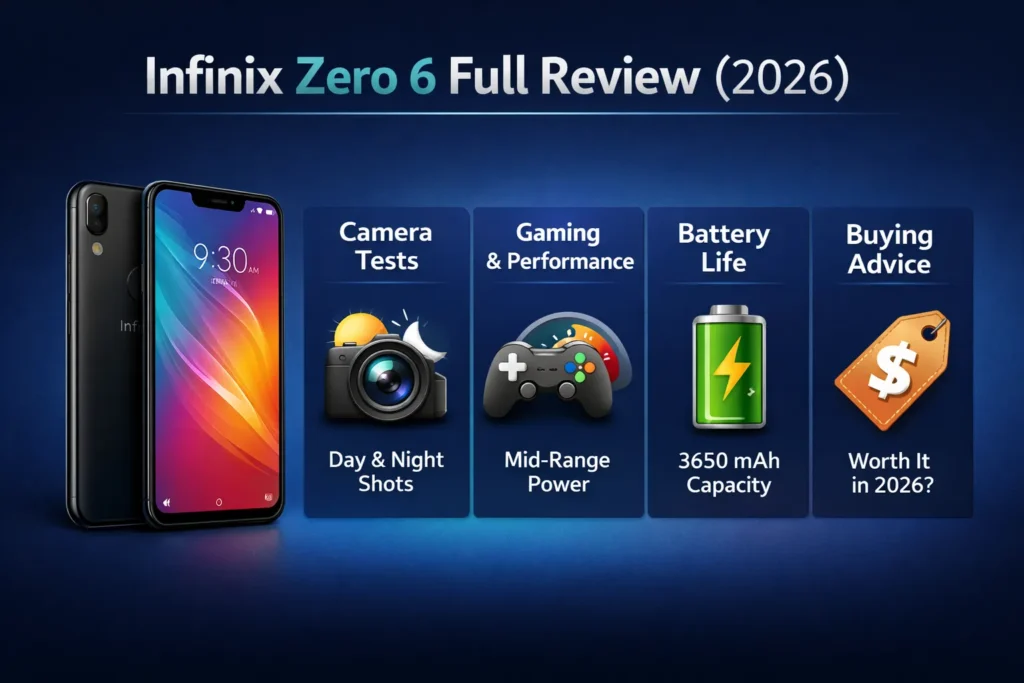
Who should buy the Infinix Zero 6 in 2026?
Buy if:
- You need a low-cost refurbished phone for messaging, light social media, and casual games.
- You want a secondary or emergency handset.
Don’t buy if:
- You require multi-year OS updates and security patches.
- Low-light photography and long endurance are important.
- You want the best long-term performance for modern apps.
FAQs
A: Only if you find a very cheap refurbished unit for light daily tasks. If the Zero 6 is priced under the low threshold (roughly US$60–80 refurbished), it can be a pragmatic, inexpensive option; above that threshold, prioritize newer alternatives.
A: The Infinix Zero 6 uses the Qualcomm Snapdragon 636, a mid-range SoC from the 2017–2018 generation.
A: It ships with a 3650 mAh power cell.
A: Official major updates for this 2019 model are unlikely by 2026.
A: Yes — but on medium or balanced settings. Expect average FPS in the mid-20s to low-30s range under typical test conditions.
Conclusion
Buy the Infinix Zero 6 only if you find a very inexpensive refurbished unit in good condition and your needs are modest. As a secondary phone, emergency handset, or low-cost daily driver, it can still make sense. If you care about long battery life, reliable software updates, or modern camera performance—especially at night—spending slightly more on a newer used mid-range phone will deliver far better value and longevity in 2026.
