
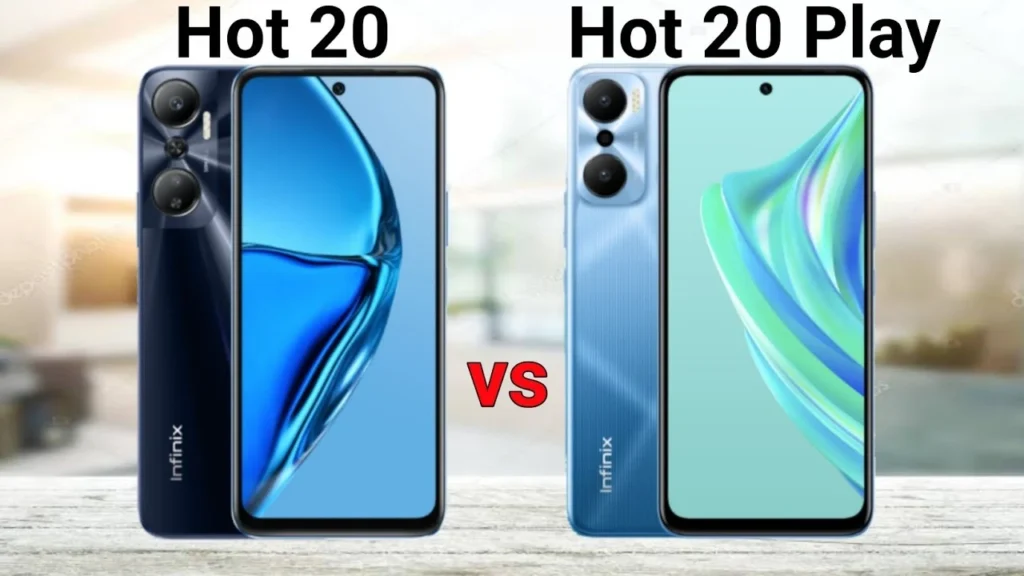
Introduction of Infinix Hot 20 vs Hot 20 Play
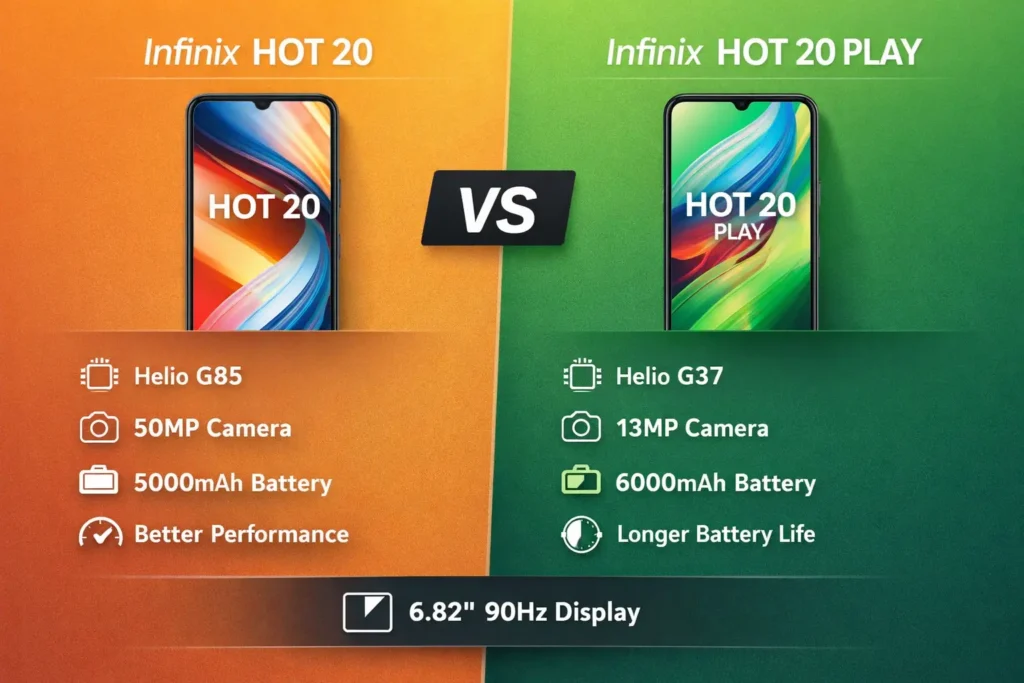
When people search Infinix Hot 20 vs Hot 20 Play, they are not usually looking for a generic specification dump. They want to know whether the extra performance of the Hot 20 is worth giving up the larger battery of the Hot 20 Play. They want a phone that feels good in day-to-day use, handles games without frustration, and still makes sense for the budget in Pakistan. The official product pages make the difference very obvious: the Hot 20 is built around the Helio G85, a 50MP rear camera, a 5000mAh battery, and a 6.82-inch 90Hz display, while the Hot 20 Play uses the Helio G37, a 13MP rear camera, a 6000mAh battery, and the same 6.82-inch 90Hz screen.
That means this is not really a battle of “better phone versus worse phone.” It is a battle of priorities. The Hot 20 is the stronger all-rounder for speed, camera quality, and responsive use. The Hot 20 Play is the endurance-first option for buyers who care more about staying unplugged for longer than they care about higher peak performance. That trade-off is the core of the whole comparison.
Quick verdict
Choose Infinix Hot 20 if you want a better performance package, stronger camera hardware, and a more balanced everyday experience.
Choose Infinix Hot 20 Play if your first priority is battery life, and you can live with slower performance and a simpler camera setup. The short version is that the Hot 20 is the smarter buy for most people, while the Hot 20 Play is the more patient phone for battery-focused users.
Infinix Hot 20 vs Hot 20 Play specs comparison
The spec difference is easy to read, but the practical effect matters more. The Hot 20 brings the Helio G85, which Infinix positions as a gaming-focused chip with stronger CPU and GPU capability. It uses the Helio G37, which is a more modest chip aimed at basic use and power efficiency. The Hot 20 also offers a 50MP main camera, while the Play model stays at 13MP. On the battery side, the Play model flips the script by adding a 6000mAh cell instead of the Hot 20’s 5000mAh battery.
Memory positioning also differs. The Hot 20 is advertised with up to 11GB RAM through 6GB physical RAM plus 5GB extended RAM, while the Hot 20 Play is shown with up to 7GB RAM through 4GB physical RAM plus 3GB extended RAM. That does not make the Play equal to the Hot 20 in speed, because extended RAM is not the same as true physical RAM, but it can help with light multitasking.
Both phones share a large 6.82-inch display with a 90Hz refresh rate. That means they feel similar when scrolling social apps or watching content, but the overall smoothness of use still depends on the processor underneath. The stronger chip in the Hot 20 helps the display feel more composed in real-life use.
Display comparison
This is the most even part of the matchup. Both devices have a 6.82-inch 90Hz panel, and both are clearly built around the same big-screen budget formula. In official marketing, Infinix highlights the Hot 20 as a “Fluid Gaming Display” and the Hot 20 Play as a “màn hình chơi game mượt mà” / smooth gaming display. That tells you the brand itself sees the screen as a shared strength rather than a separating feature.
For everyday buyers, that means video watching, reading, and scrolling will feel familiar on both. The real difference is not the display size; it is how well each phone feeds that display. The Hot 20’s stronger chipset makes the interface feel more confident, while the Hot 20 Play’s weaker chip can feel more restrained under heavier app loads. So although the panel specs are similar, the experience is not identical.
If your decision is based only on display size and refresh rate, there is no dramatic winner. If your decision is based on overall smoothness, the Hot 20 has the edge because the G85 class platform is simply better suited to keep up with a 90Hz screen in real use. That is exactly why spec-sheet parity can be misleading.
Performance and gaming comparison
This is where the Hot 20 separates itself clearly. The Helio G85 is the stronger chipset, and Infinix markets it directly as a gaming processor. On the official Hot 20 page, Infinix stresses better CPU and GPU behavior, with the G85 designed for stronger gaming performance and faster responsiveness. The Hot 20 Play’s Helio G37 is serviceable for light tasks, but it is not in the same league.
In real-world terms, the Hot 20 is the better pick for users who open many apps, switch between social media and video apps, or play games that need a stable frame rate and better touch response. The Hot 20 Play can still handle basic communication, browsing, messaging, and casual gaming, but it is the kind of phone that reminds you of its limits sooner. If your idea of a budget phone includes occasional gaming, the Hot 20 is the safer and more enjoyable choice.
The official Hot 20 page also highlights gaming-oriented helpers such as Dar-Link 2.0, LinkPlus 1.0, and XArena. Those features are meant to optimize gameplay stability and networking behavior, which tells you Infinix is targeting a more performance-minded buyer with this model. The Hot 20 Play has related features too, but its core role is more about endurance and everyday convenience than raw gaming muscle.
So if someone asks for the best Infinix phone for gaming between these two, the answer is the Hot 20. The Hot 20 Play is not a gaming phone in the same sense; it is a battery-first budget phone that can game a little, but should not be chosen for gaming first.
Camera comparison
The camera gap is large enough to matter in everyday use. The Hot 20 is built around a 50MP rear camera with a Super Nightscape focus, while the Hot 20 Play uses a 13MP AI dual-camera setup. On paper, that already tells the story: the Hot 20 has the stronger sensor class and should be better for detail, flexibility, and general image confidence.
Infinix’s own language makes the Hot 20 feel more photography-oriented. The brand emphasizes Nightscape behavior, a wider f/1.6 aperture, portrait mode, eye tracking, and short-video features. That combination suggests the phone is meant for people who actually care about the quality of what they capture, not just whether the camera exists. The Hot 20 Play still offers useful basics, including an 8MP AI portrait selfie camera and a 13MP rear camera, but it is clearly the simpler imaging device.
For day-to-day buyers, this matters in three situations. First, if you take photos in daylight, the Hot 20 is more likely to preserve texture and cleaner detail. Second, if you scan documents or photograph product labels, the stronger rear camera on the Hot 20 is the safer choice. Third, if you shoot in dimmer indoor spaces or evening light, the Hot 20 again has the better chance of producing a usable image without immediate disappointment.
So when the question becomes 50MP vs 13MP camera, the Hot 20 wins by a comfortable margin. The Hot 20 Play is fine for casual social media shots and basic documentation, but the Hot 20 is the model that gives you more room to work with.
Battery and charging comparison
Battery life is the main reason to consider the Hot 20 Play. Its 6000mAh battery is larger than the Hot 20’s 5000mAh battery, and the official Hot 20 Play page heavily leans into that endurance story. Infinix even markets it with long-use claims and battery-saving modes that reinforce the phone’s stamina-first positioning. The Hot 20 also offers 18W charging, but the Play model’s bigger battery is the headline.
The important nuance is that a larger battery does not automatically mean a better phone. The Play model may last longer on paper and in lighter mixed-use, but it is also powering a weaker chipset. That can help efficiency, yet it does not erase the reality that the Hot 20 is the more capable device in daily interaction. So the battery win is real, but it is only meaningful if long unplugged time matters more to you than speed and camera quality.
If the search question is 5000mAh vs 6000mAh battery, the Hot 20 Play wins. If the question is about overall value, the answer is less simple. Many buyers are happier with the Hot 20’s smaller battery because the phone gives them a better camera and a more satisfying experience across the rest of the device. That is why the best battery phone is not always the best overall phone.
Design and software comparison
Both phones follow the same Infinix budget design language: large display, plastic build elements, practical everyday ergonomics, and bold color choices. The Hot 20 Play is slightly heavier in the comparison pages, while the Hot 20 is a little slimmer and lighter in some listings. That means neither phone feels ultra-premium; instead, both are designed to be functional, recognizable, and budget-friendly.
On the software side, the Hot 20 Play official materials point to XOS 10.6 and Android 12-era positioning, while comparison pages likewise frame it in the Android 12 generation. The Hot 20 is also from the Android 12 family in the pages we checked. That places both phones in a similar software era, which matters because this is not a new-launch software race. The meaningful question is not which one has fresher software; it is which hardware package gives better day-to-day satisfaction for the money.
In practical buyer language, this section is simple: neither phone wins by design or software alone. The design is acceptable on both, and the software story is broadly similar enough that it should not drive the buying decision. Use the hardware strengths to decide instead.
Price in Pakistan and value for money
This is where the market gets messy, and that is exactly why the article should be useful instead of just repeating a single number. WhatMobile shows the Hot 20 as discontinued in Pakistan on its pictures page, while the Hot 20 Play is shown on comparison pages as “coming soon” with an expected price of Rs. 29,999. At the same time, other comparison listings still show different figures, such as Rs. 32,999 for the Hot 20 Play and Rs. 27,999 for the Hot 20, which means the live price landscape is inconsistent.
That inconsistency is not a weakness of the article; it is a weakness of the market data. It means the smarter way to write this section is to focus on value logic instead of pretending there is one perfectly stable figure. In Pakistan, a buyer comparing these two should not fixate on a single price line from one site. The better question is whether the extra money, if any, buys a better processor, a stronger camera, and a more balanced phone experience. On that question, the Hot 20 makes a stronger case for itself.
The Hot 20 Play still makes sense for battery-minded buyers who need a big-screen budget device and do not care much about camera or gaming strength. But if the gap is not large, the Hot 20 is the better value because it gives you more useful performance headroom and a much better rear camera. When the budget is tight, the phone that stretches further in daily use usually wins the value battle.
Which phone should you buy?
Buy the Infinix Hot 20 if you want a better all-around phone. It has the faster Helio G85, the much stronger 50MP rear camera, and the more confident everyday experience. It is the better choice for students, social media users who also take photos, and budget buyers who want more performance breathing room.
Buy the Infinix Hot 20 Play if battery life is your biggest concern and you are willing to accept weaker performance. It is the more endurance-focused model, and its 6000mAh battery makes sense for users who spend long hours away from a charger. It is a practical option, but it is not the strongest overall phone.
For most buyers, the safer recommendation is the Hot 20. The reason is simple: a better chipset and a far better camera matter every single day, while the extra battery on the Play model matters mainly when you are away from charging for longer periods. In a tight-budget purchase, the more balanced phone tends to age better in the owner’s hands.
FAQs
Yes, for most users. The Hot 20 has the stronger Helio G85 chipset and a much better 50MP rear camera, while the Hot 20 Play mainly wins on battery capacity.
The Hot 20 Play because it carries a 6000mAh battery compared with the Hot 20’s 5000mAh battery.
The Hot 20. Infinix positions the Helio G85 as a gaming processor, and it is clearly stronger than the Helio G37 inside the Hot 20 Play.
The Hot 20, because it uses a 50MP rear camera, while the Hot 20 Play uses a 13MP rear camera.
Yes. Both phones use a 6.82-inch display with a 90Hz refresh rate.
Final buying verdict
If the goal is a stronger phone, the answer is Infinix Hot 20. It gives you better performance, a much better camera, and a more balanced experience for everyday use. If the goal is the longest battery life possible on a budget, the Infinix Hot 20 Play is the more endurance-focused pick. For most Pakistan buyers, the Hot 20 is the better long-term value because it solves more real-world problems than the Play model does.
